
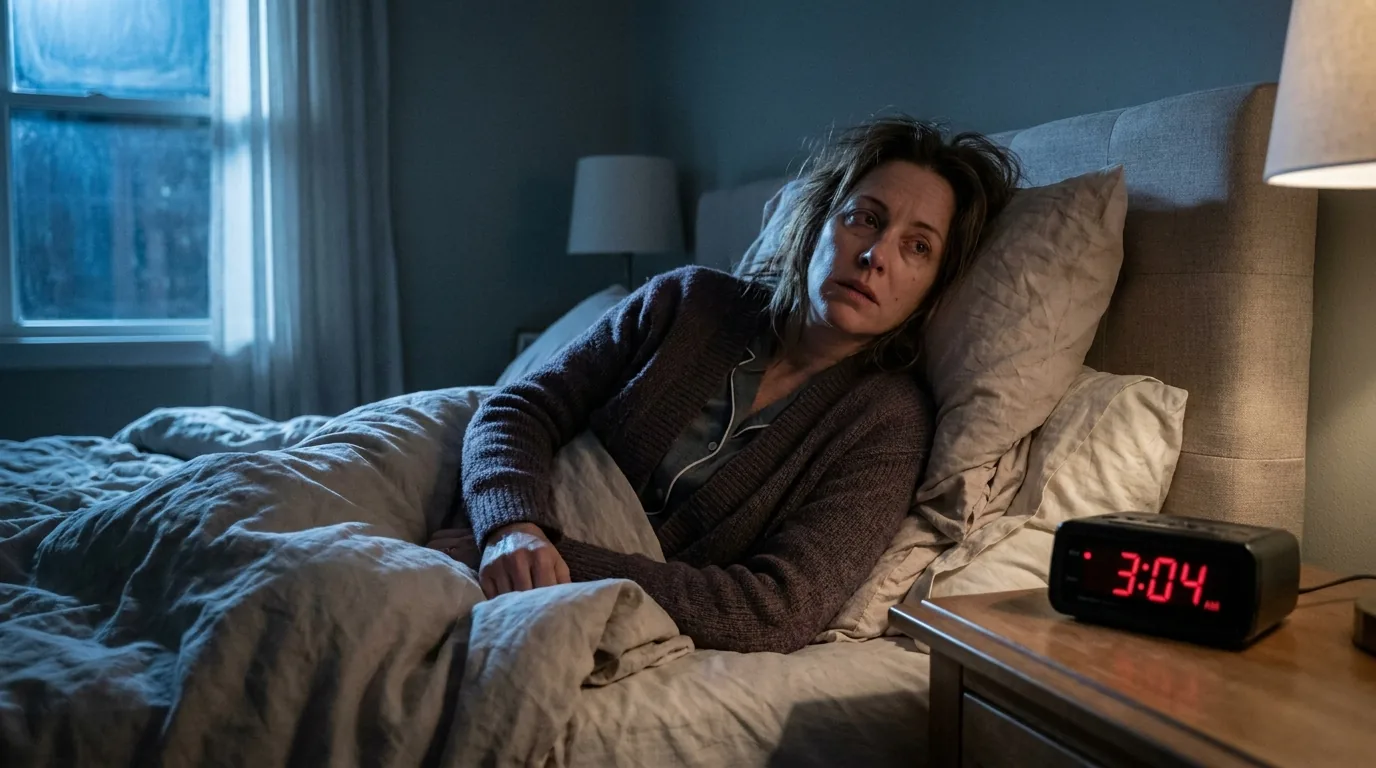
Wide Awake at 3am
It is 3:04am in a house somewhere between Grand Rapids and Green Bay, and a woman is lying flat on her back, staring at the ceiling, wide awake. She was not tossing and turning her way toward this moment. She was asleep, and then, all at once, she was not. Her heart is beating faster than it should be for someone lying still in bed. Her mind, which was quiet an hour ago, is suddenly running through her calendar, her kids' schedules, an email she sent three days ago that she is now certain was worded wrong, and a low, wordless sense that something is off, even though nothing in particular has happened.
This is not the first night this has happened this week. It might not even be the third. She has started to dread going to bed, not because she cannot fall asleep, falling asleep has never been the problem, but because she knows what is coming at 2am, or 3am, or sometimes 3:47am with an almost mocking specificity. She lies there and does the math on how many hours of sleep she will get if she falls back asleep right now, and then the math itself becomes one more thing keeping her awake.
By the time her alarm goes off, she is exhausted in a way that coffee does not quite fix. She gets the kids to school, sits through a meeting where she has to work harder than usual to follow the conversation, and somewhere around 2pm hits a wall of fatigue so heavy it feels almost physical. And then, quietly, underneath the exhaustion, there is a low hum of dread about tonight, about whether it will happen again, about what is actually wrong with her. She has started avoiding her evening glass of wine some nights, just in case that is the problem, and started an eight dollar sleep app, and neither has made a real difference. She has not told her doctor the full extent of it, because it is hard to explain in a fifteen minute appointment, and she is not entirely sure it is something a doctor can help with anyway.
If this is you, I want to start by naming exactly what you are likely asking yourself, because I hear it from women in my practice constantly, in Traverse City, in Appleton, in Ann Arbor, in Eau Claire. Why can't I sleep anymore? Why does my heart race for no reason? Why am I anxious about things that never used to bother me, in a way that feels physical, not just mental? What has changed? Because here is the part that makes this so disorienting: for many women, nothing has changed. The job is the same job. The marriage, the kids, the mortgage, the life, it is mostly the same life it was two years ago. And yet something in her body has shifted enough that sleep and calm, two things she used to take completely for granted, now feel out of reach several nights a week.
This article exists because this particular experience, waking up in the middle of the night with a racing heart and a mind that will not quiet down, followed by new anxiety that shows up during the day for no obvious reason, is one of the most common symptoms of the hormonal transition that begins in the late 30s and 40s, and it is also one of the least talked about. Most women who search for an explanation land on generic sleep hygiene advice or general anxiety content that never once mentions hormones. Many never think to connect the two at all. They assume it is just stress, or a new anxiety disorder appearing out of nowhere, or something wrong with their heart, or simply what getting older feels like.
Some of those explanations may, in fact, be part of the picture, and we are going to take all of them seriously rather than waving them away in favor of a single hormonal explanation. But for a very large number of women, there is a specific, well-documented hormonal mechanism behind this exact pattern of 3am waking and new physical anxiety, one that involves cortisol, progesterone, and blood sugar regulation, and understanding that mechanism changes what you do about it. That is what this article is for. Not to tell you that it is "just hormones" and you should stop worrying. To give you the complete, honest picture of what might be happening in your body, so you can figure out what to actually do next.
Consider a composite version of a conversation I have often, based on patterns I see repeatedly rather than any single patient. A woman in Wausau, 42, a project manager, two kids in middle school, describes it this way: she goes to bed tired, actually tired, falls asleep within minutes, and then somewhere between 1am and 3am she is suddenly, completely awake, heart pounding, as though someone flipped a switch. There is no dream she can point to, no noise that woke her, no reason she can identify. She lies there for anywhere from 40 minutes to two hours before finally drifting back off, only to wake up the next morning already exhausted, and then spends part of her day wondering if she is developing a heart problem, an anxiety disorder, or both. She has read that this could be perimenopause, but she is 42, still having regular periods, and does not feel like she matches the image of menopause she has in her head, so she has mostly dismissed the idea.
If any part of that description feels familiar, you are not alone, and you are not imagining a pattern that is not there. This is one of the most consistently reported symptom clusters among women in this age range, and it has a name, a mechanism, and, importantly, options. Let's walk through all of it.
Why This Isn't "Just Stress" (Even If Your Life Is Stressful)
Before we go any further, I want to address the argument I know many of you are already having with yourselves, because I have heard women voice it in almost these exact words. "But I do have a lot going on right now. Work is a lot. The kids are a lot. Maybe this really is just stress, and I am overthinking the hormone angle." That reasoning is not unreasonable. Most women in their late 30s and 40s genuinely do have a lot going on, careers at their most demanding stretch, kids at ages that require constant logistics and emotional labor, aging parents entering the picture, marriages that require maintenance, a body that is asking for more care than it used to need. Stress is real, and it is not a small factor.
But here is the question worth sitting with: has your actual stress level increased enough, this year specifically, to explain a brand new symptom that was not there before, one that shows up as a specific physiological event at a specific time of night? Most women I talk to, when they really think about it, say no. Their life is stressful, but it has been stressful in roughly this same way for years. What changed is not the volume of stress in their life. What changed is how their body is responding to it, and when.
Hormonal Change and Life Stress Are Not Either-Or
This is the distinction I most want you to walk away with from this section, because it changes what you actually do next. This is not a choice between "it's stress" and "it's hormones." For most women in this life stage, it is both, and they compound each other rather than existing separately. Chronic life stress, the kind that comes from running a household, managing a career, and carrying the invisible mental load of a family, keeps your stress response system, the hypothalamic-pituitary-adrenal axis (HPA axis, the communication loop between your brain and your adrenal glands that governs your stress hormone output), more activated than it would be in a lower-stress period. At the same time, the hormonal shifts of perimenopause are changing how well that same stress response system regulates itself, particularly overnight.
Think of it this way. If your nervous system's capacity to absorb stress without a physical reaction is like a cup, chronic life stress fills that cup more than it used to. Declining progesterone, which we will explain in detail in the next section, simultaneously makes the cup itself smaller, because progesterone's calming effect on your nervous system is part of what used to give you a buffer. A stress load that you would have absorbed without a second thought five years ago can now overflow into a racing heart at 3am, not because the stress itself is worse, but because your capacity to buffer it has changed.
This matters practically because it means the fix is not simply "reduce your stress," which is often not realistic advice for a woman managing a full life, nor is it simply "balance your hormones" as though your actual life circumstances are irrelevant. Both matter. A comprehensive approach addresses the hormonal piece that has changed your capacity to buffer stress, while also being honest that stress management, boundaries, and support systems remain genuinely important. Neither piece works as well without the other, and an approach that only addresses one is why so many women feel like they have already tried everything without real improvement.
Allostatic Load: Why the Same Stress Hits Harder Now
There is a useful concept from stress physiology called allostatic load, which refers to the cumulative wear on your body's stress-response systems from being activated repeatedly over months and years. Allostatic load is not about any single stressful event. It is about the accumulated cost of your HPA axis being called on again and again, year after year, to manage everything from work pressure to sleep debt to the low-grade vigilance of running a household. A body with a high allostatic load has less reserve capacity left to absorb any additional stressor without a physical reaction, which is exactly the dynamic at play when hormonal changes reduce your buffering capacity at the same time your cumulative stress load has been building for years.
This is also why the timing so often feels unfair. The late 30s and 40s are frequently the years of peak cumulative demand, the years when a career, children, aging parents, and a household are all asking the most of a woman simultaneously, which is precisely when the hormonal buffering that used to help absorb it all is declining. It is not a coincidence that this symptom pattern clusters in this decade. It is two trends converging at once: rising cumulative load and declining physiological capacity to absorb it.
This reframe matters for a practical reason, beyond simply understanding what is happening. Many women, once they land on "it's just stress," respond by trying to white-knuckle through it, pushing harder, sleeping less to get more done, telling themselves that once this particular busy season passes, things will go back to normal. For some stressors, that approach eventually works, the busy season ends and the nervous system recovers. But when a hormonal shift is part of the underlying picture, that recovery does not happen automatically once the external stressor resolves, because the hormonal buffering capacity does not return on its own. This is why some women describe getting through an especially demanding stretch of life, a big work project, a move, a family crisis, and expecting their sleep and anxiety to improve once things calm down, only to find the pattern persists. That persistence is itself a clue that something beyond situational stress is at play.
The Cost of Assuming It's Only Stress
There is a real cost to defaulting to the "it's just stress" explanation and stopping there, beyond the discomfort of the symptoms themselves. Women who accept that framing often spend months or years cycling through stress-management strategies, meditation apps, therapy focused on coping skills, attempts to delegate or drop commitments, that may genuinely help around the edges but do not resolve a pattern that has a real physiological driver underneath it. This is not a criticism of those strategies, which are valuable tools in their own right. It is an observation that a tool aimed at the wrong primary target produces partial results at best, and partial results, repeated over months without a clear explanation for why they are only partial, tend to erode a woman's confidence that anything will really help, which is its own kind of harm worth naming.
The Hormonal Mechanics of 3am Waking
This section is the heart of this article, because understanding the actual mechanism behind 3am waking is what makes the experience feel less frightening and more solvable. There are four interconnected hormonal factors at play, and while any one of them can contribute on its own, they most often show up together.
Cortisol's Changing Rhythm
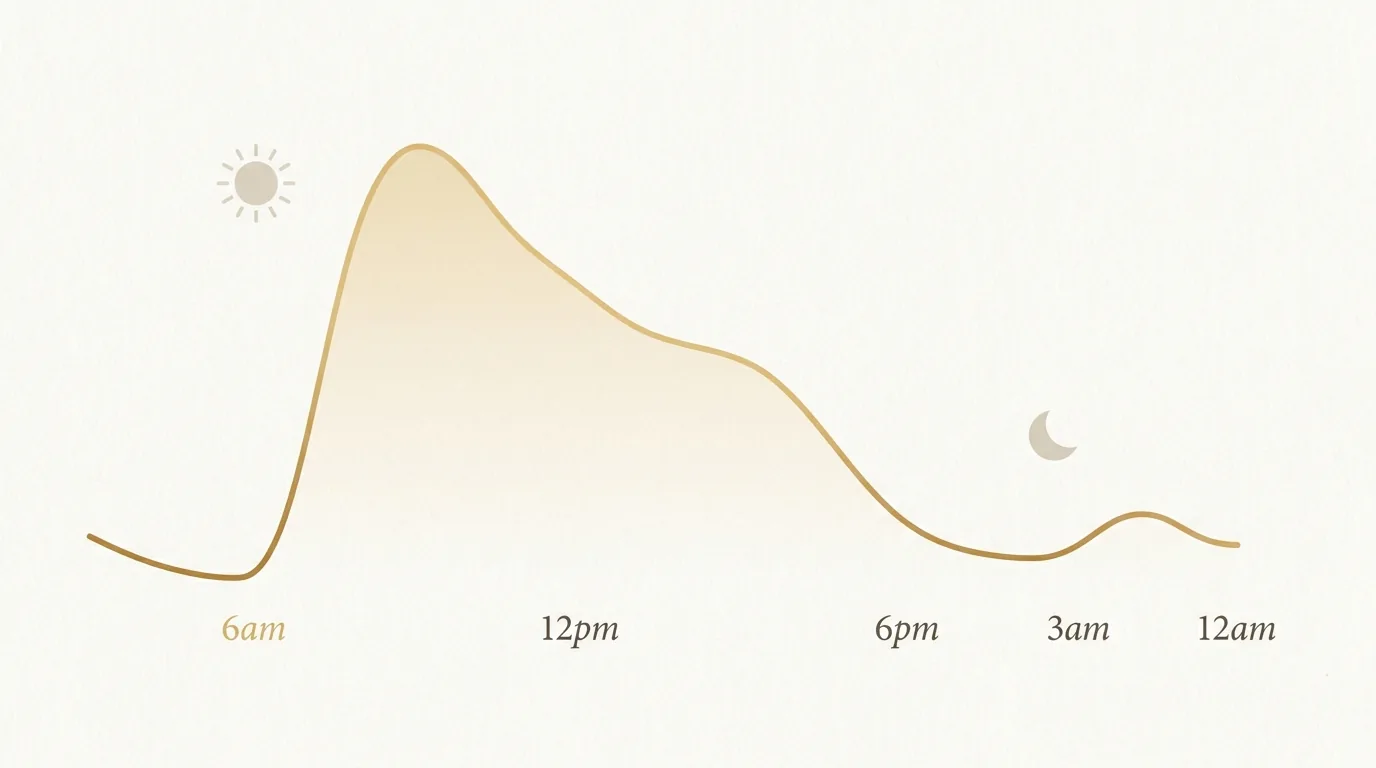
Cortisol is your body's primary stress hormone, produced by the adrenal glands, and it is not supposed to be a flat, unchanging number throughout the day. In a healthy pattern, cortisol follows a specific daily rhythm called the circadian cortisol curve. It rises sharply in the 30 to 45 minutes after you wake up, a normal, healthy spike called the cortisol awakening response that helps get you alert and moving. It then gradually declines throughout the day, reaching its lowest point in the evening and staying low through the first several hours of sleep, which is part of what allows deep, restorative sleep to happen. This daily rhythm is entirely separate from the short-term cortisol spikes you feel during an acutely stressful moment, a near miss in traffic, a tense conversation, a sudden deadline. Those short spikes are a normal, healthy response to an identifiable trigger and resolve quickly. The pattern this section focuses on is different: a shift in your baseline daily rhythm itself, occurring even on nights with no identifiable trigger at all.
Here is what changes for many women in their late 30s and 40s. That evening and overnight cortisol trough, the low point that is supposed to hold steady through the night, becomes less stable. Instead of staying low, cortisol can spike at an unexpected point in the middle of the night, most commonly in the 2 to 4am window. When that spike happens, it activates the same fight-or-flight physiology that cortisol produces at any time of day: increased heart rate, a surge of mental alertness, and a subjective feeling of alarm, even though nothing in your environment has actually changed. Your brain is receiving a biochemical signal that says "something requires your attention right now," and there is no external threat to attach that signal to, so it attaches itself to whatever is available: your to-do list, a worry, a vague sense of dread.
Why does this nighttime cortisol instability develop? Several converging factors contribute: declining progesterone (discussed below) reduces some of the natural buffering effect on the HPA axis, chronic stress keeps baseline cortisol output elevated and less able to settle into a clean rhythm, and for many women, blood sugar fluctuations overnight (also discussed below) directly trigger a cortisol response as part of your body's blood sugar defense system. The result is a nervous system that, for reasons that have nothing to do with anything actually happening in the room around you, decides in the middle of the night that it needs to be on high alert.
It is worth naming why this feels so different from ordinary stress-related wakefulness. Lying awake because your mind is actively turning over a problem is a familiar, recognizable experience. A cortisol-driven awakening feels different because the physical alarm arrives first, a jolt of alertness and a pounding heart, and the anxious thoughts follow afterward, almost as an attempt to explain a sensation that has already appeared. Many women describe this exact sequence: awake, heart racing, and only then reaching for something to worry about, rather than a worry keeping them awake in the first place. That order of operations, physical sensation before mental content, is itself a clue that a hormonal and physiological process, not a purely psychological one, is driving the experience.
Progesterone's Role as a Natural Calming Hormone
Progesterone does far more than regulate the menstrual cycle. One of its most important and least understood functions is its effect on the brain's calming system. Progesterone is metabolized in the body into a compound called allopregnanolone, which binds to GABA receptors in the brain. GABA (gamma-aminobutyric acid, your brain's primary calming neurotransmitter) is the same receptor system that anti-anxiety medications and sleep aids target to produce a calming, sedative effect. In other words, progesterone's metabolite acts, in a real biochemical sense, similarly to your brain's own natural anti-anxiety compound.
In perimenopause, progesterone is typically the first hormone to decline, often years before estrogen drops meaningfully, because progesterone production depends on regular ovulation, and ovulation becomes increasingly inconsistent even while cycles still look relatively normal on the surface. As progesterone (and its calming metabolite allopregnanolone) declines, the natural buffering effect it provided against anxiety and nighttime nervous system arousal declines with it. A woman can be having largely normal-looking periods and have no idea that her progesterone has already dropped enough to meaningfully change how anxious and how easily awakened she feels, particularly overnight when there is no daytime activity to distract from the shift.
This is one of the most clinically important and most commonly missed explanations for new-onset anxiety and 3am waking in women who are told their labs are "normal," because a single estradiol or FSH level drawn on a random day does not capture progesterone's monthly pattern or its overnight effect on GABA activity, and progesterone specifically is often not even included in a standard hormone panel.
There is also a useful, if slightly counterintuitive, timing pattern worth understanding here. In a normal menstrual cycle, progesterone rises after ovulation and is highest in the week or so before a period, then drops sharply right before menstruation begins, which is part of why premenstrual anxiety, irritability, and sleep disruption are common even in women who are years away from perimenopause. In perimenopause, cycles increasingly include anovulatory months, months without ovulation, during which progesterone barely rises at all. A woman can go from a predictable one-week premenstrual window of disrupted sleep to a pattern that feels far less predictable and more persistent, simply because her body is not reliably producing the progesterone rise it used to, some months, in an irregular pattern that can feel confusing rather than obviously cyclical.
Overnight Blood Sugar Dips
This mechanism surprises most women, because it seems entirely unrelated to sleep or anxiety on the surface, but it is one of the more common and more fixable contributors to 2 to 4am waking. If your blood sugar drops too low overnight, whether from insulin resistance (a pattern we cover in detail in The Ultimate Guide to Hormones and Weight Resistance Over 40 rather than re-explaining here), from not eating enough protein or fat at dinner, or from alcohol consumed in the evening (which can cause a rebound blood sugar drop several hours after it is metabolized), your body treats a significant blood sugar drop as an emergency. It responds by releasing cortisol and adrenaline to rapidly raise blood sugar back to a safe level. That hormonal rescue response is effective at correcting your blood sugar, but it also produces the exact physical sensation of an anxiety episode: racing heart, sudden alertness, a jolt of adrenaline, and a felt sense of alarm, all occurring in the middle of the night for what feels like no reason.
This is a genuinely useful piece of the puzzle for a specific reason: it is often the most immediately addressable factor, since evening nutrition and alcohol timing are within a woman's direct control in a way that hormone levels are not. We will return to specific strategies for this in Section 7.
It is also worth understanding why insulin resistance specifically makes this pattern more likely, even in women who are not significantly overweight and would not think of themselves as having a blood sugar problem. When cells become less responsive to insulin's signal, blood sugar regulation becomes less smooth throughout the day, with sharper rises after meals followed by sharper compensatory drops, including overnight. A dinner that would have kept blood sugar stable for eight hours a decade ago may now produce a meaningful dip by 2 or 3am, simply because the underlying insulin signaling has become less efficient with age and hormonal change. This is one more reason overnight waking so often clusters in this same decade of life, layering on top of the cortisol and progesterone shifts already discussed. It is also part of why this mechanism can catch slender, generally healthy women off guard, since insulin resistance is not solely a consequence of excess weight, and a woman who has never had any reason to think about her blood sugar can still be affected by this specific overnight pattern.
Estrogen's Role in Temperature Regulation
Most women associate estrogen decline with hot flashes, and assume that if they are not having obvious hot flashes, estrogen is not yet part of their picture. But estrogen's effect on sleep quality often begins well before hot flashes become noticeable or frequent enough to be identified as such. Estrogen plays a direct role in regulating the hypothalamus, the brain region that governs body temperature, and even modest, early fluctuations in estrogen can disrupt the temperature drop that is supposed to happen as you enter deeper sleep stages, without producing a hot flash dramatic enough to fully wake you or to be consciously registered as a hot flash at all. The result can be a subtler, harder-to-name sense of restlessness or lighter, more easily interrupted sleep, which then makes it easier for a cortisol spike or blood sugar dip to fully wake you rather than passing through as a brief, unremembered arousal.
Some women describe this as waking up feeling "too warm" without a distinct hot flash, kicking off blankets in the middle of the night without fully registering why, or noticing they wake more easily on nights they slept under a heavier comforter. These subtler temperature-regulation disruptions often show up months or years before a woman would describe herself as having hot flashes in the classic sense, and they compound the other three mechanisms rather than acting alone. A sleep cycle that is already lighter and easier to interrupt because of estrogen-related temperature shifts is simply more vulnerable to being fully broken by a cortisol spike or a blood sugar dip that might otherwise have passed as a brief, unremembered stirring.
A Quick Self-Check
Before moving on, it can help to see which of these four mechanisms sound most familiar to your own experience. You do not need to match every item to have a real hormonal contributor at play, and this is not a diagnostic tool, only a way to organize your own observations before a comprehensive evaluation. Keep this list in mind as you read the rest of the article, particularly the composite scenarios later on, since seeing how these individual signs cluster together in a real evaluation often makes the mechanisms described above feel far more concrete than they do in the abstract.
- Waking at a fairly consistent time, most often between 2 and 4am, with a racing or pounding heart and a sudden jolt of alertness
- Anxiety or PMS that has felt worse than usual over the past year or two, or a history of significant PMS or postpartum mood changes earlier in life
- Noticing your waking pattern is worse on nights you have alcohol, a light dinner, or skip a meal, and better on nights with a protein-forward dinner
- Feeling warm or kicking off blankets at night without a dramatic hot flash, or noticing your sleep feels lighter and easier to disturb than it used to
- A racing heart or physical anxiety that shows up during the day without an identifiable trigger, sometimes before any specific worried thought arrives
- Being told your labs are normal despite a persistent, disruptive symptom pattern that has lasted more than a few weeks
Why This Clusters So Specifically in the Late 30s and 40s
It is worth stepping back and naming why all four of these mechanisms tend to converge in this particular decade, rather than appearing gradually and evenly across adulthood. Progesterone decline begins earliest, often in the mid-to-late 30s, as ovulation becomes less consistent even while periods still look regular. Cortisol rhythm instability tends to follow, compounding as progesterone's buffering effect weakens and as allostatic load, discussed in Section 2, accumulates through the demanding years of this life stage. Insulin sensitivity, which affects the blood sugar mechanism, gradually declines with age for most adults regardless of hormonal status, but that decline becomes more consequential once progesterone and cortisol are already less stable. And estrogen, while it declines most sharply later, in the 40s and into the menopausal transition itself, begins its earliest fluctuations well before that, layering a fourth variable on top of the first three. None of these four mechanisms operates on exactly the same timeline, which is part of why the overall experience can feel gradual and confusing rather than sudden and obvious, a slow accumulation of small changes rather than one clear turning point a woman can easily point to.
Put together, these four mechanisms, an unstable overnight cortisol rhythm, declining progesterone's reduced calming effect, overnight blood sugar swings, and early estrogen-related shifts in temperature regulation, explain why 3am waking with a racing heart is such a specific, recognizable, and common experience in this decade of life, rather than a random or purely psychological event. None of this means your life stress is irrelevant. It means your body's ability to absorb that stress without a physical alarm response has genuinely changed, for identifiable, physiological reasons.
New Anxiety That Feels Different From "Normal" Anxiety

Many of the women I talk to describe something specific and consistent: this anxiety does not feel like the anxiety they may have experienced before, in college, during a hard year, around a major life event. Past anxiety, for many women, tracked to something. There was a deadline, a conflict, a loss, an identifiable trigger the anxious feeling was responding to. This new anxiety often shows up seemingly out of nowhere, during an ordinary Tuesday afternoon with nothing acutely wrong, and it tends to feel more physical than mental: a racing or pounding heart, a tight or heavy sensation in the chest, a wave of dread that arrives before any specific worried thought does, sometimes described as a feeling of doom without content, anxiety without a clear object.
This pattern is consistent with the hormonal mechanisms described in Section 3. When progesterone's calming, GABA-supporting effect declines and cortisol's daily rhythm becomes less stable, the physical, bodily components of anxiety, the racing heart, the chest tightness, the sense of alarm, can activate somewhat independently of an actual anxious thought. The body produces the physiological anxiety response first, and the mind then scrambles to explain a sensation that arrived without a clear cause, often landing on whatever worry happens to be nearby. This is genuinely different from anxiety that originates primarily from repetitive worried thinking, and understanding that difference is often, on its own, a relief for women who have been wondering what is psychologically wrong with them.
It can also help to distinguish this from anxiety that centers primarily on repetitive, content-heavy worry, replaying a conversation, rehearsing a difficult scenario, cycling through worst-case outcomes for a specific situation. That kind of anxiety often responds well to cognitive strategies, therapy techniques designed to interrupt and reframe worried thinking, because the thinking itself is the primary driver. The hormonally-mediated pattern described in this article tends to respond less predictably to those same cognitive strategies precisely because the physical sensation is arriving first, independent of any specific thought to interrupt. Many women report trying therapy techniques that worked well for them in the past, box breathing, reframing exercises, grounding techniques, and finding them only partially helpful for this specific new pattern, which is often a meaningful clue rather than a sign the techniques or the therapy itself have failed.
A History of PMS or Postpartum Anxiety Is a Relevant Clue
One detail that often turns out to be clinically relevant, and that many women do not think to mention because it feels unrelated, is a history of significant premenstrual mood symptoms (sometimes called PMDD, premenstrual dysphoric disorder, when severe) or a difficult experience with anxiety or mood changes in the weeks after childbirth. Both of these are periods of significant progesterone fluctuation, a sharp drop premenstrually, and a dramatic drop after delivery, and women who had a strong mood or anxiety reaction to those specific hormonal shifts earlier in life often turn out to be more sensitive to the progesterone decline of perimenopause as well. This is not universally true, and plenty of women with no such history still experience significant perimenopausal anxiety, but if this history applies to you, it is worth mentioning specifically during any evaluation, since it can be a meaningful clue about how your particular nervous system responds to hormonal change. If this describes you, it is worth saying so plainly during your evaluation rather than assuming it is old history with no bearing on what you are experiencing now.
When It Shows Up During the Day, Too
For many women, this pattern is not confined to nighttime. The same physiological anxiety, a racing heart, chest tightness, a wave of dread with no clear cause, can appear during the day as well, often at seemingly random moments: standing in a grocery store checkout line, sitting in a work meeting, driving a familiar route. Some women describe a heightened startle response, feeling more easily rattled by ordinary noise or interruption than they used to. Others notice a kind of low-grade background unease that was not there a few years ago, even on days that are objectively fine. This daytime pattern often tracks the same cortisol and progesterone mechanisms described in Section 3, since those hormonal shifts are not limited to nighttime, they simply tend to be most noticeable overnight because there are fewer daytime distractions competing for attention.
A Direct, Important Note About Mental Health Support
I want to be completely explicit here, not as a brief disclaimer buried at the bottom of the page, but as a genuine, central part of this section. Hormonal shifts can be a real and significant contributor to new or worsened anxiety, and for many women, addressing the hormonal piece meaningfully reduces or resolves the specific pattern described above. But hormones are not the only possible explanation for new anxiety, and investigating a hormonal contributor is not a substitute for appropriate mental health care when it is needed.
If your anxiety is new, severe, persistent, interfering with your ability to function at work or in your relationships, accompanied by panic attacks, or accompanied by thoughts of harming yourself, please talk with a licensed mental health professional or your physician. This is true whether or not a hormonal contributor turns out to also be present. A hormonal explanation and a standalone anxiety disorder, or an anxiety disorder that existed before perimenopause and is now being intensified by hormonal changes, are not mutually exclusive, and the right approach for many women involves both a hormonal evaluation and mental health support working together, not one instead of the other. The American Psychological Association and general clinical guidance are clear that anxiety symptoms significant enough to affect daily functioning warrant professional evaluation, and that guidance does not change simply because a hormonal contributor is also present.
I am telling you this directly because I never want a woman to read an article like this one and conclude that she should skip seeing a therapist or her physician because "it's probably just hormones." It might be significantly hormonal. It might also benefit enormously from therapy, from medication if appropriate, or from both alongside a hormonal evaluation. None of these paths compete with each other. The goal is the most complete picture of what is happening in your body and mind, not a single explanation that lets you avoid one type of care in favor of another.
Other Explanations Worth Ruling Out
I said at the start of this article that we would take every plausible explanation seriously, not just the hormonal one, and I meant it. Before you settle on "this is hormonal" as your working theory, it is worth understanding a handful of other conditions that can produce a very similar pattern of nighttime waking, racing heart, and new anxiety, some of which are common, some of which are more serious, and all of which are worth ruling out or addressing alongside a hormonal evaluation rather than after it.
Sleep Apnea
Obstructive sleep apnea, a condition in which the airway repeatedly narrows or closes during sleep, causing brief pauses in breathing, is significantly underdiagnosed in women, partly because it was studied for decades primarily in men and partly because women's symptoms often look different, less dramatic snoring and gasping, more subtle fatigue, waking with a racing heart, and morning headaches. Sleep apnea becomes more common after menopause, in part because declining progesterone reduces upper airway muscle tone, and it can produce a nighttime waking pattern that looks remarkably similar to the cortisol-driven pattern described in Section 3, since each apnea episode triggers its own small stress hormone surge as your body responds to the drop in oxygen. If you snore, if a partner has ever mentioned you seem to stop breathing briefly during sleep, if you wake up gasping or feeling like you cannot catch your breath, or if you are significantly fatigued despite what should be adequate hours in bed, a sleep study is worth pursuing alongside, not instead of, a hormonal evaluation. The two are not mutually exclusive, and sleep apnea left untreated can itself worsen cortisol dysregulation over time.
Thyroid Dysfunction
Both an underactive thyroid (hypothyroidism) and an overactive thyroid (hyperthyroidism) can produce symptoms that overlap significantly with what this article describes. An overactive thyroid in particular can cause a racing heart, a feeling of internal jitteriness, difficulty sleeping, and genuine anxiety, since thyroid hormone directly affects heart rate and nervous system excitability. An underactive thyroid more commonly produces fatigue and low mood but can also disrupt sleep architecture and, somewhat counterintuitively, contribute to anxiety in some women. Because thyroid dysfunction becomes more common with age and can develop around the same life stage as perimenopause, a complete thyroid panel (not just TSH, but Free T4, Free T3, and thyroid antibodies, covered in more depth in The Ultimate Guide to Hormones and Weight Resistance Over 40) is a standard part of any comprehensive evaluation for this symptom pattern, not an optional add-on.
Caffeine and Alcohol Sensitivity Changes
Many women notice that their tolerance for caffeine and alcohol genuinely changes in their late 30s and 40s, not because anything is wrong, but because the liver enzymes responsible for metabolizing both substances can become less efficient with age and hormonal change, meaning the same afternoon coffee or evening glass of wine that was fine for years starts to have a more noticeable effect on sleep and nervous system arousal. This is worth examining honestly rather than assuming it could not possibly be a factor because "I've always had coffee in the afternoon and it never bothered me before." A body that processes caffeine differently at 43 than it did at 33 is not a character flaw or a sign of losing tolerance in a negative sense. It is a normal metabolic shift, and it is one of the more straightforward things to test by adjusting timing and noticing whether your pattern improves.
Iron Deficiency and Anemia
Iron deficiency, with or without full-blown anemia, is common in women of reproductive age and can independently cause a racing or pounding heart, restless legs that disrupt sleep, fatigue, and a subjective sense of anxiety or unease, since your heart works harder to circulate oxygen when iron stores are low. Perimenopause can paradoxically worsen this in some women, particularly those experiencing heavier or more unpredictable periods during the transition, even as it improves it in others whose periods become lighter. A complete blood count along with a ferritin level, which reflects your iron stores rather than just the iron currently circulating in your blood, is a simple, inexpensive addition to a comprehensive evaluation that can meaningfully change the picture for some women, and it is frequently left out of a standard basic metabolic panel.
Cardiac Symptoms That Warrant Direct Medical Evaluation
I want to address this directly because I know some of you reading this are quietly worried about your heart, and that worry deserves a straightforward answer rather than reassurance that skips past it. A racing heart at night, especially in a woman in her late 30s or 40s, is overwhelmingly likely to be explained by the hormonal and physiological mechanisms described throughout this article. But new heart palpitations, chest pain, especially pain that radiates to your arm, jaw, or back, significant shortness of breath, dizziness or fainting, or a racing heart that persists for an extended period rather than settling within several minutes, should be evaluated by a physician directly and promptly, and should not be assumed to be hormonal without that evaluation. Perimenopause is also a time when cardiovascular risk factors can begin to shift for some women, which makes an honest baseline evaluation, rather than an assumption in either direction, the responsible starting point if these more concerning symptoms are present.
Why a Comprehensive Evaluation Matters More Than a Single Guess
The reason I am walking through all of this is not to make you more anxious about a longer list of possibilities. It is the opposite. A woman who receives a genuinely comprehensive evaluation, one that considers her hormonal picture alongside thyroid function, sleep quality, and relevant cardiovascular screening where appropriate, ends up with real clarity rather than a guess. This is precisely why a single explanation offered in a 15 minute appointment, whether that explanation is "it's just hormones" or "it's just anxiety" or "it's just stress," so often leaves women feeling like they have not gotten the full picture. The goal of this article, and of the evaluation process described in Section 6, is to replace a guess with an actual answer.
None of these other explanations are mutually exclusive with the hormonal mechanisms described in Section 3, and in practice, they often overlap and compound each other rather than existing as separate, competing diagnoses. A woman with mild sleep apnea and declining progesterone is dealing with two contributors at once, not one or the other, and a plan that addresses only one will likely produce only partial relief. This is, again, the argument for comprehensive rather than piecemeal evaluation, and it is why this article has spent as much time on what this is not as it has on what it is.
Why Standard Approaches Fall Short
If you have gotten this far, there is a good chance you have already tried some combination of the standard advice for both sleep and anxiety, and found that it helped only partially, or not at all. I want to validate that experience directly, because it is common, real, and not a sign that you did the advice wrong.
Sleep Hygiene: Necessary, But Often Not Sufficient
You have probably heard, and possibly already tried, the standard sleep hygiene checklist: no screens before bed, keep the bedroom cool and dark, stick to a consistent bedtime, avoid caffeine after noon, limit alcohol. These are genuinely good practices, and I am not going to tell you to abandon them. But here is the honest problem: sleep hygiene primarily addresses your ability to fall asleep and the environmental conditions that support good sleep. It does very little to address a nighttime cortisol spike or a progesterone-related loss of nervous system buffering, which is precisely why so many women report that they have an excellent sleep routine, a cool dark room, no screens, a consistent bedtime, and they still wake up at 3am with a racing heart. The room is not the problem. The hormonal signal happening inside their body is the problem, and no amount of blackout curtains changes that signal.
Standard Anxiety Treatment: Helpful, But Often Incomplete Without the Hormonal Piece
For women who bring this pattern to a primary care doctor or psychiatrist, the standard response is often an SSRI (selective serotonin reuptake inhibitor, a common class of anxiety and depression medication) or a referral to therapy, sometimes both. These are legitimate, evidence-based treatments, and for many women they provide real, meaningful relief, particularly for the cognitive and emotional components of anxiety. What they often do not do, because it is not their mechanism of action, is directly address an unstable overnight cortisol rhythm, a progesterone deficit, or overnight blood sugar swings. A woman can be adequately treated for anxiety in the conventional sense and still wake up at 3am with a racing heart, because the medication and the therapy are working on a different system than the one driving that specific nighttime pattern.
Again, I want to be clear this is not an argument against SSRIs or therapy. Many women benefit from both a hormonal evaluation and continued mental health treatment simultaneously, and stopping an effective psychiatric medication without medical guidance is not something this article is suggesting. The point is narrower and more practical: if you are already engaged in mental health treatment and still experiencing this specific 3am pattern, that is useful information, not evidence that your treatment has failed, and it is a reasonable signal that a hormonal evaluation is worth adding to the picture.
It is also worth noting that some women are prescribed a short-term sleep medication, a benzodiazepine or a non-benzodiazepine sedative, for this exact pattern, and find that it helps them fall back asleep but does not resolve the underlying nightly recurrence, meaning they are managing the symptom nightly rather than addressing why it keeps happening in the first place. This is a reasonable short-term tool in some circumstances, best used under a physician's guidance, but it is worth understanding that it is treating the symptom of the awakening rather than the overnight cortisol, progesterone, or blood sugar pattern that is producing it.
"It's Just Part of Getting Older": Why That's Not a Sufficient Answer
Many women tell me they raised this exact pattern, waking at the same time most nights, new racing-heart anxiety, with a doctor and were told some version of "that's just part of getting older" or "that's just perimenopause, it happens." I understand why a busy primary care visit sometimes ends there. But being told your symptom has a name is not the same as being offered an explanation you can act on, and it is certainly not the same as being offered a plan. Perimenopause is not a single, uniform experience that has to be endured identically by every woman. The specific mechanisms described in Section 3 are identifiable and, for many women, meaningfully addressable. "It's just perimenopause" should be the beginning of a conversation about what is actually happening in your body, not the end of one.
I understand why this dismissal happens so often. A standard primary care visit is typically 15 to 20 minutes, covering whatever else is on the agenda that day, and a full workup of cortisol rhythm, progesterone status, and overnight blood sugar patterns simply does not fit into that window, nor is it typically what a general primary care visit is structured to investigate. This is not a criticism of primary care physicians, who are managing an enormous range of concerns with limited time. It is simply an honest observation about why this particular symptom pattern so often goes uninvestigated in a conventional care setting, and why a more comprehensive, dedicated evaluation tends to uncover what a routine visit does not have the time to pursue.
Wearables and Sleep Trackers: Useful Data, Incomplete Picture
Many women have already turned to a sleep tracking ring or watch to try to understand this pattern, and that instinct is a reasonable one. These devices can be genuinely useful for confirming what time you are waking, how long it takes you to fall back asleep, and broad trends in sleep stages over time, and that data is worth bringing to any evaluation. But a wearable device estimates sleep stages and heart rate variability indirectly, through movement and pulse patterns, and it cannot measure your actual cortisol, progesterone, or blood sugar levels, which are the specific physiological drivers behind the pattern this article describes. A sleep tracker can confirm that you woke up at 3:12am with an elevated heart rate. It cannot tell you why, in the sense of which hormonal mechanism was responsible, which is precisely the gap that the testing described in this section is designed to fill.
Online Content and Community Are Not a Substitute for Individual Testing
There is a lot of genuinely helpful perimenopause content online right now, social media accounts, podcasts, and community forums where women share their own experiences with this exact symptom pattern, and that visibility has done real good in normalizing a topic that used to be barely discussed at all. But there is an important difference between finding language for your experience, which this kind of content can genuinely offer, and getting an individualized evaluation of your specific hormonal pattern, which it cannot. A woman in an online forum describing relief from a particular supplement or approach is describing what worked for her specific cortisol, progesterone, and blood sugar picture, which, as the case studies later in this article illustrate, can be meaningfully different from another woman's picture even when the symptoms look identical on the surface. Reading widely and feeling less alone is valuable. Assuming what worked for someone else online will work identically for you, without your own testing, is where that value has real limits.
A Word About Generic "Hormone Balance" Supplements
If you have searched for anything related to this symptom pattern online, you have almost certainly encountered supplements marketed broadly as "hormone balance" or "sleep and calm" formulas, often combining a long list of herbs, vitamins, and minerals in a single capsule aimed at every woman regardless of her specific pattern. Some individual ingredients in these formulas, magnesium, certain adaptogens, specific B vitamins, do have real, studied roles in supporting sleep and stress physiology, which is part of why these products can feel like they are doing something. But a generic combination product, dosed the same way for every buyer, cannot address whether your specific pattern is cortisol-dominant, progesterone-dominant, or blood sugar-dominant, the distinction that Section 3 and the case studies later in this article show matters enormously for what actually works. This is not a wholesale dismissal of supplementation, which can be a genuinely useful part of a targeted plan once your specific pattern is understood. It is a caution against expecting a one-size-fits-all product to solve a problem that, as this article has hopefully made clear by now, is rarely one-size-fits-all in its underlying cause.
How to Talk to Your Doctor About This
If you plan to raise this pattern with your primary care doctor or gynecologist before or alongside a comprehensive evaluation, a few specifics can help the conversation go further than a general "I'm not sleeping well." Bring dates and times rather than impressions: how many nights per week you are waking, the approximate time, whether it correlates with your cycle, what you ate and drank that evening, and whether alcohol was involved. Ask directly whether a full thyroid panel (not just TSH), a fasting insulin level, and progesterone testing have been included, since these are commonly left off a standard panel and are directly relevant to this symptom pattern. If daytime anxiety is also present, describe it in physical terms, racing heart, chest tightness, a wave of dread with no trigger, rather than only "I've been anxious," since the physical description carries diagnostic information a purely emotional description does not. And if you leave an appointment with "it's just perimenopause" as the entire explanation, it is reasonable to ask what specific testing would help clarify what is actually happening, rather than accepting the label as the end of the conversation.
Already tried the sleep tips and the standard advice?
If you've done the things you're supposed to do and you're still waking up at 3am, it's time to look at what's actually driving it. A free 15-minute discovery call is a low-pressure place to start.
Book Your Free 15-Minute CallWhat Comprehensive Testing Can Reveal
A standard blood panel, even a thorough one, has a real limitation for this specific symptom pattern: it captures a single moment in time. A cortisol level drawn at 9am during a lab visit tells you almost nothing about what your cortisol is doing at 3am, which is precisely the information you need if 3am waking is your primary symptom. This is exactly why the pattern across the day and night matters more than any single number, and why we rely on the DUTCH test (dried urine test for comprehensive hormones) for this specific evaluation, the same testing approach we describe in full detail in The Ultimate Guide to Hormones and Weight Resistance Over 40, so we will not re-explain the full panel here.
What a Cortisol Rhythm Test Specifically Shows
A cortisol rhythm test collects multiple samples across the day, typically upon waking, at midday, in the late afternoon, and before bed, sometimes with an additional overnight collection point, mapping out the actual shape of your cortisol curve rather than a single value. This is what allows us to see whether your cortisol awakening response is appropriately robust, whether your evening cortisol is dropping the way it should, and whether there is evidence of the kind of overnight instability described in Section 3, an elevated or poorly timed cortisol pattern that correlates with the hours you are actually waking up. This shape-of-the-curve information is simply unavailable from a single morning blood draw, and it is often the single most clarifying piece of data for a woman experiencing this specific symptom pattern.
Progesterone and Blood Sugar Markers Alongside Cortisol
The same comprehensive panel evaluates progesterone and its metabolites, giving us a picture of whether declining progesterone's reduced calming effect, described in Section 3, is likely contributing to your specific pattern. Alongside this, fasting insulin and glucose markers, along with a detailed history of your evening eating and drinking patterns, help identify whether overnight blood sugar swings are part of the picture, since this is frequently one of the most directly modifiable pieces once identified. Between cortisol rhythm, progesterone, and blood sugar markers, a comprehensive evaluation typically identifies which of the four mechanisms from Section 3 are most active in your specific case, which is what allows a protocol to be built around your actual physiology rather than a generic recommendation applied to every woman with this symptom.
What This Looks Like in Practice
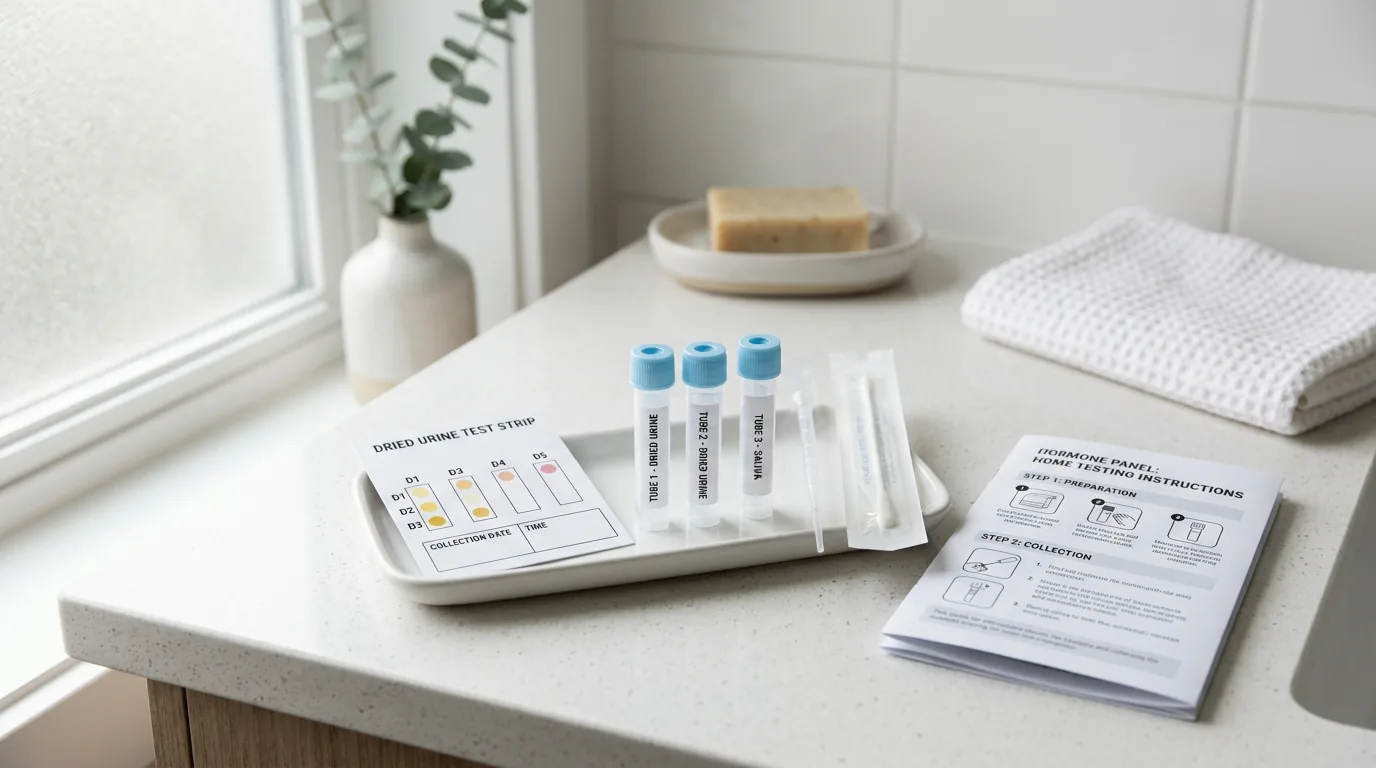
In practical terms, this testing is done at home rather than requiring a lab visit, using a kit that collects several dried urine or saliva samples across a single day, timed to waking, midday, late afternoon, and bedtime. The kit is mailed to a specialty lab, and results typically come back within one to two weeks, at which point we review them together over telehealth, correlating the actual shape of your cortisol curve and your progesterone and blood sugar markers with the specific pattern of symptoms you have been experiencing, when you wake up, how anxiety shows up during the day, what your evening routine looks like. This is what allows the plan in the next section to be built around your actual physiology rather than a generic checklist handed to every woman with this symptom, and it is often the first time a woman gets to see, in a genuinely visual, understandable way, what her own cortisol pattern is actually doing across a 24 hour period.
Saliva Versus Dried Urine Testing
You may see both saliva and dried urine testing offered for cortisol rhythm evaluation, and it is worth understanding the difference briefly. Saliva testing measures free, unbound cortisol at each collection point and has a long track record specifically for mapping the daily cortisol curve. Dried urine testing, the method behind the DUTCH test, captures both free cortisol and its metabolites, providing additional detail about how your body is processing and clearing cortisol, not just how much is present at a given moment, along with the progesterone and estrogen metabolite information discussed elsewhere in this article. For a woman whose primary question is specifically about her cortisol curve in isolation, either method can be informative. For a comprehensive evaluation that also needs to assess progesterone and its metabolites, which is the case for most women reading this article, dried urine testing allows both to be captured from a single, coordinated collection process rather than requiring two entirely separate testing approaches. Neither method requires a blood draw, which many women find meaningfully more comfortable, and both are designed to be collected in your own home on a normal day rather than during an artificial lab visit that might not reflect your actual daily pattern.
Reading Your Own Cortisol Curve
Once your results come back, we walk through your specific curve together, comparing it to the healthy pattern shown in the graphic in Section 3: a sharp rise in the 30 to 45 minutes after waking, a gradual decline through the day, and a low, stable trough through the evening and overnight hours. Most women's curves show one of a few recognizable variations. Some show a blunted morning rise, meaning the cortisol awakening response is weaker than it should be, which often correlates with morning fatigue and difficulty getting going, distinct from the nighttime waking pattern this article focuses on but sometimes present alongside it. Others show an evening trough that does not drop as low as it should, staying moderately elevated into the first part of the night, which can make falling asleep harder even before any middle-of-the-night waking occurs. And many show the specific pattern most relevant to this article: an otherwise reasonable curve with a distinct secondary rise in the early morning hours, frequently landing right around the time a woman reports waking. Seeing your own curve mapped out this way, rather than being told a single number is "high" or "low," is often the single most clarifying moment of the entire evaluation process.
What Happens After Testing
Testing is a starting point, not an end point. Once we have a clear picture of your cortisol rhythm, progesterone status, and blood sugar markers, we build a protocol specific to what your results actually show, which is covered in detail in the next section, and typically schedule a follow-up evaluation, often at the eight to twelve week mark, to reassess symptoms and, when clinically useful, repeat relevant testing to confirm the plan is working the way we intended. This is an iterative process rather than a one-time fix, and adjustments along the way are a normal, expected part of getting your specific protocol right rather than a sign that the initial evaluation missed something.
A Note on Cost and Coverage
Comprehensive cortisol and hormone testing of this kind is typically billed directly, since specialty functional lab testing generally falls outside standard insurance lab coverage, similar to the DUTCH test discussed in our other hormone-focused articles. Rather than quoting a specific figure here, since testing costs can shift over time, I would rather be direct about the factors that affect it: the specific panel ordered, whether additional markers like a full thyroid panel or ferritin are included based on your history, and the number of follow-up visits built into your plan. The clearest way to understand what this looks like for your specific situation is a conversation, which is exactly what a discovery call is for, a chance to ask about cost and coverage directly before deciding whether to move forward with a full evaluation.
What Actually Helps: A Root-Cause Approach to Sleep and Anxiety

A comprehensive approach to this symptom pattern is built around the specific mechanisms your testing identifies, layered alongside continued sleep hygiene and mental health support where appropriate, rather than any single intervention presented as a cure-all.
Addressing Cortisol Rhythm
Once a cortisol rhythm test identifies where your specific pattern is disrupted, evening-focused interventions, adaptogenic support timed to your specific curve, stress management practices concentrated in the hours before bed rather than generically throughout the day, and addressing any daytime patterns (like excessive caffeine or under-eating) that are keeping baseline cortisol elevated, can help restore a more stable overnight trough. This is meaningfully different from generic stress management advice because it is targeted to the actual shape of your curve rather than applied uniformly.
Evaluating Progesterone Support
For women whose testing shows a significant progesterone decline, bioidentical progesterone, most commonly oral micronized progesterone taken at bedtime, is one of the more well-studied and frequently effective interventions for exactly this symptom pattern, since it directly restores some of the GABA receptor activity described in Section 3. We cover the full picture of bioidentical hormone therapy, including who is and is not a good candidate, in our complete guide to bioidentical hormone therapy, which is worth reading in full if progesterone support looks like it may be relevant for you specifically. This is one option among several, not an automatic recommendation for every woman with this symptom pattern. That guide also covers the timing hypothesis and candidacy considerations in detail, including who should approach hormone therapy cautiously, which is worth understanding fully before pursuing this option even if your testing points toward it.
For women who are not candidates for hormone therapy, or who prefer not to pursue it, there are non-hormonal ways to support GABA activity and nervous system calming, including specific magnesium forms, certain adaptogenic herbs studied for HPA axis support, and targeted amino acid support, though these tend to produce a more modest effect than directly addressing a significant progesterone deficit. The right combination depends on your testing, your preferences, and your broader health history, which is exactly why this is an individualized conversation rather than a standard protocol applied to everyone.
Blood Sugar Stabilization Strategies
For women whose pattern involves overnight blood sugar swings, practical, immediately actionable changes often make a real difference: a dinner that includes adequate protein and fat rather than a carbohydrate-heavy, protein-light meal, a small protein-containing snack before bed if dinner was early, and awareness of alcohol's delayed blood sugar effect, since a nightcap several hours before the 2 to 4am window can be a direct contributor to waking during exactly that window. This is often the piece of the puzzle women can start adjusting immediately, even before a full evaluation is complete.
A few concrete starting points, useful regardless of what a full evaluation eventually reveals: aim for at least 20 to 25 grams of protein at dinner rather than a light, carbohydrate-heavy meal; if you eat dinner early, before 6pm, a small bedtime snack with protein and a bit of fat, a handful of nuts or a spoonful of nut butter, can help prevent an overnight dip; and if you drink alcohol in the evening, consider having it earlier and pairing it with food, since alcohol on an empty stomach late in the evening is one of the more common and correctable contributors to a 2 to 4am blood sugar drop.
Continued Sleep Hygiene and Mental Health Support
None of the above replaces the value of good sleep hygiene or appropriate mental health care. A cool, dark room and a consistent bedtime routine still support better sleep architecture once the underlying hormonal drivers are being addressed, and for women who are also managing an anxiety disorder or working with a therapist, continuing that care alongside a hormonal evaluation typically produces better results than either approach pursued in isolation. If you are also working with a therapist or prescribing psychiatric provider, we are glad to coordinate directly with them, with your permission, so that your hormonal protocol and your mental health treatment are working together rather than happening in two disconnected silos that neither provider has full visibility into.
The Non-Negotiables, Regardless of Your Specific Results
While the specific protocol varies by what testing reveals, a handful of foundational practices tend to support every version of this plan, regardless of which mechanism turns out to be most dominant for you. Consistent sleep and wake times, even on weekends, help anchor your circadian rhythm and support a more stable cortisol curve. Morning light exposure, even ten to fifteen minutes outside shortly after waking, helps reinforce a healthy cortisol awakening response, which in turn supports a cleaner overnight trough later. Regular movement during the day, not necessarily intense exercise, supports both insulin sensitivity and stress hormone regulation. And limiting screens and stimulating content in the hour before bed remains genuinely useful, not because it fixes the hormonal piece on its own, but because it removes one more variable competing for your nervous system's attention as it tries to settle into sleep. None of these replace the targeted interventions described above, but they form a foundation that makes those targeted interventions more effective.
Working With What You Have While You Wait
If you are reading this and a full evaluation is still weeks away, whether because you are still deciding, waiting on a scheduled appointment, or waiting for a testing kit to arrive, there are a few things worth starting now, since none of them require a diagnosis first and none of them will interfere with subsequent testing. Begin the two-week symptom log described in the FAQ section below tonight rather than waiting for it to feel urgent. Experiment with an earlier, more protein-forward dinner and notice whether your waking pattern shifts at all over the following week or two. If you drink alcohol in the evening, try shifting it earlier and pairing it with food for a stretch of nights and watch for a pattern. None of this replaces a comprehensive evaluation, but it gives you real, useful data to bring to that evaluation, and for some women, these initial changes alone produce a noticeable difference even before any testing or targeted treatment begins.
A Realistic Timeline
I want to be honest rather than overpromising here. Blood sugar related changes can sometimes produce a noticeable difference within one to two weeks, since evening eating patterns can be adjusted almost immediately. Cortisol rhythm and progesterone-related interventions typically take longer, often six to twelve weeks, to produce a clearly noticeable, consistent change, since they involve retraining a hormonal system rather than a single quick fix. Some women notice gradual, partial improvement along the way rather than a single dramatic turning point, and that gradual pattern is normal, not a sign the approach is not working.
A realistic early progression often looks something like this: in the first one to two weeks, blood sugar related adjustments may reduce the frequency of waking, from several nights a week down to one or two, though the nights it does happen may still feel just as intense. By four to six weeks, alongside cortisol and progesterone support if indicated, many women notice the racing-heart intensity beginning to soften even on nights they do wake, and falling back asleep starts taking less time. By eight to twelve weeks, for women who respond well, waking becomes infrequent, and daytime anxiety symptoms typically show a parallel, gradual improvement over that same window. This is a general pattern, not a guarantee, and some women need longer or a different combination of interventions, which is exactly why ongoing follow-up and adjustment, rather than a single fixed protocol, matters.
Ready to find out what's actually driving your 3am wake-ups?
A free 15-minute discovery call is a chance to talk through your specific pattern and what a real evaluation could look like for you, no generic tip list, no pressure.
Schedule Your Free Discovery CallFour Women, Four Different Root Causes
It can be difficult to picture how all of the mechanisms in this article actually play out for a real evaluation, so I want to walk through three composite scenarios, drawn from patterns I see repeatedly rather than any single patient, to show how the same surface-level complaint, waking at night with a racing heart and new anxiety, can trace back to different dominant mechanisms, and why that distinction changes the plan.
Scenario One: Cortisol-Dominant
A woman in Grand Rapids, 44, a hospital administrator with a demanding job and a long commute, describes waking almost every night between 2:30 and 3:30am, heart racing, mind immediately jumping to work stress even though nothing acute is happening at work. Her periods are still fairly regular. She does not have significant premenstrual symptoms. Her evening meals are reasonably well balanced with protein. Her cortisol rhythm test shows a pattern consistent with what we discussed in Section 3: an appropriately robust morning cortisol awakening response, but an evening cortisol level that is not dropping as low as it should be, with a distinct secondary rise in the early morning hours that lines up almost exactly with her reported waking time. Her progesterone and blood sugar markers are largely unremarkable. For this woman, the plan centers on evening-focused cortisol support, adjusting the timing of her most demanding work tasks earlier in the day where possible, targeted evening stress-reduction practices, and specific nutrient and adaptogenic support aimed at helping her evening cortisol trough settle back into a more stable pattern. Progesterone support is not part of her plan, because her testing does not point to it as a significant contributor.
Scenario Two: Progesterone-Dominant
A woman in Appleton, 41, a teacher and mother of three, describes a somewhat different pattern: her waking is less tied to a specific clock time and more tied to her cycle, worse in the two weeks before her period, better in the two weeks after. She has a history of significant PMS in her 20s and 30s that she describes as having "gotten worse, not better" over the last few years. Her periods are still monthly but have become noticeably lighter and occasionally arrive early. Her cortisol rhythm is largely normal. Her comprehensive panel shows a progesterone level that is low relative to what would be expected for a woman still cycling regularly, consistent with the anovulatory cycles described in Section 3. For this woman, the plan centers on evaluating bioidentical progesterone support, typically oral micronized progesterone taken at bedtime during the second half of her cycle, alongside continued attention to sleep hygiene. Her blood sugar markers are unremarkable, and the plan does not center on dietary blood sugar strategies the way it might for another woman.
Scenario Three: Blood Sugar-Dominant
A woman in Eau Claire, 46, notices her waking is most consistent on nights she has wine with dinner or eats a lighter, more carbohydrate-heavy meal, and less frequent on nights she has a protein-forward dinner and no alcohol, a pattern she had noticed informally but had not connected to anything specific. Her fasting insulin comes back mildly elevated, and her detailed evening intake history reveals a consistent pattern of lighter dinners (often just a salad) paired with a glass or two of wine most evenings, a combination that, as described in Section 3, sets up exactly the kind of overnight blood sugar dip that triggers a cortisol and adrenaline rescue response. Her cortisol rhythm test and progesterone levels are both within a largely normal range. For this woman, the plan centers on restructuring her evening meals to include adequate protein and fat, adjusting when and how she drinks alcohol, and addressing the mild insulin resistance directly, without progesterone support or targeted cortisol-timing interventions being a significant part of her protocol.
Scenario Four: Combined Picture with a Mental Health Component
A woman in Ann Arbor, 39, has a history of generalized anxiety disorder dating back to her 20s, already managed reasonably well for years with an SSRI and periodic therapy. Over the past year, she has noticed her baseline anxiety has intensified again despite no medication change and no major new life stressor, and she has started waking at night with a racing heart in a way that feels distinct from her usual daytime anxiety pattern. Her testing shows both an unstable overnight cortisol rhythm and a declining progesterone level, consistent with early perimenopause, alongside her existing, well-documented anxiety disorder. For this woman, the plan does not replace her psychiatric care, and we coordinate directly with her therapist and prescribing provider rather than working in isolation. It adds a hormonal layer, evening cortisol support and progesterone evaluation, alongside her continued mental health treatment, with the explicit goal of addressing the specific nighttime pattern that her existing, effective anxiety treatment was not designed to touch. Her case illustrates why "hormonal contributor" and "anxiety disorder" are so often both true at once, and why a good plan treats them as complementary pieces of the same picture rather than competing explanations.
These four women had overlapping presenting complaints and would have received very similar generic advice from a rushed conventional visit: better sleep hygiene, maybe an SSRI, maybe a reassurance that this is just perimenopause. But their actual root causes, and therefore their actual effective treatment plans, were meaningfully different, and none of them would have received real relief from a plan designed for one of the other two. This is the entire argument for comprehensive testing rather than a generic protocol, and it is why we do not offer a single standard "hormone balance package" applied uniformly to every woman who comes to us with this symptom pattern.
If you recognize pieces of more than one of these scenarios in your own experience, that is common, and it is exactly why testing rather than guessing matters. Many women have some combination of two or three mechanisms contributing simultaneously, a mildly unstable cortisol rhythm alongside declining progesterone, for example, rather than a single, cleanly isolated cause. A comprehensive evaluation does not require you to fit neatly into one of these four categories. It is designed to show us the actual combination at play for you, however many pieces that turns out to include.
Michigan and Wisconsin Considerations

This symptom pattern is not geography-specific the way some of our other content is, but a few practical points are worth naming for women in Michigan and Wisconsin specifically. Novaleo Weight and Wellness is licensed to provide telehealth functional medicine consultation across both states, which means the comprehensive cortisol, progesterone, and blood sugar evaluation described in Section 6 does not require an in-person visit or a long drive, a genuine advantage for women managing this symptom on top of an already full schedule in Marquette, Wausau, or anywhere in between.
It is also worth noting that Michigan and Wisconsin winters, with their extended darkness and reduced sunlight from roughly November through March, can independently affect both sleep quality and mood regulation, sometimes overlapping with and intensifying the hormonal pattern described throughout this article. If your symptoms noticeably worsen in winter months, that seasonal pattern is useful information to bring into a comprehensive evaluation rather than something to dismiss as unrelated. Reduced daylight affects melatonin production and circadian rhythm regulation independently of the cortisol, progesterone, and blood sugar mechanisms described earlier in this article, which means a woman whose 3am waking is already partly hormonal may find the pattern noticeably worse from December through February, only to see some natural improvement as daylight returns in the spring, even before any treatment begins. We cover the vitamin D and seasonal factors specific to this region in more depth in our Michigan and Wisconsin articles, which may be useful additional reading if fatigue and weight changes are also part of your picture alongside sleep and anxiety.
And a final, brief note: while this article was written for the reader whose primary concern is sleep and anxiety rather than weight, it is common for both to show up together as hormones shift. If you have noticed both, our perimenopause guide covers the fuller decade-by-decade symptom picture, including the weight and energy changes that often accompany what you have read about here.
If you are also on a GLP-1 medication or considering one, it is worth knowing that some of the mechanisms in this article, particularly cortisol and blood sugar regulation, intersect with how those medications affect your body as well. Our GLP-1 and Ozempic article covers that overlap in more detail if it is relevant to your situation.
A Small, Common Regional Pattern Worth Naming
One pattern comes up often enough in conversations with women across both states that it is worth naming directly. A relaxed evening glass of wine or two with dinner, a genuine part of social and family life across Michigan and Wisconsin, from a Friday fish fry in Wisconsin to a summer evening on a porch in the Traverse City wine region, can be precisely the kind of evening alcohol intake described in Section 3 that contributes to an overnight blood sugar dip and a subsequent cortisol-driven 3am waking. This is not a suggestion to eliminate something that is a genuine source of enjoyment and connection. It is simply useful, practical information: if this pattern sounds familiar, experimenting with having that glass earlier in the evening, alongside food, rather than as a nightcap closer to bedtime, is one of the more immediately testable adjustments available, and it costs nothing to try before pursuing a fuller evaluation.
Finding Time for an Evaluation in a Full Life
One of the most common reasons women in Michigan and Wisconsin delay looking into this pattern is simply logistics. Between a job, kids' schedules, and everything else that fills a week, finding time for an in-person specialist appointment, especially one that might involve a drive to a larger city and a wait for an available slot, often falls to the bottom of the list, even when the symptom itself is genuinely disruptive. This is precisely the gap telehealth is designed to close. A comprehensive evaluation can begin with a video visit scheduled around your existing calendar, testing completed at home on your own timeline rather than during a narrow lab window, and a follow-up visit to review results, all without needing to take a half day off work or arrange childcare for a drive to an appointment. For a woman in Marquette juggling a full-time job and three kids' hockey schedules, or a woman in Oshkosh managing an aging parent's care alongside her own job, that logistical simplicity is often the difference between finally getting an answer and continuing to put it off for another season.
Mental Health Resources Across Both States
Because this article has repeatedly emphasized that mental health support belongs alongside, not instead of, a hormonal evaluation, it is worth noting that both Michigan and Wisconsin have expanded telehealth access for therapy and psychiatric care considerably in recent years, meaning a woman in a smaller community no longer needs to be geographically close to a mental health provider to access one. If you do not already have a therapist or psychiatric provider and are looking for one, your primary care physician, your insurance plan's provider directory, or the national 988 Suicide and Crisis Lifeline (available by call or text for anyone in immediate distress, not only crisis situations in the most severe sense) are all reasonable starting points. This is worth having on hand regardless of whether you ultimately pursue a hormonal evaluation with us, because, as this article has said from the start, your access to appropriate mental health support should never wait on sorting out the hormonal piece first.
Comprehensive FAQ: Your Questions Answered
Why do I wake up at the same time every night?
Waking at a consistent time, most commonly between 2 and 4am, is a recognizable pattern often tied to a specific overnight cortisol spike or a blood sugar dip occurring at a fairly predictable point in your sleep cycle. Because these are physiological triggers rather than random events, they tend to happen around a similar time night after night until the underlying pattern is addressed, which is why so many women report waking at what feels like an oddly specific, consistent hour.
Can perimenopause cause panic attacks?
Hormonal shifts in perimenopause, particularly declining progesterone and unstable cortisol rhythms, can produce physical sensations that closely resemble or trigger panic attacks, including a racing heart, chest tightness, and a sudden sense of dread or alarm. This does not mean every panic attack during this life stage is purely hormonal, and if you are experiencing panic attacks, it is important to also be evaluated by a mental health professional or physician, since panic attacks can have multiple contributing causes that deserve individual attention.
Is this menopause or an anxiety disorder?
It can genuinely be either, or both at once, and the two are not mutually exclusive. Hormonal changes can produce new anxiety symptoms in a woman with no prior history of an anxiety disorder, and hormonal changes can also intensify a pre-existing anxiety disorder. A comprehensive evaluation that includes both a hormonal assessment and, when appropriate, a mental health evaluation, is the most reliable way to understand which factors are contributing in your specific case rather than guessing at a single explanation.
Will hormone therapy help me sleep?
For women whose testing shows a significant progesterone decline contributing to their sleep disruption, bioidentical progesterone, typically taken orally at bedtime, is one of the more well-studied interventions for this specific symptom pattern, since it directly supports the calming GABA receptor activity described in this article. It is not automatically the right choice for every woman, and candidacy depends on your full health history, which we cover in our complete guide to bioidentical hormone therapy.
Should I see a therapist or a hormone specialist first?
If your anxiety is new, severe, persistent, or interfering with your daily functioning, please see a mental health professional or your physician regardless of whether you also pursue a hormonal evaluation. The two are not competing options. Many women benefit from both simultaneously. If your primary symptom is specifically the 3am waking pattern described in this article without broader anxiety disorder symptoms, a hormonal evaluation is often a reasonable starting point, but this is a decision worth discussing with a provider who can look at your complete picture.
Why does my heart race when I wake up at night, even though nothing scary is happening?
A racing heart during nighttime waking is typically driven by a cortisol or adrenaline release, either from an unstable overnight cortisol rhythm or from your body's response to a blood sugar drop. Both trigger the same fight-or-flight physiology regardless of whether an actual external threat is present, which is why the sensation can feel so alarming even when your surroundings are completely safe. If new heart palpitations, chest pain, or significant shortness of breath accompany this pattern, that combination warrants direct medical evaluation, as discussed earlier in this article, rather than being assumed to be hormonal without a physician's assessment first.
I don't have hot flashes. Can this still be hormonal?
Yes. Progesterone decline and cortisol rhythm changes, the two mechanisms most directly tied to 3am waking and new anxiety, do not require hot flashes to be present and often occur before hot flashes become noticeable. Many women experience sleep and anxiety changes as an earlier perimenopausal symptom than hot flashes, which is part of why this pattern is so often missed or misattributed to something else entirely.
Can Michigan and Wisconsin women get this evaluated through telehealth?
Yes. Novaleo Weight and Wellness is licensed to provide telehealth functional medicine consultation and comprehensive hormone testing across both Michigan and Wisconsin. Testing kits are typically completed at home, and results are reviewed together over a secure video visit, with no need for an in-person appointment.
Is it normal for this to come with weight changes too?
It is common, though not universal. The same cortisol and hormonal patterns discussed in this article can also contribute to weight resistance, since elevated cortisol promotes abdominal fat storage and disrupts blood sugar regulation. If you are noticing both sleep and anxiety changes alongside weight changes, our Ultimate Guide to Hormones and Weight Resistance Over 40 covers that fuller picture in depth.
How long until I start feeling better?
It varies by which mechanisms are contributing to your specific pattern. Blood sugar related changes can sometimes improve within one to two weeks of adjusting evening eating habits. Cortisol rhythm and progesterone-related improvements typically take longer, often six to twelve weeks, since they involve retraining a hormonal system rather than a single quick fix. Gradual, partial improvement along the way is a normal part of the process, not a sign that something isn't working.
Is melatonin or magnesium worth trying on my own first?
Magnesium, particularly magnesium glycinate taken in the evening, is generally well tolerated and has some support for improving sleep quality and mildly calming the nervous system, making it a reasonable, low-risk thing to try while you consider a fuller evaluation. Melatonin can help with falling asleep initially, but it addresses sleep onset rather than the mid-sleep cortisol and blood sugar mechanisms most responsible for 3am waking, so many women find it does not resolve this specific pattern on its own. Neither is a substitute for identifying and addressing the underlying hormonal drivers if this pattern is persistent.
What if my labs came back "normal" already?
This is one of the most common experiences among women with this symptom pattern, and it usually reflects what was tested rather than the absence of a real hormonal contributor. A standard panel often includes only TSH, a single estradiol level, and general metabolic markers, none of which capture your cortisol rhythm across the day and night, your progesterone levels specifically, or how your blood sugar behaves overnight. "Normal" on a standard panel does not rule out the mechanisms described throughout this article, since those specific markers are frequently not included in a routine workup at all.
Could this be sleep apnea instead of hormones?
It is genuinely possible, and it is worth ruling out, particularly if you snore, have ever been told you stop breathing briefly during sleep, wake up gasping, or are significantly fatigued despite adequate hours in bed. Sleep apnea becomes more common around this same life stage, partly because declining progesterone reduces upper airway muscle tone, and it can produce a racing-heart waking pattern that closely resembles the cortisol-driven pattern described in this article. A sleep study alongside a hormonal evaluation is a reasonable approach if any of these signs apply to you.
Can stress alone cause this without any hormonal component?
Yes, chronic stress alone can disrupt sleep and produce anxiety symptoms independent of hormonal status, particularly through sustained elevation of baseline cortisol. For most women in their late 30s and 40s experiencing this specific pattern, though, stress and hormonal change tend to compound each other rather than acting entirely separately, as discussed in Section 2. A comprehensive evaluation helps clarify how much each factor is contributing in your specific case, rather than assuming it must be one or the other.
Does this go away on its own once I reach menopause?
For some women, sleep and anxiety symptoms do improve somewhat once hormone levels stabilize at a lower, more consistent baseline after menopause, since some of the instability described in this article is specifically tied to the fluctuating nature of perimenopause rather than low hormone levels themselves. For others, symptoms persist into postmenopause, particularly if cortisol rhythm or blood sugar regulation remain unaddressed. Waiting to see if it resolves on its own can mean months or years of disrupted sleep and anxiety that a comprehensive evaluation could address much sooner.
What should I track before my first appointment?
A simple two-week log is genuinely useful: the nights you wake and approximately what time, whether it correlates with your cycle if you are still having periods, what you ate and drank in the evening, alcohol included, and how your daytime anxiety showed up, physical sensations versus specific worries. This kind of detail helps correlate your testing results with your actual lived pattern and often speeds up identifying which of the mechanisms in this article are most relevant to you specifically. A notes app on your phone works just as well as a paper journal for this purpose, the format matters far less than simply capturing the pattern consistently for those two weeks.
Can birth control or an IUD affect this pattern?
Hormonal birth control, including combined pills and hormonal IUDs, can influence this picture in different ways depending on the specific method and your individual response. Some women find hormonal contraception stabilizes hormone-related sleep and anxiety symptoms, while others find it does not fully address the pattern once perimenopause is also contributing, since most hormonal contraceptives are not designed to replicate the same progesterone and cortisol dynamics discussed in this article. If you are on hormonal birth control and still experiencing this pattern, that is worth mentioning specifically during an evaluation rather than assuming birth control has already ruled out a hormonal explanation.
I'm in my late 30s. Isn't this too early to be perimenopause?
No. Perimenopause can begin as early as the mid-30s for some women, often years before periods become noticeably irregular, since progesterone decline typically precedes any obvious change in cycle regularity. We cover this specifically in our guide to perimenopause in your 30s, which may be useful additional reading if your age has been a reason you have dismissed a hormonal explanation for this pattern.
Can exercise make this pattern better or worse?
Regular, moderate exercise generally supports better sleep and healthier cortisol regulation over time, and is one of the non-negotiable foundational practices described in Section 7. However, intense exercise performed too close to bedtime can temporarily elevate cortisol and adrenaline, which may worsen nighttime waking for some women in the hours immediately after a hard evening workout. If you exercise intensely in the evening and notice your waking pattern is worse on those nights specifically, shifting harder workouts earlier in the day and keeping evening movement gentler, a walk rather than high intensity training, is a reasonable adjustment to test.
Is it worth seeing a specialist if my regular doctor already ran some tests?
It depends entirely on what was actually tested. If your workup included only TSH and a basic metabolic panel, which is common in a standard visit, it likely did not include cortisol rhythm testing, progesterone levels, or fasting insulin, the three markers most directly relevant to the pattern described in this article. Bringing your existing results to a comprehensive evaluation is genuinely useful, since it avoids unnecessary repeat testing, but "some tests were normal" does not mean the specific mechanisms in this article have already been ruled out.
Book a Free Discovery Call
If you have read this far, I hope the biggest thing you are taking away is this: what you are experiencing has a name, a mechanism, and, for most women, a real path toward feeling better. You are not imagining this. You are not losing your mind. And you are not simply "getting older" in some vague, unexplainable way that you just have to accept.
The next step is not a leap. It is a conversation, a chance to walk through your specific pattern, what you have already tried, and what a comprehensive evaluation could reveal about what is actually happening in your body at 3am.
A quick recap, because I know this was a lot to take in. Your 3am waking and new anxiety are very often driven by four interconnected, identifiable mechanisms: an unstable overnight cortisol rhythm, declining progesterone and its calming effect on your brain, overnight blood sugar swings, and early, sometimes unnoticed shifts in estrogen's role in temperature regulation. None of this rules out that your life is genuinely stressful, and none of this replaces appropriate mental health support if your anxiety is significant. It simply means there is a real, physiological piece of the puzzle that a comprehensive evaluation, cortisol rhythm testing, progesterone assessment, and blood sugar markers, can identify and address, often starting to show real change within six to twelve weeks.
Let's find out what's actually keeping you up at night.
Book your free 15-minute discovery call. No generic sleep tips, no pressure, just a real conversation about your specific symptoms and what to do next.
Book Your Free 15-Minute Discovery CallA personal note from Katie:
Of everything I see in my practice, this is one of the symptoms that leaves women feeling the most alone. Weight changes are frustrating, but at least they are visible, something you can point to and say, "look, this is real." Waking up at 3am with your heart pounding, for no reason you can name, is invisible in a way that makes a lot of women quietly wonder if something is wrong with their mind rather than their body. I want you to know that is an extremely common thing to wonder, and it is very often not the right explanation.
I remember one conversation, a composite of many I have actually had, that has stuck with me. A woman told me she had started keeping her phone on her nightstand not to scroll, but because she had convinced herself that if her heart was going to keep doing this, she wanted to be able to call someone. She had not told her husband how scared she actually was, because she did not want him to worry, and she had not told her doctor the full extent of it, because her one appointment a year did not feel like enough time or space to get into something that felt so hard to explain. She was managing this entirely on her own, night after night, and she had been for the better part of a year before we talked. That is far too long for any woman to carry something like this alone, and it is a large part of why I wanted this article to exist, so that a woman in that exact position could find real language for what she is experiencing before she spends a year quietly wondering what is wrong with her.
I also want to say clearly, one more time, because it matters to me that this lands: if you are struggling with anxiety that feels bigger than what I have described here, please do not wait to reach out to a therapist or your physician while you sort out whether hormones are part of the picture. You do not have to choose one path. Many of my patients are doing both at once, working with a therapist and working with me, and that combination often gets them further than either path alone.
I want to be honest that this particular symptom pattern took me time to fully understand myself, early in my career, before I had built the kind of comprehensive testing approach I use now. I remember treating sleep and anxiety as separate problems from hormones for longer than I wish I had, because that is largely how conventional training frames it, sleep in one silo, anxiety in another, hormones somewhere else entirely, rarely connected on the same chart. It was not until I started looking at cortisol rhythm testing specifically, and seeing the same pattern show up again and again in women describing this exact 3am experience, that the picture became clear to me. I share that not to dwell on my own learning curve, but because I think it is honest and useful for you to know that this connection is not obvious even to many well-trained clinicians, which is exactly why so many women go years without anyone connecting these dots for them.
If you are a woman in Michigan or Wisconsin lying awake right now, or dreading tonight because of what the last several nights have looked like, I would be honored to help you understand what is actually happening in your body. Not with a generic checklist. With real testing, a real conversation, and a plan built around what we actually find.
And if you are reading this on behalf of someone else, a daughter checking in on her mother, a friend who mentioned she has not been sleeping, a partner trying to understand what his wife is going through, thank you for looking for real information rather than dismissing it. So many women in this exact situation describe feeling like the people around them assume they are simply more stressed or more anxious than they used to be, without anyone stopping to ask why, physiologically, that might be true right now specifically. If you know a woman in Michigan or Wisconsin who sounds like she is living through what this article describes, sharing it with her may be one of the more useful things you can do.
I will say one more time, because I would rather repeat myself than have this get lost: if what you are feeling is more than the pattern I have described here, if it is constant, if it is affecting your ability to function, if it comes with thoughts that frighten you, please reach out to a mental health professional or your physician without waiting to see if this article's explanation fits first. Your safety and your wellbeing come before any hormone panel. For everyone else, for the woman who recognizes this specific 3am pattern and wants to understand what her own body is doing, I am genuinely glad you found this, and I would love to help you get some real answers.
You are not broken, and you are not alone in this. Reach out whenever you are ready.
Katie Long, NP-C
Founder, Novaleo Weight and Wellness
Kathryn Long, NP-C
Board-Certified Nurse Practitioner
Katie is the founder of Novaleo Weight and Wellness, a telehealth functional medicine practice licensed in both Michigan and Wisconsin. With over 20 years of healthcare experience, she specializes in helping women over 35 identify and address the root causes of sleep disruption, hormonal anxiety, weight resistance, and metabolic dysfunction, using comprehensive testing and evidence-based, individualized care. Katie is committed to making quality functional medicine accessible to women across both states, regardless of where they live.
You Don't Have to White-Knuckle Through Another Night
If 3am has become a familiar, unwelcome part of your routine, there is a real, identifiable reason, and a real path forward. Your free 15-minute discovery call is the first step.
Book Your Free 15-Minute CallReferences
- The North American Menopause Society. "Sleep Problems." The Menopause Society Position and Guidance. View resource
- Baker FC, de Zambotti M, Colrain IM, Bei B. "Sleep Problems During the Menopausal Transition: Prevalence, Impact, and Management Challenges." Nature and Science of Sleep. 2018;10:73-95. View study
- Freeman EW, Sammel MD. "Anxiety as a Risk Factor for Menopausal Hot Flashes: Evidence from the Penn Ovarian Aging Cohort." Menopause. 2016;23(9):942-949. View study
- American Psychological Association. "Understanding Anxiety Disorders and Effective Treatment." APA Clinical Practice Guidance. View resource
- Prairie BA, Wisniewski SR, Luther J, et al. "Symptoms of Depressed Mood, Disturbed Sleep, and Sexual Problems in Midlife Women: Cross-Sectional Data from the Study of Women's Health Across the Nation." Menopause. 2015;22(3):310-317. View study
- 988 Suicide and Crisis Lifeline. Free, confidential support available 24/7 by call or text. View resource