

The Hair in the Drain
It usually starts in the shower. You are standing there on an ordinary Tuesday morning in Grand Rapids, or Green Bay, or Marquette, and you look down and see more hair around the drain than you remember seeing before. You tell yourself it is nothing. You pull it out, rinse your hand, and carry on with your day. Then a week later you notice the hairbrush, and a month after that you catch a photo of yourself under bright light at a family event and realize that your part looks wider than it did last year. Nobody else seems to have noticed. You have noticed, and you cannot stop noticing.
If that is where you are, I want to begin with three things that are true and that almost nobody says to women in this position.
First, you are not being vain, and you are not overreacting. Hair is tied up with identity, with how you feel walking into a meeting, and with how you feel looking in the mirror at 6:15 in the morning before the day has started. Researchers who study women with hair loss consistently describe real psychological weight, including lower self-esteem and reduced quality of life, and a 2026 clinical review noted that these effects often exceed what is seen in men with the same condition.[1] Feeling shaken by this is a normal response to a real change, not a character flaw.
Second, hair loss in women between 35 and 55 is common, and it is rarely one thing. In my experience, and in the clinical literature, the most useful mental shift is to stop asking "why am I losing hair?" as though there is a single villain, and start asking "which of several overlapping processes are happening in my scalp right now, and which of them can be changed?" A woman can have a shedding episode triggered by a rough year, low iron stores from years of heavy periods, a genetic tendency toward thinning at the part line, and the early hormonal shifts of perimenopause all at once. Untangling those layers is the actual work.
Third, and this is the one that matters most: many of the causes of hair loss in this age group are identifiable, and a meaningful share of them are reversible or at least treatable, but the window for the best results is often earlier than women expect. The American Academy of Dermatology puts it plainly for the most common form of hair loss in women, saying that treatment works best when started at the first sign of hair loss, and that a dermatologist's involvement matters because other common causes of hair loss can look a lot like it and each requires different treatment.[2] The trouble is that the usual path into care is slow. A woman notices the change, waits months hoping it will pass, mentions it to a primary care provider, has a thyroid test (TSH only) and a hemoglobin checked, is told her results are normal, and is sent home with reassurance and possibly a recommendation to try biotin. Six months to two years can pass that way.
This guide is written to change that path. It is written for women in Michigan and Wisconsin between roughly 35 and 55 who are noticing more shedding, a widening part, thinner ponytails, or receding temples, and who want a thorough, honest, evidence-based explanation rather than a product pitch. It is also written with a particular respect for how much information is already out there. You have probably searched this topic at midnight. You have seen the influencer with the rosemary oil, the supplement ad with the before and after photos, the forum thread where everyone has a different theory. Some of what you found is useful. A lot of it is not. Part of my job here is to help you sort the two.

What This Guide Covers
We will start with the biology of how hair grows, because nearly every confusing thing about hair loss becomes less confusing once you understand the hair cycle and, in particular, the delay between a trigger and the shedding it causes. We will then help you tell the difference between shedding and thinning, which are different problems with different answers. From there we walk through the six patterns that account for most hair loss in women in this age group, and we spend real time on the two most common: telogen effluvium and female pattern hair loss.
Then we go into the root-cause layers that a good evaluation looks at: midlife hormones, iron and ferritin, vitamin D and other nutrients, thyroid function, insulin and blood sugar, and stress physiology. We give a full section to a newer and increasingly common cause of hair shedding, which is rapid weight loss on GLP-1 medications such as semaglutide and tirzepatide. We cover the autoimmune and scarring conditions that must not be missed, the everyday hair care and scalp factors that quietly make things worse, and the seasonal and regional factors specific to Michigan and Wisconsin. Finally we lay out what a thorough evaluation looks like, what treatments have real evidence behind them, which supplements help and which can backfire, what a realistic twelve month recovery looks like, and how to prepare for your first visit.
Along the way I will be direct about what the research does not know. Hair science has real gaps, especially for women, who were historically underrepresented in hair loss trials. A 2026 review in the American Journal of Clinical Dermatology noted the paucity of randomized controlled trials for female androgenetic alopecia that actually include women, and the urgent need for more approved therapies for them.[1] I will tell you where the evidence is strong, where it is thin, and where clinicians are working from experience and reasoned judgment rather than large trials. I think you deserve that honesty, and I have found that women who understand the limits of the evidence make better decisions and are far less likely to be taken in by promises that sound too good.
One more note before we begin. If at any point while reading you find yourself matching a description in the section on red flags, particularly patchy bald spots, a scalp that burns, itches, or shows redness and scaling around the hair openings, or eyebrow and eyelash loss along with a receding hairline, please do not wait for a full evaluation to get a dermatologist's eyes on your scalp. Some forms of hair loss scar the follicle permanently, and early treatment is the only way to protect the hair you still have.
How Hair Actually Grows (and Why Loss Runs on a Delay)

To understand hair loss you need one piece of biology, and it explains more than you would expect. Every hair on your head is growing out of a tiny organ called a follicle, and each follicle runs on its own repeating cycle rather than growing continuously. There are three main phases. Anagen is the growth phase, during which the follicle actively builds a hair shaft. On the scalp it can last for several years, which is why hair can grow long. Catagen is a brief transition phase, lasting a couple of weeks, during which growth stops and the lower part of the follicle shrinks back. Telogen is the resting phase, lasting roughly three months, at the end of which the old hair is shed and the follicle restarts and begins a new anagen phase, growing a fresh hair.
On a healthy scalp the great majority of follicles, commonly cited as around 85 to 90 percent, are in anagen at any given time, and the remainder are resting or transitioning. Because each follicle is on its own schedule, the cycle is asynchronous. A few follicles are shedding while most are growing, which is why healthy people lose some hair every day without ever looking thinner. Dermatologists commonly describe 50 to 100 shed hairs a day as within the normal range, although the number varies with hair length, thickness, and how often you wash and brush.
The Delay That Confuses Everyone
Here is the part that matters most for making sense of your own situation. When something disrupts the hair cycle, it does not cause immediate loss. Instead, follicles that were in growth phase get pushed prematurely into the resting phase. They then sit in telogen for roughly two to three months before the hair is finally released. The result is that the shedding you see today reflects something that happened, on average, two to four months ago.
The dermatology literature has known this for a long time. The term telogen effluvium was coined by Kligman in 1961, and his working idea was that whatever the cause, the follicle tends to respond in a similar way, with premature termination of the growth phase.[3] A useful consequence, noted by Harrison and Sinclair in their classic review, is that seeing telogen hair loss does not in itself tell you the cause. To find the cause you need a careful history to identify known triggers, biochemical investigations to exclude endocrine, nutritional, or autoimmune drivers, and in some cases a biopsy to identify the earliest stages of androgenetic alopecia.[3] That is the intellectual foundation of a root-cause approach to hair, and it is why I will keep returning to the question of timing.
This delay is the reason so many women feel gaslit by their own experience. You lost hair in September, but the illness, the crash diet, the surgery, the death in the family, or the medication change that triggered it happened in June. By the time the hair is in the drain, you have forgotten the trigger, your doctor has no reason to connect the two, and the stressful summer looks like ancient history. Part of a good hair loss evaluation is a patient, backward-looking timeline of the six months before the shedding started.
Why Hair Is So Sensitive to Everything
There is a reason hair is often the first place the body shows that something is off. Follicle matrix cells, the cells building the hair shaft, are among the fastest dividing cells in the entire body. That makes them highly demanding of energy, protein, iron, and other micronutrients, and highly responsive to hormonal and inflammatory signals. When the body faces a stress that requires resource triage, hair is not essential to survival, so it is one of the first non-essential processes to be dialed back. A 2019 review of vitamins and minerals in hair loss notes that micronutrients play major roles in the follicle cycle, in cellular turnover in the rapidly dividing cells of the follicle bulb, and in immune function around the follicle, while also noting that the exact role of each is still incompletely understood.[4]
This is worth repeating in plain language, because it changes how you should feel about your hair: shedding is often not a sign that your hair is failing, but a sign that your body made a triage decision. The follicles themselves are frequently intact and capable of regrowing once the underlying pressure is addressed. That is precisely why understanding the cause matters so much, and why the strategies that only cover up the symptom, whether that is a thickening shampoo or a fiber spray, cannot replace finding out what changed.
Hair Loss Is Not One Disease
The last piece of foundation is that "hair loss" is an umbrella for very different processes. In one, healthy follicles are shed early because of a temporary trigger, and the hair comes back. In another, follicles are gradually shrinking under the influence of genetics and hormones, so each new hair is thinner and shorter than the last. In another, the immune system attacks the follicle. In yet another, chronic inflammation destroys the follicle and replaces it with scar tissue. These have overlapping surface appearances but radically different implications and treatments, which is exactly why a woman who tries a treatment meant for one type while she has another can spend a year and a great deal of money getting nowhere.
Shedding or Thinning? How to Read What You See
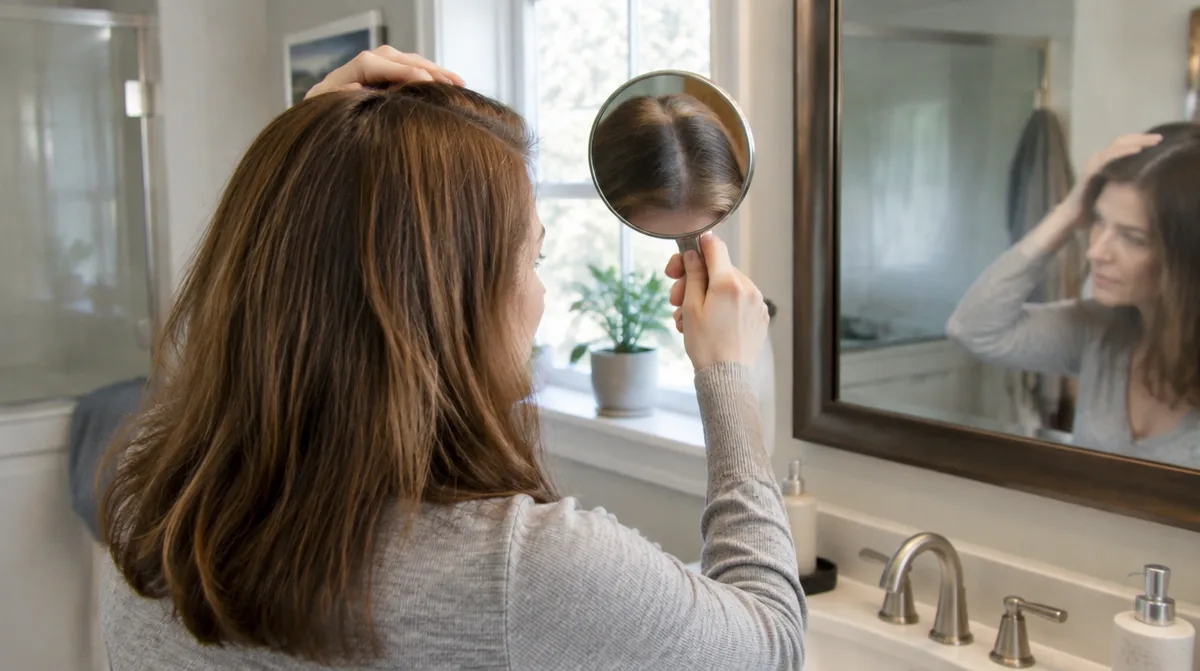
The single most useful distinction you can make before you ever see a clinician is whether you are primarily noticing shedding or primarily noticing thinning. The two overlap, and many women have both, but they point in different directions.
Shedding: More Hair Coming Out
Shedding means more hair is leaving the scalp than usual. You notice it in the shower, on the brush, on your pillow, on your clothes, and in the car seat. Women describe handfuls, clumps, or a ponytail that has gotten noticeably thinner over just a few months. The density across the whole scalp may look diffusely lighter, without one specific area standing out. Shedding tends to have a fairly clear starting point, even if you have to think hard to find it. It is the hallmark of telogen effluvium.
A detail that surprises many women: the hairs in a shedding episode often come out with a small white bulb at the root. That bulb is the club of a telogen hair, and it is a normal, healthy resting hair being released, not a sign of a damaged follicle. It looks alarming and is usually reassuring.
Thinning: Smaller Hair, Wider Part
Thinning is different. In thinning, the hairs are not necessarily falling out in large numbers. Instead, follicles are progressively shrinking, so each new hair grows in finer, shorter, and lighter than its predecessor, a process called miniaturization. The visible result is a part line that has slowly widened, a ponytail that has lost circumference over years, and more scalp showing at the crown or the top of the head. Thinning develops slowly, over many months to years, and it usually has no clear starting point. It is the hallmark of female pattern hair loss.
The classic scale used by dermatologists to describe this pattern in women is the Ludwig classification, first published in 1977, which grades the widening of the central part with preservation of the frontal hairline.[5] The American Academy of Dermatology describes the same picture in plain language: the part often gets wider, and hair near the temples may recede.[2]
A Side-by-Side Comparison
| Feature | Shedding (telogen effluvium) | Thinning (pattern hair loss) |
|---|---|---|
| Tempo | Often abrupt, over weeks to a few months | Gradual, over months to years |
| What you notice | Handfuls in the shower, on the brush, on the pillow | Wider part, thinner ponytail, more scalp visible at the crown |
| Distribution | Diffuse, all over the scalp | Central part line and crown, hairline usually preserved |
| Has a starting point? | Often, if you look 2 to 4 months back | Rarely, it creeps in |
| Hair quality | Normal hairs with white bulbs at the root | Progressively finer, shorter, lighter hairs |
| Typical outlook | Usually reversible once the trigger is removed | Progressive without treatment, but often treatable |
Two important caveats. First, women very often have both at the same time, and this is one reason midlife hair loss is so confusing. A telogen effluvium can unmask an underlying pattern hair loss that was previously hidden, because the shedding makes a scalp that was already slightly thinning suddenly look sparse. Second, the pattern of shedding versus thinning is a starting hypothesis, not a diagnosis. Other conditions, including alopecia areata and scarring alopecias, can mimic each of these.
Why Chronic Shedding in Midlife Deserves Special Attention
One important entity to know about sits between these two. In 1996, dermatologist David Whiting described a group of 355 patients, 346 of them women, with diffuse thinning of scalp hair of unknown cause, and gave it the name chronic telogen effluvium. These patients typically reported abrupt onset increased shedding and thinning with a fluctuating course, showed diffuse thinning all over the scalp, and frequently had recession at both temples.[6] This is a real and recognizable pattern in middle-aged women, and it is a reminder that "shedding for months without an obvious trigger" is a legitimate clinical story that deserves a proper work-up, not a shrug.
How Clinicians Actually Assess It
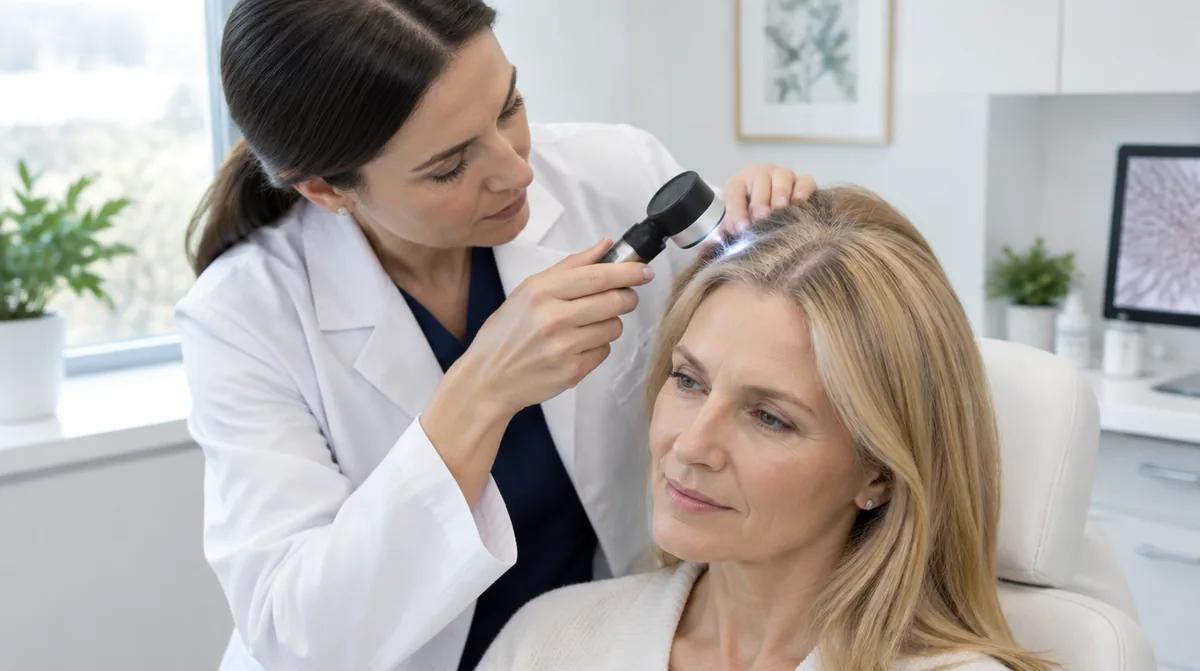
You cannot diagnose your own hair loss from the shower drain, and even a great phone photo has limits. Dermatologists and trained clinicians use several tools. Trichoscopy is a magnified, lit view of the scalp using a handheld device that reveals follicle openings, hair shaft variation, and signs of inflammation or scarring. Pull testing involves gentle traction on small groups of hairs to see how many release, which helps distinguish active shedding. Trichometric measurements assess hair density and diameter, and the presence of miniaturization. Reviews of telogen effluvium also describe hair wash tests, trichograms, phototrichograms, and, when the diagnosis is uncertain, scalp biopsy.[7][1]
Most women do not need a biopsy, and I do not want you to picture something dramatic. But it helps to know that the tools exist and to understand why a clinician may look at your scalp with a magnifier rather than just your hair. A specialist looking at the scalp is looking for things you cannot see: whether the follicle openings are preserved, whether hairs vary in thickness, whether there is redness or scale, and whether there is any sign of scarring.
What You Can Do This Week to Gather Useful Information
Before you see anyone, you can quietly collect the kind of information that makes an evaluation much more productive. Here is a practical set of steps.
- 1.Take a set of baseline photos in the same lighting: the part line from directly above, the crown from a mirror, both temples, and your ponytail or a standard hair tie wrap. Use the same spot near a window in the morning and repeat monthly. Photos beat memory every time.
- 2.Write a timeline going back at least twelve months: illnesses (including COVID or influenza), fevers, surgeries, dental work, new medications, new supplements, changes in birth control, pregnancies or losses, major stressors, big weight changes, and changes in diet, especially any period of eating much less.
- 3.Note your menstrual pattern: how heavy your periods are, how many days, and any change in cycle length. Heavy periods matter enormously for iron.
- 4.Keep a rough count of shed hairs for one week, always at the same time of day, such as when you brush before bed. The number is less important than the trend.
- 5.Do not change your shampooing routine dramatically. Rushton's review of nutritional factors in hair loss makes the point that many people reduce shampooing because they fear losing more hair, which simply increases the amount seen in subsequent washes and fuels the fear.[8] Hairs that have already reached the end of the cycle will come out whenever you wash or brush, so washing does not cause the loss.
- 6.List every product on your scalp, including dry shampoo, styling products, and any supplements. Note in particular anything containing biotin, because it interferes with some lab tests, which we will come to.
Bring this information to your first visit, whether it is with a dermatologist, your primary care clinician, or our practice. A woman who arrives with a timeline, photographs, and a medication list can often save one or two appointments and get to the right tests months sooner.
The Six Patterns Behind Hair Loss in Women 35 to 55
When a woman in this age range comes to me with hair loss, I am mentally sorting her story into six buckets. They are not mutually exclusive, and she is very likely to sit in more than one. But naming them gives you a map, and a map is what most women are missing.
| Pattern | What it looks like | Core mechanism | Usually reversible? |
|---|---|---|---|
| 1. Acute telogen effluvium | Sudden diffuse shedding, 2 to 4 months after a trigger | Follicles pushed early into the resting phase | Yes, if the trigger is removed |
| 2. Chronic telogen effluvium | Fluctuating diffuse shedding for more than about 6 months | Ongoing or repeated triggers, or no trigger found | Often, once drivers are found |
| 3. Female pattern hair loss | Wider part, thinner crown, preserved hairline | Progressive follicle miniaturization | Treatable and slowable, rarely fully reversed |
| 4. Alopecia areata | Round or oval bald patches, sometimes diffuse loss | Autoimmune attack on the follicle | Variable, often regrows, may relapse |
| 5. Scarring alopecias | Patchy or band-like loss, redness, scale, pain or itch | Inflammation that destroys the follicle | No, so early treatment protects what remains |
| 6. Traction, breakage, and hair-shaft damage | Loss at hairline or part edges, or broken short hairs | Mechanical, chemical, or heat stress | Often, if caught before scarring |
What the Numbers Tell Us About Which Patterns Are Common
In large clinical series, telogen effluvium is one of the most common presentations. One retrospective study of 3,028 patients with telogen effluvium, described by its authors as the largest of its kind, was used to propose a diagnostic algorithm for the laboratory and clinical work-up.[9] Female pattern hair loss, in turn, is the single most common cause of chronic hair loss in women. A 2026 review in the American Journal of Clinical Dermatology states that androgenetic alopecia affects nearly 50 percent of women during their lifetime, yet remains underdiagnosed and undertreated.[1] The European evidence-based guideline puts the figure for women at up to 42 percent.[10] These figures vary by population and method, but the message is consistent: this is very common, and very often unaddressed.
Alopecia areata affects nearly 2 percent of the general population at some point in life.[11] Scarring alopecias are far less common overall, but some subtypes are concentrated in specific groups and age ranges, which is why we discuss them in their own section.
The Overlap Problem
I want to underline the point about overlap, because it is where many well-intentioned women go wrong. A woman with early female pattern hair loss goes through a stressful winter and develops a telogen effluvium on top. She sees a lot of shedding, panics, and assumes the shedding is the whole story. Six months later the shedding calms down, as telogen effluvium does, but her part is still wider than it was two years ago, because the underlying pattern thinning never went away. She concludes that the treatment she tried "did not work" or that "it never really grew back," when in truth two processes were in play and only one had resolved.
Understanding that layering is one of the most valuable things a good clinician offers. It lets you set realistic expectations for each layer: the shedding layer should recover as triggers are removed, while the pattern layer needs its own long-term plan.
For the next two sections, we take the two most common patterns in turn and look at them in detail.
Telogen Effluvium: The Great Delayed Reaction

Telogen effluvium is the medical name for excessive shedding of resting hairs. Reviews describe it as one of the most common causes of alopecia, with triggers that include drugs, physical trauma, and emotional and physiological stress, and it can present as acute or chronic hair fall.[7] It is the pattern that produces the "I can't believe how much is in the drain" experience, and it is the pattern most likely to be fully reversible. The essential feature to remember is the delay between trigger and shedding, roughly two to four months.
The Most Common Triggers
Because the delay hides the cause, it helps to have a checklist. Here are the major categories clinicians look for.
- ●Physical illness and fever. High fevers, influenza, pneumonia, and other significant infections are classic triggers. Postinfectious shedding after COVID-19 has been described in the literature, and clinicians who reviewed the hair findings of COVID-19 reported that the onset and intensity of shedding depended on how severe the illness had been, with complete recovery of hair afterward.[12] If you had a rough illness last spring and are shedding now, this may be the whole story.
- ●Surgery and anesthesia. Major surgery, hospitalization, and significant blood loss can all trigger a shedding episode.
- ●Childbirth and the postpartum period. During pregnancy, more follicles remain in the growth phase for longer because of hormonal changes. After delivery, when hormones fall sharply, those follicles return to the resting phase, typically within three to six months, and shedding follows. One study that compared 116 women at different stages of pregnancy and the postpartum year documented exactly this shift in the ratio of growing to resting hairs.[13] For women in their late 30s, postpartum shedding can also unmask an underlying pattern hair loss.
- ●Rapid weight loss and undereating. Crash diets, very low calorie or very low protein intake, prolonged fasting, bariatric surgery, and more recently rapid weight loss on GLP-1 medications are among the most frequent triggers I see in women in this age group. We give this its own section below.
- ●Iron deficiency and other nutritional shortfalls. Low iron stores are one of the most common and most correctable contributors. We cover this in depth in the nutrient section.
- ●Thyroid disease. Both underactive and overactive thyroid can change the hair cycle. See the thyroid section below.
- ●Medications. A review of drugs and hair loss describes several mechanisms, including anagen arrest, telogen effluvium, and accentuation of androgenetic alopecia by androgens. Its authors also warn that fever, hemorrhage, severe illness, stress, and childbirth must be excluded as confounders before hair loss is blamed on a medication.[14] Drug classes commonly discussed include some blood thinners, retinoids, certain blood pressure medications, some antidepressants and anticonvulsants, high-dose vitamin A, and starting or stopping hormonal contraception. Never stop a prescribed medication on your own because of hair loss. Bring it to the prescriber.
- ●Emotional stress and major life events. Divorce, bereavement, a job loss, and prolonged caregiving strain are all recognized triggers. The mechanism is not simply "stress makes hair fall out" in a vague sense. In mice, chronic stress raises corticosterone, the rodent equivalent of cortisol, which prolongs follicle stem cell quiescence and keeps follicles in an extended resting phase.[15] That is an animal study, and I want to be careful not to overstate what it proves in women, but it is a plausible biological pathway consistent with what clinicians see.
Acute Versus Chronic
By convention, telogen effluvium that resolves within about six months is called acute, and shedding that persists longer than that is called chronic. Chronic telogen effluvium, as Whiting described it, characteristically appears in women in midlife with a fluctuating course, and the shedding waxes and wanes.[6] When shedding will not stop, the useful question is usually one of three: is there a persistent trigger I have not found (such as ongoing iron loss, a silent thyroid problem, or a medication), is there repeated triggering (one stressor after another, so the cycle never settles), or is this actually early pattern hair loss with a shedding component layered on top?
A useful rule of thumb from the literature
Harrison and Sinclair noted that the duration of hair loss at presentation helps predict in which patients further investigation will have the greatest yield.[3] In practice, this means that a woman who has been shedding for two or three months after a clear trigger often needs reassurance and time, while a woman who has been shedding for eight months with no clear trigger deserves a fuller investigation.
What Recovery Looks Like
When the trigger is removed, shedding typically slows over a few months. Regrowth then begins, but hair grows only about a centimeter a month, so visible density takes a long time to return. In practical terms, you may see shedding slow at three to four months after the trigger resolves, tiny short "baby hairs" along the hairline and part around month four to six, and a return of meaningful density over nine to eighteen months. This is why so many women feel like nothing is happening: the biology is genuinely slow.
A pattern I see often is what I call the false ending. A woman tells me her shedding has stopped, but her hair still looks thin. Both statements are true at once. The shedding has ended, but regrowth has not yet caught up. That is normal, and knowing it in advance prevents a lot of unnecessary panic.
Telogen Effluvium Is a Diagnosis of Exclusion for a Reason
It bears repeating that seeing a telogen shedding pattern does not tell you the cause. One large series of 3,028 patients found that, among those who were tested, a substantial share had low vitamin D, a meaningful share had low vitamin B12, about six percent of all patients had iron deficiency anemia, and about five percent had thyroid dysfunction.[9] Those numbers illustrate an important truth: the proportions are modest for any single cause, which is exactly why testing broadly, rather than guessing at one nutrient, is the sensible approach. It also shows that a clean thyroid test or a normal hemoglobin does not close the case.
Shedding that will not stop deserves more than a shrug.
If you have been losing hair for more than a few months and have only had a TSH and a hemoglobin checked, a free 15-minute discovery call is a low-pressure way to talk through your timeline and decide what a more complete evaluation should include.
Book Your Free 15-Minute CallFemale Pattern Hair Loss: The Slow Pattern That Gets Missed
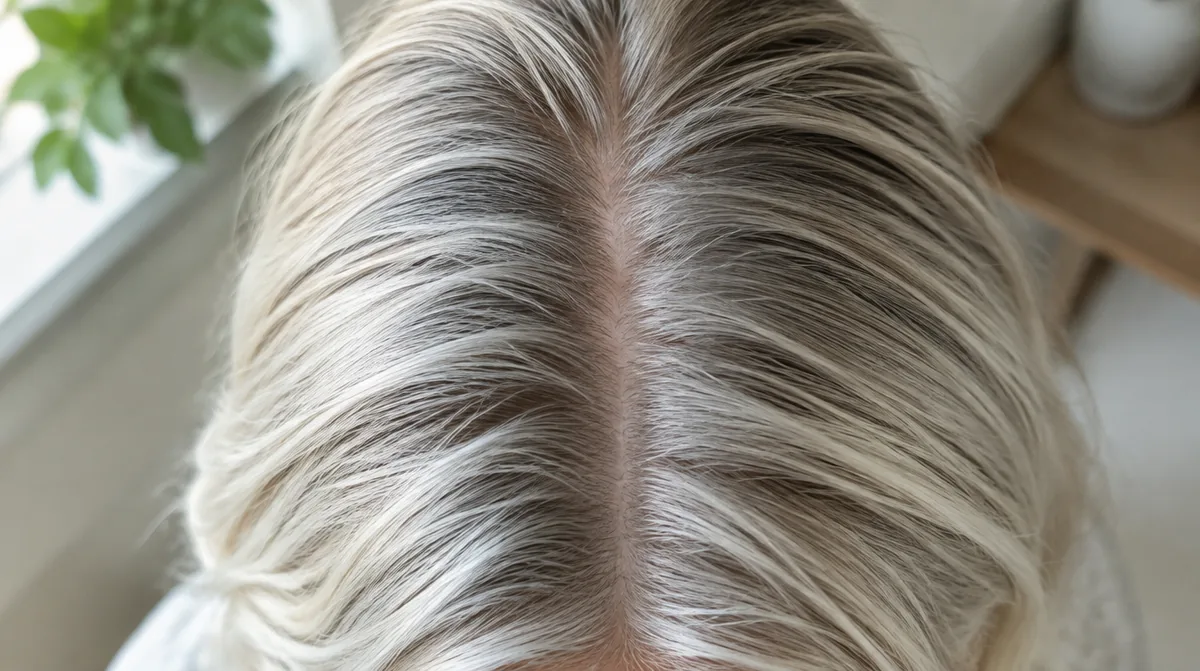
Female pattern hair loss, also called androgenetic alopecia in women, is the most common cause of chronic hair loss in women worldwide, and it is also the one that women most often hear nothing helpful about. It is not baldness in the way people picture male pattern baldness. Women with this condition typically keep their frontal hairline and instead experience a gradual thinning across the top and crown of the scalp, with a widening part.
How Common Is It, Really?
The numbers depend on who was studied and how. In a classic study of 1,006 Caucasian women aged 20 and older, Norwood found female androgenetic alopecia to be quite common starting in the late 20s and reaching its peak after age 50.[16] A study by Birch and colleagues of 377 women attending a general dermatology clinic found that 6 percent of women under 50 had female pattern hair loss, rising to 38 percent in women aged 70 and over.[17] A systematic review of laser therapy put the lifetime figure at about half of women by age 80.[18] The European guideline cites up to 42 percent.[10] And the AAD notes that it typically begins in midlife, in a woman's 40s, 50s, or 60s.[2]
For our audience the take-home is this: if you are 35 to 55 and noticing gradual thinning at the part, you are in the age range where this becomes common, and you are not unusual. It is also worth knowing that the Norwood study was in Caucasian women only, and a 2025 Nature Reviews Disease Primers article on androgenetic alopecia emphasizes that there is substantial ancestral variation in how this condition presents and who is affected.[19] Women of color deserve the same careful evaluation, and as we discuss in the scarring alopecia section, some conditions that mimic pattern loss are much more common in Black women.
What Is Actually Happening in the Follicle
In female pattern hair loss, susceptible follicles undergo progressive miniaturization. Per the 2026 review, androgens promote miniaturization by progressively shortening the anagen phase, while estrogens may provide a protective effect.[1] Each cycle, the follicle produces a slightly shorter, finer hair than the previous one. Over years, thick pigmented terminal hairs are gradually replaced by thin, short, wispy vellus-like hairs, and hair density on the top of the scalp falls.
In men, the story centers on androgen signaling in the follicle, and effective therapies target that pathway. In women, honesty compels me to say the biology is less settled. The 2025 Nature Reviews article states plainly that while in men the condition is hypothesized to be caused by increased androgen signalling within susceptible follicles, the molecular basis of androgenetic alopecia in women remains undetermined.[19] Genome-wide studies have identified more than 380 genomic regions associated with the condition, including genes involved in androgen and WNT pathways.[19] Genetics matters enormously, and so does the hormonal environment, but in an individual woman the exact recipe is not fully understood.
Birch and colleagues added a helpful piece of context that I often share with patients. Hair density in women is distributed as a normal variable, meaning it is a multifactorial trait like height. The average density in their study was about 293 hairs per square centimeter at age 35, falling to about 211 at age 70. Women who were diagnosed with female pattern hair loss generally had a density that fell below the mean but still within the range of normal, and the perception of hair loss depended on low density and also on hair diameter.[17] In plain English: there is no single threshold at which hair "counts" as thin. What matters is how it has changed for you, and how it looks and feels to you.
Why It Gets Missed
There are several reasons this pattern is so often overlooked in women.
- ●It looks normal for a long time. A gradual reduction in density is invisible day to day. Women often notice it only in photographs or in hair salon comments.
- ●Many clinicians simply do not examine the scalp. A standard primary care visit rarely includes trichoscopy or hair density assessment.
- ●It gets blamed on stress or aging. Both can contribute, but "it's just stress" is not a diagnosis.
- ●Blood tests are often normal. Most women with female pattern hair loss have normal routine labs, which leads to the classic "your labs are fine, so this is nothing" dismissal.
- ●Treatments are often off-label and less familiar. Topical minoxidil is the only FDA-approved treatment for female androgenetic alopecia according to the 2026 review, and other options are used off label, so many clinicians are simply not comfortable prescribing them.[1]
The Two Situations Where Blood Work Really Matters
Two clusters of women with pattern-type thinning deserve a more careful hormonal and metabolic look. The first is the woman with signs of excess androgens: acne, facial hair growth, irregular or absent periods, or a history that fits polycystic ovary syndrome (PCOS). PCOS is a common and underdiagnosed driver of pattern hair loss in younger women. If that sounds like you, our full guide to PCOS and weight resistance in your 30s explains the syndrome, its diagnostic criteria, and the insulin connection in detail, and hair thinning is one of the symptoms that women often report least willingly but most wish they had raised earlier.
The second cluster is the woman whose thinning began or accelerated around the time her cycles started to change, her sleep worsened, and her mood or energy shifted. That is the perimenopausal pattern, and it deserves its own section, coming up next. If you are in your late 30s and have not yet considered that perimenopause could be involved, our guide to perimenopause in your 30s is a good companion read.
What the Evidence Says About Early Treatment
A key principle in pattern hair loss is that treatment is generally aimed at slowing or stopping progression and encouraging some regrowth, not at restoring a teenage head of hair, and it works best the earlier it starts. This is why the AAD emphasizes starting at the first sign of loss.[2] It is also why waiting a year for it to "sort itself out" can cost you follicles that are easier to save now than later. We cover the specific treatments, with the evidence for each, in the treatment section.
Midlife Hormones and Your Scalp
If there is one thing I wish every woman knew about her hair at 42, it is that the hair follicle is a hormone-responsive organ, and the hormonal ground beneath it is shifting in your late 30s, 40s, and early 50s. This does not mean that hormones are the only story, and it does not mean hormone therapy is a hair loss treatment. It means hormones are part of the context, and a thorough evaluation cannot ignore them.

What Hormones Do at the Follicle
A 2020 review in the International Journal of Molecular Sciences summarizes what is known. Androgens, including testosterone, dihydrotestosterone (DHT), and their precursors DHEA-S and androstenedione, are the key factors in terminal hair growth; they bind to androgen receptors in the dermal papilla cells of the follicle, and most follicles require the enzyme 5-alpha reductase to convert testosterone into DHT. Estradiol can significantly alter the hair follicle growth and cycle by binding to estrogen receptors and influencing aromatase activity, the enzyme that converts androgen into estrogen. Progesterone, at the level of the follicle, decreases the conversion of testosterone into DHT. Prolactin has also been intensively studied, and its receptors have been detected in scalp skin.[20]
That last set of details deserves a moment. It means that estrogen and progesterone, the two hormones that decline and fluctuate in perimenopause, are both plausibly protective at the scalp, one by influencing the growth cycle and the other by blunting the conversion of testosterone into its more potent form. As those buffers fall, the androgen signal to susceptible follicles can become relatively stronger, even when your absolute testosterone level has not risen. I want to be careful here: this is a reasonable mechanistic picture, not a proven account of what happens in every woman. But it fits the clinical experience of many midlife women, and it fits the observation in the 2026 review that estrogens may provide protective effects against follicular miniaturization.[1]
What Studies of Menopause and Hair Have Found
Dermatologist Paradi Mirmirani reviewed this question in a paper with the memorable title "Hormonal changes in menopause: do they contribute to a 'midlife hair crisis' in women?" Her review notes that, in a study of pre- and postmenopausal women without alopecia, menopausal status significantly influenced hair parameters, specifically the hair growth rate, the percentage of follicles in anagen, and hair diameter distributions, most notably in the frontal scalp. Hair density decreased with age but was not correlated with menopausal status, and the impact of the changing hair parameters appeared to be most notable in the mid-forties.[21]
I find that pairing valuable. It tells us the menopausal transition can change the quality of the hair fiber, its growth speed, and its thickness, without necessarily changing the sheer number of follicles, and it tells us that the mid-forties may be an especially vulnerable window. That matches what many women describe: hair that is not just less abundant but also finer, drier, slower to grow, and less willing to hold a style.
The Perimenopausal Picture
Perimenopause is not a smooth decline. Progesterone tends to fall first as ovulation becomes irregular, estrogen swings unpredictably between high and low, and eventually settles at a lower baseline after the final period. During this stage women may also be dealing with disrupted sleep, higher stress reactivity, changes in insulin sensitivity, and shifts in iron status due to heavy or erratic bleeding. Each of those, independently, can push follicles toward shedding. This is why hair thinning is so common in the years around the transition, and why a pure "hormone panel" is never enough by itself.
If your hair changes appeared alongside sleep disruption, night waking, or new anxiety, our guide on the hormonal reasons behind sleepless nights and new anxiety explains the cortisol and progesterone mechanics behind that cluster, and the same physiology is frequently working on your follicles. If the first thing you noticed was memory or concentration changes, our perimenopause brain fog guide covers the same transition from the cognitive side.
Which Hormone Tests Are Worth Doing, and Which Are Not
Hormone testing for hair loss is a place where more is not better. In perimenopause, estradiol and FSH swing from day to day and even hour to hour, so a single random value is a poor guide, and the diagnosis of perimenopause is largely clinical, based on age, symptoms, and cycle pattern. What testing is most useful depends on your story.
- ●If you have irregular cycles, acne, or excess facial or body hair: total and free testosterone, DHEA-S, SHBG (sex hormone binding globulin), and often thyroid function, prolactin, and a 17-hydroxyprogesterone screen to look for PCOS and related conditions. Fasting insulin and glucose belong on this list too.
- ●If cycles are regular and hair has thinned gradually: a broader metabolic and nutrient screen usually yields more than a large hormone panel.
- ●If you are on hormonal birth control or hormone therapy: the type and dose of the progestogen matters, and this should shape both the testing and the interpretation.
A caution I want to state clearly: an androgen level that falls "within the normal range" does not rule out a role for androgens in your hair. Susceptibility of the follicle, not just the circulating level, drives pattern loss, which is part of why the condition can occur with completely normal blood tests.
Hormone Therapy and Hair: An Honest Answer
Women often ask whether starting hormone therapy will fix their hair. The honest answer is that hormone therapy is not an approved or established treatment for hair loss, and the research on its hair effects is limited and inconsistent. A dermatology review of hormonal therapies focused on hair concludes that the task of predicting effects is complicated by the paucity of data and discrepancy in the literature on the effect of specific hormone-receptor activities.[22] The details matter: different progestogens have different androgenic or antiandrogenic properties, so a regimen that helps one woman's scalp could be neutral or unhelpful for another's.
The North American Menopause Society's 2022 position statement, which is the most recent comprehensive guidance from that organization, identifies hormone therapy as the most effective treatment for vasomotor symptoms and the genitourinary syndrome of menopause and notes it prevents bone loss and fracture. Hair is not on that list, and the statement emphasizes individualizing therapy by type, dose, duration, route, timing of initiation, and the use of a progestogen.[23] For a fuller and more balanced discussion of the benefits, risks, and delivery methods, see our complete guide to bioidentical hormone therapy. If you start hormone therapy for another reason and notice your hair improves, that is a welcome bonus. It should not be the reason to start.
There is one more caution I raise with every patient considering androgen-containing therapy, including testosterone: a review of drug-related hair loss notes that some medications can cause "accentuation of androgenetic alopecia by androgens."[14] In a woman who is genetically susceptible to pattern hair loss, more androgen signal can make thinning worse. This is a key reason to have a baseline of your hair pattern documented before starting any hormone regimen, and to review it at follow-up.
Birth Control, Starting and Stopping
Hormonal contraception is a frequent, underappreciated player. Starting, stopping, or switching a pill, patch, ring, or IUD can trigger a telogen effluvium in the following months, because the hormonal environment changes. Women who stop the pill in their late 30s to try to conceive, or because of side effects, sometimes experience a shedding episode three to four months later that they never connect to the change. Some progestins are more androgenic than others, and some are antiandrogenic and are even used for pattern hair loss, as we discuss under treatments. This is a discussion to have with your prescriber, not a reason to stop anything abruptly.
Your hair and your hormones are telling the same story.
If your thinning arrived alongside cycle changes, night waking, or new anxiety, a free discovery call is a good place to talk through whether perimenopause, iron, thyroid, or insulin is the most likely driver.
Talk It Through With KatiePerimenopause, Menopause, and Beyond: How Hair Changes by Stage

The women who read this article range from 35 to 55 and beyond, and their hair is answering different questions at different stages. It helps to know which stage you are in, because the likely contributors, the tests worth doing, and the realistic goals all shift.
Early and Mid Perimenopause (Roughly Late 30s to Mid 40s)
This is the stage of fluctuation. Cycles may still be fairly regular, or may begin to shorten, lengthen, or skip. Progesterone tends to fall first, and estrogen swings between high and low. Hair changes at this stage are more often shedding-type, tied to sleep disruption, stress reactivity, changes in iron status from heavier or more erratic bleeding, and metabolic shifts. A review of the menopausal transition and hair found the influence of changing hormones on hair growth rate, the proportion of growing follicles, and hair diameter to be most notable in the mid-forties.[21] This is also the stage in which underlying genetic tendencies toward pattern thinning often start to show. The most productive work is usually a broad evaluation and correcting what can be corrected.
Late Perimenopause and the Final Menstrual Period (Roughly Mid 40s to Early 50s)
As cycles space out and estrogen trends lower, the balance between androgens and estrogens at the follicle can shift further. The 2026 review notes that androgens promote follicular miniaturization while estrogens may have a protective effect,[1] which helps explain why part widening and crown thinning become more noticeable for many women in this window. Hot flashes, night sweats, and sleep disruption are common, and their effect on stress physiology contributes indirectly. Women at this stage are the most likely to benefit from a coordinated look at hormones, iron, thyroid, and metabolic health, and to discuss early evidence-based pattern hair loss treatment.
Postmenopause (After 12 Months Without a Period)
After the final period, estrogen settles at a lower and more stable baseline. Hair often becomes finer, drier, and slower growing, and density continues to decline with age, as the Birch study showed across decades.[17] Pattern hair loss is common and, per the 2025 Nature Reviews article, frontal, mid-scalp, and crown follicles in postmenopausal women are susceptible to androgenetic alopecia.[19] Norwood found female androgenetic alopecia reaches its peak after age 50.[16] This is also the stage at which frontal fibrosing alopecia, a scarring condition, is most often seen, with a mean age of 61 in a large multicenter series.[24] A receding hairline with eyebrow thinning is a reason to see a dermatologist, not a reason to add another supplement.
Iron deserves a special note in this stage. Menstrual blood loss has ended, so newly low iron stores in a postmenopausal woman are unusual, and as discussed earlier, the standard advice is to look for a source of blood loss, especially gastrointestinal, before assuming diet is the explanation.[25]
Surgical or Early Menopause
Women who go through menopause abruptly, after removal of the ovaries, or early, before age 45, experience an abrupt or premature loss of estrogen. Many describe faster hair changes than their peers. The evidence specific to hair in this group is limited, so I rely on the same principles: evaluate for coexisting iron, thyroid, and metabolic contributors, discuss the broader health implications of early estrogen loss with a menopause-informed clinician, and treat pattern hair loss on its own merits. Hormone therapy in this group is often recommended for reasons beyond hair, and the North American Menopause Society position statement discusses those considerations.[23]
A Stage-by-Stage Summary
| Stage | Common hair pattern | Worth checking | Realistic goal |
|---|---|---|---|
| Early to mid perimenopause | Diffuse shedding episodes; earliest widening of the part | Ferritin, thyroid, vitamin D, insulin, sleep, cycle changes | Remove drivers of shedding; document baseline |
| Late perimenopause | Part widening, finer texture, crown thinning | The above plus hormone context; scalp exam if any red flags | Stabilize thinning; start evidence-based treatment early |
| Postmenopause | Progressive pattern thinning; drier, finer hair; higher risk of frontal fibrosing alopecia | Scalp exam; iron with cause if low; thyroid; vitamin D; metabolic health | Slow progression; protect density; rule out scarring |
| Surgical or early menopause | Often faster changes | Full nutrient and thyroid screen; bone and cardiovascular counseling | Address contributors and pattern loss in parallel |
Pregnancy, Postpartum, Loss, and Fertility Treatment

For women in their late 30s and early 40s, reproductive events are among the most common and most overlooked hair loss triggers. If you have had a baby, a pregnancy loss, a course of fertility treatment, or a change in breastfeeding in the last year, the timeline of your hair may be sitting right in your reproductive history.
Postpartum Shedding: Normal, Until It Is Not
During pregnancy, higher estrogen levels keep more follicles in the growth phase for longer. After delivery, when hormones fall sharply, those follicles return to the resting phase and the extra hair is shed. A study comparing women at different stages of pregnancy and the postpartum year found that follicles return to the resting phase within about three to six months after delivery, and that women who were breastfeeding at four months postpartum had a higher proportion of growing hairs than those who were not.[13] The practical message: postpartum shedding tends to begin around month three, peak around months four to five, and settle over the following months. For most women it is over, or clearly improving, by about a year.
That is why I take it seriously when a woman tells me she is well past that point and still shedding heavily. In that case something else is usually going on. The most common contributors I look for are:
- ●Depleted iron stores from pregnancy, delivery blood loss, heavy postpartum or returning periods, and breastfeeding, particularly after two pregnancies close together.
- ●Thyroid changes. Postpartum thyroiditis is a recognized condition in which the thyroid becomes overactive and then underactive in the months after delivery. It can be subtle and is easy to attribute to new-parent exhaustion.
- ●Low vitamin D and B12, particularly with a winter delivery in Michigan or Wisconsin.
- ●Sleep deprivation and sustained stress, which are constant with a young child.
- ●An unmasked pattern hair loss or underlying PCOS, since the hormonal swings of pregnancy can bring forward a tendency that was already there.
- ●Inadequate nutrition, because many mothers eat on the run, skip meals, or diet aggressively to lose the weight.
If you are a mother in your 30s who has been told for a year that "it's just postpartum," I want you to hear that it is reasonable to ask for iron studies, thyroid tests, and a look at the whole picture. You do not need to wait until your child's second birthday to ask.
Pregnancy Loss and Fertility Treatment
A pregnancy loss involves a sudden hormonal shift, an emotional shock, and sometimes blood loss or a procedure, all of which are recognized triggers for telogen effluvium. It is a subject women rarely raise unprompted, partly because the grief is the main event and the hair seems trivial by comparison. It is not trivial to you if it is one more thing going wrong. I tell women in this situation that hair shedding three to four months after a loss is a well-understood physiological reaction and not a sign that something else is wrong with their bodies or a judgment on them.
Fertility treatment can also affect hair. Medications that manipulate hormones, and the stress and sleep disruption of a treatment cycle, can trigger shedding. Some women stop hormonal birth control to try to conceive, and the resulting hormonal change can trigger a shedding episode several months later. If you are actively trying to conceive or are pregnant, please tell any clinician prescribing hair loss treatment. Several of the treatments discussed in this guide, including oral minoxidil, spironolactone, and finasteride, are not appropriate during pregnancy or when pregnancy is possible without effective contraception, and topical minoxidil should be avoided in pregnancy and breastfeeding.
Breastfeeding and Hair
Breastfeeding delays the return of estrogen fluctuation in some women and can prolong the hormonal environment that influences hair. In the same postpartum study, hair-cycle ratios differed between breastfeeding and non-breastfeeding mothers at four months.[13] Breastfeeding also draws on iron, zinc, B12, and calories, which is why nutritional adequacy matters even more. Do not stop breastfeeding to protect your hair unless you are otherwise ready to. Do get your iron and thyroid checked.
When Your Cycle Returns and Your Hair Changes Again
Women often see a second wave of shedding when their periods return or after weaning, as hormones shift again. This second wave is usually milder than the first. It is also a common point at which underlying PCOS or early perimenopause becomes visible. Our guides to PCOS in your 30s and perimenopause in your 30s are helpful reading for that moment, since the symptom lists overlap heavily and the right tests differ.
Ferritin, Iron, and the Nutrient Question
If you have read anything about hair loss, you have read about ferritin. It is the most discussed lab in the hair conversation, and it is also one of the most misunderstood. So let us go slowly and honestly.
What Ferritin Is
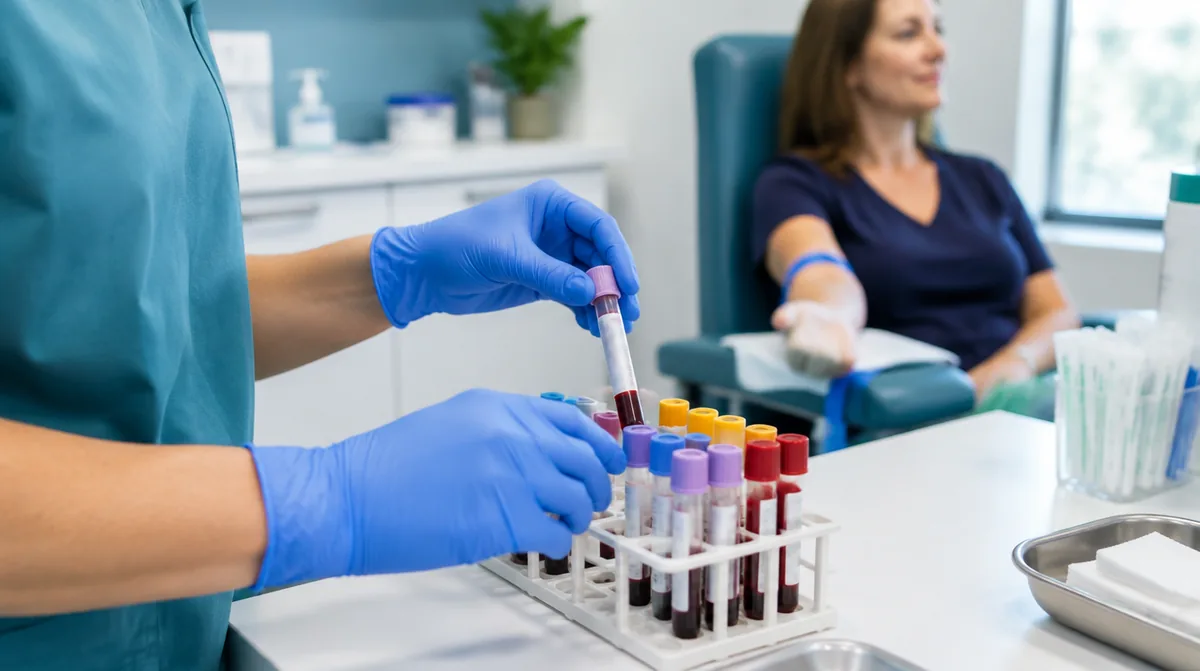
Ferritin is the protein that stores iron inside your cells. A ferritin level in your blood reflects how much iron you have in reserve, like a savings account, while hemoglobin reflects the iron currently in circulation, like a checking account. You can have a normal hemoglobin and a nearly empty savings account for years. Trost and colleagues, in their review from the Cleveland Clinic, explain that hemoglobin can be used to screen for iron deficiency while serum ferritin can be used to confirm it, and they also point out an important complication: ferritin can rise with infection, inflammation, and some other conditions, which can make a low-normal ferritin look better than it really is.[25] This is one reason many clinicians order an inflammatory marker such as hs-CRP alongside it.
How Common Is Iron Deficiency in Women Like You?
Very. In premenopausal women, the most common causes of iron deficiency anemia are menstrual blood loss and pregnancy, as Trost and colleagues note.[25] A CDC analysis of national survey data from 1999 to 2000 found that iron deficiency affected about 9 to 16 percent of adolescent and adult females aged 12 to 49, and was roughly two times higher among non-Hispanic Black and Mexican-American females (19 to 22 percent) than among non-Hispanic white females.[26] Those data are a quarter century old, so I would not treat the percentages as current, but they establish that this is a common and unevenly distributed problem, and that many women who look healthy on paper are running low.
Does Low Ferritin Cause Hair Loss? What the Research Really Shows
This is where I want to earn your trust by not oversimplifying. The evidence is genuinely mixed, and the best clinicians hold two ideas at once.
- ●The association is real. In a study of 80 women aged 18 to 45 with chronic telogen effluvium or female pattern hair loss and 40 matched controls, mean serum ferritin was 14.7 in the telogen effluvium group and 23.9 micrograms per liter in the pattern loss group, compared with 43.5 in controls, and the levels fell further as severity increased.[27] Kantor and colleagues found that mean ferritin was significantly lower in women with androgenetic alopecia (37.3 nanograms per milliliter) and alopecia areata (24.9) than in women without hair loss (59.5), although the telogen effluvium group in that smaller study did not differ significantly.[28] A 2026 meta-analysis of studies of telogen effluvium found significantly lower ferritin levels in cases than in controls.[29]
- ●But proof of benefit from treating it is incomplete. Trost and colleagues concluded that there was insufficient evidence to recommend universal screening for iron deficiency in patients with hair loss, and insufficient evidence to recommend iron supplementation in patients with hair loss and iron deficiency in the absence of anemia; the decision, they wrote, should be based on clinical judgment.[25]
Both statements are true. Rushton, in a widely cited review of nutritional factors in hair loss, recommended a serum ferritin of 70 micrograms per liter as a target in people with increased shedding when the erythrocyte sedimentation rate is normal.[8] Other researchers have proposed cut-offs closer to 30. The reality is that no one has definitively established the ideal ferritin for hair, and I distrust anyone who claims to know a precise magic number. What I do find persuasive, clinically, is this: a ferritin of 12 or 15, which many laboratories still label as within the reference range, is very hard to defend as adequate for a woman who is shedding, and a ferritin in the 20s deserves a closer look at why it is that low.
The Most Important Rule About Iron: Find the Reason
I want to be emphatic about this because it is a safety point. Low ferritin is a finding, not a diagnosis. Before treating it, the cause must be identified. Trost and colleagues state that if the patient is a man or postmenopausal woman, or has risk factors for blood loss, the patient should be evaluated for sources of blood loss, especially gastrointestinal, because iron deficiency in that group can signal serious conditions including colon cancer.[25] For the premenopausal woman, the usual suspects include:
- ●Heavy or prolonged menstrual bleeding, including fibroids and adenomyosis
- ●Low dietary iron intake, particularly in vegetarians, vegans, and women who have been dieting for years
- ●Malabsorption, such as celiac disease, chronic gut inflammation, or long-term use of acid-suppressing medications
- ●Frequent blood donation
- ●Recent pregnancy, delivery, or breastfeeding
- ●Rapid growth in athletes, particularly endurance runners
For a woman who is postmenopausal or well into the transition and finds low iron for the first time, the conversation is different and the medical work-up must be more thorough. Never simply start high-dose iron on your own. It can cause constipation and stomach upset, it is dangerous in people with hemochromatosis, and it will mask a bleeding source that needs to be found.
How Iron Is Typically Repleted
Once the cause is understood, replenishment usually involves a combination of dietary iron and an oral iron supplement chosen and dosed by a clinician, with recheck labs after a few months. In practice: separate iron from coffee, tea, calcium, and thyroid medication (levothyroxine should typically be taken apart from iron by several hours); pair it with vitamin C; and expect that it takes many months, not weeks, to rebuild stores. Some women with malabsorption or intolerance require intravenous iron, which is a physician-supervised treatment. Hair responds slowly and late; it is common to see energy improve before shedding does.
Vitamin D: The Michigan and Wisconsin Angle
In the study by Rasheed and colleagues, serum vitamin D levels in women with telogen effluvium and pattern loss were dramatically lower than in controls, and the levels fell as severity increased.[27] The 2026 meta-analysis found significantly lower vitamin D in telogen effluvium cases.[29] In the 3,028-patient series, vitamin D deficiency or insufficiency was the single most frequent abnormality among those tested (72.2 percent).[9] Again, association is not proof of cause, but vitamin D plays roles in the hair follicle cycle, and it is inexpensive to test and easy to correct.
For women living in Michigan and Wisconsin, latitude matters. A classic study by Webb, Kline, and Holick showed that in Boston (42.2 degrees north) sunlight from November through February produced no previtamin D3 in skin, and in Edmonton (52 degrees north) this ineffective winter extended from October through March.[30] Michigan and Wisconsin sit between roughly 42 and 48 degrees north, at or above Boston. In practical terms, from late autumn to early spring, the sun in the Great Lakes region is not going to give you meaningful vitamin D no matter how many walks you take. The Endocrine Society guideline suggests measuring 25-hydroxyvitamin D as the initial test in people at risk for deficiency and treating deficiency with vitamin D2 or D3.[31] The Society defines deficiency as a level below 20 nanograms per milliliter. Many functional medicine clinicians aim higher, and I do too for most patients, but I will be candid that there is no trial-derived, hair-specific ideal level.
We discuss the same winter pattern, and how it interacts with thyroid function, in our thyroid guide for Michigan and Wisconsin women, and with weight and energy in our Michigan guide and Wisconsin guide.
Vitamin B12, Folate, and Zinc
In the large telogen effluvium series, roughly 31 percent of those tested had low vitamin B12, about 4 percent low folate, and about 2 percent low zinc.[9] B12 deficiency is more common in vegetarians and vegans, in women taking metformin or long-term acid suppressors, and in people with gut conditions. It is worth checking, and correcting if low, because it matters for far more than hair. Zinc is the supplement most women reach for first and the one where the evidence is weakest: Rushton's review found no evidence to support the popular view that low serum zinc concentrations cause hair loss.[8] Zinc deficiency exists, but it is uncommon in the general population, and excessive zinc can interfere with copper. If a test shows a low level, treat it. If not, skip it.
Protein: The Overlooked Building Block
Hair is made of protein, primarily keratin. What we know about nutrition and hair comes mostly from studies of protein-energy malnutrition, starvation, and eating disorders, as Rushton notes, and in otherwise healthy people nutritional factors seem to matter in those with persistent increased shedding.[8] In practice I see two groups at risk. The first is women who have been undereating for years, often in the name of weight loss, and whose protein intake is quietly low. The second is women on rapid weight loss regimens, including GLP-1 medications, where appetite is suppressed and protein falls short. If that describes you, please read the GLP-1 section that follows and our detailed article on why Ozempic stops working and how to protect muscle, which includes protein targets.
The Bigger Picture on Micronutrients
A 2019 review of the role of vitamins and minerals in hair loss concluded that micronutrients such as vitamins and minerals play an important but not entirely clear role in normal hair follicle development and immune function, that deficiency may represent a modifiable risk factor, and that large double-blind, placebo-controlled trials are still required to determine whether supplementation actually improves hair growth in people with both deficiency and non-scarring alopecia.[4] That is a fair summary of the field. The practical translation: measure, do not guess; correct real deficiencies; and be skeptical of mega-dose supplementation in the absence of one. We return to what can go wrong with supplements in a later section.
Eating for Your Follicles: A Practical Plan

Nutrition advice about hair is easy to overcomplicate. There is no single "hair food," and no meal plan has been proven to regrow pattern hair loss. But the follicle is a demanding tissue, and the research consistently points to protein sufficiency, iron adequacy, and avoidance of prolonged restriction as the foundations. What follows is the practical translation I offer, rooted in ordinary food available to any household in Michigan or Wisconsin.
Start With Protein at Every Meal
Hair is built from protein, and reviews of nutrition and hair loss note that the best-established connections involve protein-energy malnutrition and restrictive eating.[8] Many women in their 40s eat a light breakfast (coffee and a piece of fruit), a moderate lunch, and a large dinner, which concentrates protein in one meal. A commonly used practical target is roughly 25 to 30 grams of protein at each of three meals, adjusted for your body size, kidney health, and clinician guidance. It is more effective to spread protein across the day than to load it at night. If you are on a GLP-1 medication, your target is likely higher, and the details are in our GLP-1 muscle preservation article.
Familiar sources of protein in our region include eggs, Greek yogurt, cottage cheese, and other dairy (Wisconsin has this covered), chicken, turkey, lean beef and venison, Great Lakes fish such as whitefish, walleye, and perch, wild-caught salmon, lentils, beans, tofu and tempeh, and nuts and seeds. A simple breakfast of eggs with vegetables and a piece of toast, or Greek yogurt with berries and pumpkin seeds, does more for your follicles than another cup of coffee.
Iron: Food First, Then Ask About Supplements
Iron in food comes in two forms. Heme iron, found in red meat, poultry, and fish, is well absorbed. Non-heme iron, found in lentils, beans, spinach, fortified cereals, and seeds, is less well absorbed, but absorption improves when eaten with vitamin C. Coffee, tea, and calcium taken at the same meal reduce absorption. Practical adjustments include:
- ●Eat your iron-rich meals with something rich in vitamin C, such as bell peppers, citrus, strawberries, or Michigan cherries and blueberries.
- ●Separate coffee and tea from your main iron sources by an hour or two, and avoid taking a calcium supplement with them.
- ●If you eat little or no meat, plan iron intentionally and have your ferritin checked. Vegetarians and vegans are at higher risk of low stores.
- ●Cooking in cast iron can add a little iron to foods, particularly acidic ones.
- ●Do not supplement iron without knowing your level, as discussed earlier.
Do Not Under-Eat
One of the most common patterns I see is chronic under-eating in the name of weight management, combined with skipped meals, long gaps, and low protein. The follicle reads this as scarcity. If you are trying to lose weight, the goal is to lose it at a moderate pace, with high protein and adequate calories, and with strength training, not to lose it as fast as possible. Very low calorie diets are a well-recognized telogen effluvium trigger. Reviews of nutritional factors note that the best-established links come from starvation, protein-energy malnutrition, and eating disorders.[8]
Healthy Fats, Colorful Plants, and Blood Sugar Stability
Healthy fats, such as those found in salmon, olive oil, walnuts, flax, and avocado, support cell membranes and the skin barrier. A varied intake of vegetables and fruit provides the vitamins and minerals involved in follicle cell turnover. And meals built around protein, fiber, and healthy fat, and less around refined carbohydrates alone, tend to produce steadier blood sugar, which is relevant if insulin resistance is part of your picture. This is the same approach I describe in our guide to hormones and weight resistance over 40.
A Sample Day
| Meal | Example | What it does for you |
|---|---|---|
| Breakfast | Two or three eggs with sauteed spinach and peppers, plus berries | Protein, iron, vitamin C, and a start to the day that is not just coffee |
| Lunch | Lentil and roasted vegetable bowl with feta and pumpkin seeds, or a chicken salad | Non-heme iron, fiber, zinc, and protein |
| Snack | Greek yogurt or cottage cheese with cherries, or a handful of nuts | Protein and a bridge to dinner |
| Dinner | Baked whitefish or salmon, a starchy vegetable, and greens; or grass-fed beef with roasted vegetables | Omega-3 fats, heme iron, and B12 |
This is an illustration, not a prescription. If you have kidney disease, are pregnant or breastfeeding, have food allergies, or have a history of disordered eating, please work with a clinician or registered dietitian to personalize it.
Thyroid, Insulin, and the Stress Question

Three metabolic systems come up in almost every evaluation I do for a woman in this age range with hair loss: thyroid function, insulin and blood sugar regulation, and the stress response. Each of them can influence the hair cycle, each is testable or at least assessable, and each is commonly under-evaluated in a standard visit.
Thyroid: Why "Normal" Does Not Always Mean Fine
The link between thyroid status and hair is old, well recognized, and biologically grounded. In a mouse study, animals lacking the main thyroid hormone receptors showed impaired hair cycling with decreased follicular cell proliferation, and hypothyroid mice showed the same, which the authors took as evidence that the hormone-bound receptors play an important role in hair growth.[32] That is animal research, so I do not want to stretch it, but it matches what clinicians see: in hypothyroid patients, the skin is affected and hair loss is common.
What women with an underactive thyroid describe is diffuse thinning across the scalp, hair that feels dry, coarse, and brittle, slow regrowth, and sometimes thinning of the outer third of the eyebrows. Overactive thyroid can also cause diffuse shedding and fine, soft hair. And thyroid medication that is out of balance in either direction can contribute. In the 3,028-patient telogen effluvium series, about 4.6 percent of patients had thyroid dysfunction, a modest but real fraction, and a reason thyroid testing belongs in the work-up of any persistent shedding.[9]
The problem is not that thyroid testing is skipped. It is that it is often too narrow. A TSH by itself can miss early autoimmune thyroid disease and problems of T4 to T3 conversion. A more complete picture includes Free T4, Free T3, and thyroid peroxidase antibodies, which can identify Hashimoto's thyroiditis years before TSH moves out of range. If you would like to understand this in depth, including why a TSH in the upper part of the reference range can coexist with real symptoms, our full guide to normal TSH and hypothyroid symptoms for Michigan and Wisconsin women covers the mechanics, the six thyroid patterns, and the recommended panel. Hair thinning and thyroid antibodies also travel together in alopecia areata, which we come back to below.
One practical caution: if you are already taking thyroid hormone, do not adjust your dose because of hair loss. Bring your labs and timeline to the prescriber and let them interpret the trend. Also take iron, calcium, and magnesium supplements several hours apart from levothyroxine, since they can reduce its absorption.
Insulin and Blood Sugar: The Quiet Contributor
Insulin resistance is a metabolic state in which cells respond poorly to insulin, and the pancreas compensates by making more of it. It is extremely common in midlife, especially around the menopausal transition, and it is often invisible on standard labs because fasting glucose and even hemoglobin A1c can stay normal for years while fasting insulin is elevated.
The strongest hair connection is through PCOS, where insulin resistance and elevated androgens reinforce each other. A 2026 review in Endocrine Connections describes androgenetic alopecia in PCOS as a prominent marker of systemic dysregulation, extending beyond simple hyperandrogenism, and proposes that insulin resistance and chronic low-grade inflammation converge with genetic susceptibility at the follicle. The authors are open that the complete pathophysiology remains incompletely understood.[33] That fits how I see it clinically: insulin resistance is more a contributing amplifier than a sole cause of pattern hair loss, and hair may be one of its more visible early signals.
There is a related signal in scarring hair loss. In a survey of 326 African American women, type 2 diabetes was significantly more common in women with central centrifugal cicatricial alopecia (CCCA), and the authors noted this is in line with a theory that scarring alopecias may reflect metabolic dysregulation.[34] Again, that is an association from a single cross-sectional survey, not proof of cause. But it reinforces why I check glucose regulation in women with hair loss, especially when other clues are present: central abdominal weight gain, skin tags, dark velvety patches at the neck or armpits, strong cravings, energy crashes after meals, or a family history of type 2 diabetes.
Fasting insulin, fasting glucose, and hemoglobin A1c together are far more informative than any one alone. Our foundational article on hormones and weight resistance over 40 walks through insulin resistance in detail, and it is often the same underlying issue that is quietly driving both the scale and the scalp.
The Stress Response: Real, but Often Overstated
Stress is the most cited and least examined explanation for hair loss. It is a real trigger, as we have seen, both from clinical observation of telogen effluvium after major life events and from mouse research showing that stress-level corticosterone can hold follicles in an extended resting phase.[15] But I want to draw a careful line between two things that get blurred online.
One is stress as a clear trigger event: a bereavement, a divorce, a period of severe illness, a year of caregiving. That is well supported as a cause of telogen effluvium, and if it fits your timeline, it deserves weight. The other is a vague, unfalsifiable claim that your hair loss is due to "cortisol" or "adrenal fatigue" without any testing or reasoning. That line of thinking is common in wellness circles, and it can distract from treatable causes. Chronic stress physiology is real and worth assessing, particularly in women whose sleep is broken, whose blood sugar swings, and whose mood or anxiety has changed. But it is one layer, and it should be evaluated alongside the others, not in place of them.
If sleep disruption and a wired-but-tired feeling ring true for you, our article on hormonal sleep and anxiety in women explains the overnight cortisol rhythm, the role of progesterone, and what a comprehensive assessment looks like. Improving sleep and nervous system regulation supports hair indirectly by removing a persistent physiological stressor.
How these three systems fit together
Low iron stores, a sluggish thyroid, insulin resistance, and a stressed nervous system are not four separate problems. They interact. Iron deficiency worsens fatigue and can impair thyroid hormone metabolism; thyroid dysfunction changes how you handle blood sugar and cholesterol; insulin resistance and poor sleep feed each other; and all of them raise the cost of every additional stressor on the hair cycle. A root-cause evaluation looks at how they layer for you, not at a checklist of isolated numbers.
Sleep, Movement, and Nervous System Support

I want to be careful here, because "reduce your stress" is the least useful advice in medicine. It is also, when translated into something concrete, one of the more valuable. Let me describe what I actually mean, and be honest about what is and is not proven for hair.
What Is Known and What Is Not
There are few direct trials of sleep or exercise interventions for hair loss in women, and I would be misleading you if I claimed otherwise. What we have is indirect. Stress hormones can hold follicles in an extended resting phase in mice.[15] Sleep and stress physiology affect insulin sensitivity, appetite, and hormone balance, and those in turn are linked with pattern hair loss and PCOS.[33] And telogen effluvium is triggered by physiological stress in humans.[7] The reasoning is plausible, and the interventions carry little risk and large other benefits. That is enough for me to recommend them, while being honest that they are supportive measures and not proven hair treatments.
Sleep: The Foundation
Perimenopausal sleep disruption is common, and it is not simply a matter of habits. Night waking at 3 a.m., night sweats, and early morning anxiety often have hormonal roots that respond to a proper evaluation. If this is your experience, the article on the hormonal reasons behind sleepless nights and new anxiety explains the mechanics and what helps. In the meantime, a consistent wake time, morning light exposure (a real challenge in a Michigan or Wisconsin winter, where a light therapy lamp can help), a cool dark bedroom, limited alcohol, and protein at dinner are reasonable starting points.
Movement: Strength First
Resistance training two to three times a week supports muscle, insulin sensitivity, mood, and bone density, all of which matter through the menopausal transition. Walking daily supports sleep and stress regulation. Extreme endurance training combined with under-eating, on the other hand, can worsen hair shedding by adding to energy deficit and iron loss, particularly in runners with heavy periods. If you are a runner with low ferritin, this is a place to look.
Nervous System Regulation
Slow breathing practices, time outdoors, brief mid-day walks, social connection, and therapy all reduce the load on your stress response. For some women, the best "hair treatment" is fewer tasks. I mean that literally: protecting even one unscheduled hour a day has measurable effects on how people feel. The point is not to eliminate stress, which is impossible in modern life, but to give your body regular signals of safety.
I also encourage women to be gentle with the fact that worrying about your hair is itself a stressor. Once you have a plan, let the plan carry some of the worry.
GLP-1 Medications and Hair Shedding

In my conversations with women over the last few years, no topic in hair loss has grown faster than shedding on GLP-1 medications such as semaglutide (Ozempic, Wegovy) and tirzepatide (Mounjaro, Zepbound). If this is you, I want to give you accurate information, because there is as much anxiety online as there is signal.
What the Drug Labels Themselves Say
Hair loss is not a rumor. It is listed as a common adverse reaction in the prescribing information for both drugs. The current Wegovy label reports that hair loss adverse reactions were associated with weight reduction, and that in a pool of studies, hair loss was reported in 3.3 percent of patients treated with the 2.4 mg dose (4 percent of women and 0.9 percent of men) versus 1 percent of patients on placebo (2 percent of women).[35] The current Zepbound label likewise states that hair loss adverse reactions were associated with weight reduction and that hair loss was reported more frequently in women than men: 7.1 percent of women versus 0.5 percent of men on the drug, compared with 1.3 percent of women on placebo.[36]
Notice the pattern: the label attributes hair loss to weight reduction, and women are affected more often than men. Those two facts are the key to understanding what is going on.
What the Broader Research Shows
Beyond clinical trial adverse event tables, several recent systematic reviews have pooled data from cohorts and drug-safety databases. A 2026 systematic review and meta-analysis of 17 studies covering more than a million patient exposures found a pooled odds ratio of 1.40 for any non-scarring alopecia among GLP-1 users, driven by telogen effluvium (adjusted OR 1.76) and androgenetic alopecia (adjusted OR 1.64) at 12 months, with no significant association for alopecia areata. Drug-safety signals were strongest for semaglutide and tirzepatide, and the authors concluded the association was primarily mediated by weight-loss-induced micronutrient deficiency and advised against premature discontinuation.[37]
A separate 2026 systematic review found that semaglutide and tirzepatide showed the highest incidence of hair loss, that telogen effluvium and androgenetic alopecia were the predominant subtypes, that tirzepatide, which is associated with the greatest weight loss, was most often linked to telogen effluvium, and that women appeared to be disproportionately affected.[38] A 2026 commentary in Dermatology and Therapy adds a note of restraint that I agree with: most of the evidence comes from database analyses and retrospective cohorts, no prospective, controlled studies have evaluated the question specifically, and causality has not been established, although rapid weight loss inducing telogen effluvium is a plausible mechanism.[39]
Why It Happens
The most credible explanation is a combination of the following, and they compound.
- ●Rapid weight loss itself is a physiological stressor. The body interprets a sudden, large energy deficit as a state of scarcity. Follicles are shifted toward the resting phase, and shedding follows a few months later, exactly like the crash diet pattern.
- ●Reduced intake of protein and micronutrients. Appetite suppression means less of everything. Protein, iron, zinc, B12, and other nutrients can fall short without anyone noticing, particularly in women who were already borderline.
- ●Loss of lean mass and shifts in hormone metabolism. Muscle loss and rapid changes in body fat can alter hormone balance.
- ●Unmasking of underlying pattern hair loss or perimenopause. A woman in her 40s starting a GLP-1 is often also entering perimenopause. The shedding can bring forward a pattern that was already developing.
What to Expect, and When
The typical timeline mirrors any telogen effluvium: shedding begins roughly three to six months after starting the drug or after the most rapid phase of weight loss, peaks over a few months, and then gradually settles, with regrowth following. It often slows once weight stabilizes. The reassurance from the literature is that many cases are transient, but I have also seen women in whom the medication has unmasked a chronic issue that continues after the initial storm passes.
What Helps: A Protective Approach
- 1.Get a baseline before or early in treatment. Ferritin, a complete blood count, vitamin D, B12, zinc, thyroid tests, and a look at your hair (with photographs) give you a starting point and let you catch deficiencies early.
- 2.Prioritize protein at every meal. Our article on Ozempic and the muscle loss problem gives specific protein targets and a resistance training framework, which protect muscle and support hair at the same time.
- 3.Avoid extreme calorie restriction on top of the medication. The drug reduces appetite, but you can still choose nutrient-dense foods, and it matters that you do.
- 4.Consider the pace. Faster is not better for hair. Your prescriber can discuss dose titration and whether the rate of loss is appropriate for you.
- 5.Do not stop the drug abruptly on your own because of hair loss. Weight regain after stopping is well documented, and the meta-analysis authors specifically advised against premature discontinuation. Any decision to change your dose belongs in a conversation with the clinician who prescribes it.
- 6.Address pattern hair loss and perimenopause in parallel, rather than waiting for the shedding to stop before doing so.
I have written more extensively about the broader picture of GLP-1 medications in midlife women, including why plateaus occur and what a combined protocol can look like, in our full Ozempic guide for Michigan and Wisconsin women. If you live outside the large metro areas and wonder whether this kind of support is available to you by telehealth, see our city-by-city guide to medical weight loss and hormone therapy across Michigan and Wisconsin.
Medications, Surgery, and Medical Conditions: A Practical Checklist

When a woman brings me a shedding story with no obvious trigger, I go back through a checklist of the less obvious things. This is the part of the evaluation where a patient often says, "Oh, I forgot about that." It is worth going through yourself before your visit.
Medications
A review of drugs and hair loss describes several distinct mechanisms: anagen arrest, in which growth stops abruptly; telogen effluvium, in which follicles are pushed into rest; and accentuation of androgenetic alopecia by androgens. It also cautions that a temporal association between starting a medication and hair loss does not prove the drug is responsible, since fever, severe illness, stress, and childbirth can all produce the same picture and must be excluded first.[14] That is a nuance worth keeping in mind in both directions. Do not assume your medication is the cause, and do not rule it out.
Rather than a list of drug names, which changes as prescribing changes, here are the categories to bring up with your prescriber or pharmacist if your shedding began within a few months of a change.
- ●Hormonal contraceptives and other hormone products: starting, stopping, or switching, and androgenic progestins.
- ●Blood thinners and some cholesterol-lowering agents.
- ●Certain blood pressure medications, including some beta blockers.
- ●Some antidepressants, mood stabilizers, and anticonvulsants.
- ●Retinoids and high-dose vitamin A products.
- ●Medications that affect thyroid function or interact with thyroid hormone absorption.
- ●Weight loss medications, including GLP-1 drugs, as discussed above.
- ●Chemotherapy and endocrine therapies used after breast cancer, which can thin hair through different mechanisms.
- ●Testosterone or DHEA products, which can accentuate pattern hair loss in susceptible women.
The single most important rule: never stop a prescribed medication on your own. Some of these medications protect you from serious conditions, and a clinician can often adjust the dose, change the agent, or time the change. Bring the list and the timeline, and ask.
Surgery, Anesthesia, and Illness
Major surgery, prolonged illness, hospitalizations, and high fevers are classic telogen effluvium triggers. So is severe infection, and postinfectious shedding after COVID-19 has been observed to track with disease severity, with full recovery of hair.[12] If you had surgery or a serious illness roughly two to four months before your shedding started, you may already have your answer.
Bariatric Surgery
Hair loss after metabolic and bariatric surgery is frequent and distressing. In a prospective study of 261 patients who had either one-anastomosis gastric bypass or sleeve gastrectomy, hair loss scores rose significantly at three months, peaking then before improving slightly by six months. Serum iron and zinc declined at three months, and reduced iron levels were strongly associated with hair loss.[40] The pattern is typical of a rapid-weight-loss telogen effluvium with a nutritional component. If you have had bariatric surgery, protein, iron, zinc, B12, and folate should be monitored carefully and supplemented under the guidance of your surgical team.
Medical Conditions Worth Excluding
- ●Thyroid disease (underactive, overactive, and autoimmune).
- ●Iron deficiency and other anemias, including from heavy periods or gut blood loss.
- ●Celiac disease and other malabsorptive conditions, particularly when iron is low despite adequate intake.
- ●PCOS and other causes of androgen excess.
- ●Prediabetes and diabetes.
- ●Autoimmune conditions including lupus, which can produce diffuse or scarring hair loss, and alopecia areata, which clusters with other autoimmune diseases.[41]
- ●Chronic kidney or liver disease.
- ●Eating disorders and restrictive eating, which are more common than many women or clinicians assume, and which can be hidden behind "dieting." Nutritional deficiency in starvation and eating disorders is among the best-documented causes of hair loss.[8] If this touches you, please know that support exists and that you deserve it.
- ●Syphilis and other infections, which are uncommon causes but are on the standard list of things to consider in unexplained patchy or diffuse loss.
I do not want this list to alarm you. The great majority of women I see with shedding do not turn out to have any of the rarer conditions. But a good evaluation acknowledges the differential, tests for the ones the story suggests, and does not skip the possibility that something more significant sits behind the hair.
Autoimmune and Scarring Causes You Cannot Afford to Miss
Most hair loss in women this age is non-scarring: the follicle is intact, and the hair can come back. But there is a smaller group of conditions in which the follicle is being attacked or destroyed, and for these the clock matters. I do not say this to frighten you. I say it because the mistake I see most often is a woman being told for a year that her patchy or band-like hair loss is "stress" when it is an inflammatory or scarring condition that needed a dermatologist months earlier.
Alopecia Areata
Alopecia areata is an autoimmune disorder in which the immune system attacks the growing follicle while preserving the follicle itself. It affects nearly 2 percent of the general population at some point in life and can produce well-defined round or oval patches of hair loss, diffuse thinning that mimics telogen effluvium, or, less commonly, total scalp or body hair loss.[11] Patches often appear suddenly, sometimes noticed first by a hairdresser or a partner. The skin in the patch is typically smooth, without scale or scarring.
Alopecia areata clusters with other autoimmune and endocrine conditions. A 2026 retrospective cohort study of alopecia areata patients matched to controls found strong associations with endocrine, rheumatologic, dermatologic, gastrointestinal, and other autoimmune conditions, and that women with alopecia areata had higher risks of thyroid disease.[41] That is why, when I see patchy hair loss in a woman, I always ask about thyroid history and check thyroid antibodies.
Treatment is specialist territory and has changed dramatically. Two oral Janus kinase (JAK) inhibitors are now labeled for severe alopecia areata in the United States: baricitinib (Olumiant) and ritlecitinib (Litfulo).[42][43] In two phase 3 trials of baricitinib in adults with at least 50 percent scalp hair loss, 38.8 and 35.9 percent of patients on the 4 mg dose reached a SALT score of 20 or less (meaning 80 percent or more scalp coverage) at week 36, versus 6.2 and 3.3 percent on placebo.[44] Ritlecitinib was tested in a phase 2b-3 trial of 718 patients aged 12 and older with at least 50 percent scalp hair loss.[45] These drugs carry meaningful risks, including serious infections, and are appropriate only under a dermatologist's care. For milder or patchy disease, dermatologists also have other well-established options such as injected corticosteroids.
Central Centrifugal Cicatricial Alopecia (CCCA)
CCCA is the most common form of scarring alopecia in African American women. It typically begins at the crown or central scalp and spreads outward, and because the early stage can look like simple thinning or a widening part, it is frequently misdiagnosed as female pattern hair loss or attributed to styling. A study of 326 African American women at two churches and a health fair in Cleveland, Ohio found that 28 percent had clinically evident central hair loss, and among those, 59 percent showed clinical signs consistent with scarring. Type 2 diabetes, bacterial scalp infections, and hairstyles associated with traction were significantly more common among women with CCCA.[34]
This matters in our region. Metro Detroit, Flint, Saginaw, Grand Rapids, Milwaukee, and Racine all have substantial Black communities, and women in those communities deserve a clinician who takes central scalp thinning seriously, looks at the scalp with trichoscopy, and considers biopsy when the picture is not clear. If you have noticed the crown thinning, scalp tenderness, burning or itching, or a smooth, shiny appearance where follicle openings used to be, please see a dermatologist experienced in hair disorders in skin of color. Early treatment with anti-inflammatory therapy can prevent further permanent loss, and good evaluation is not the same thing as changing your hairstyle. Discussions about tension and heat are fair, but they should never substitute for a diagnosis.
Frontal Fibrosing Alopecia
Frontal fibrosing alopecia (FFA) is a scarring condition that recedes the frontal and temporal hairline, often with loss of eyebrows and sometimes eyelashes. It has historically been most associated with postmenopausal women, but women in their 40s and early 50s are affected too. In a multicenter review of 355 patients, 343 were women (49 premenopausal) with a mean age of 61; eyelash loss, facial papules, and body hair involvement were associated with more severe disease; and antiandrogen medications such as finasteride and dutasteride, used in 31 percent of patients, produced improvement in 47 percent and stabilization in 53 percent of those treated.[24] The lesson for you: a receding hairline with eyebrow loss in a woman of any age warrants a dermatologist, not a supplement.
Lichen Planopilaris and Fibrosing Alopecia in a Pattern Distribution
Lichen planopilaris is an inflammatory scarring condition that causes scalp itching, burning, or tenderness with redness and scale around the hair openings. A related, more subtle entity called fibrosing alopecia in a pattern distribution looks just like female pattern hair loss but is actually a lymphocytic scarring alopecia. In a 2026 multicenter cohort of 110 biopsy-proven cases, most patients were women (85.5 percent) with a mean age of onset of about 52, nearly all had loss of follicle openings on trichoscopy, and the authors warned the condition may be prone to misdiagnosis because of overlapping features with androgenetic alopecia. A combination of anti-inflammatory and hair-promoting treatments stabilized or improved hair density in many patients treated for a year or longer.[46]
Why this section matters for the rest of the article
Everything else in this guide, iron, thyroid, hormones, supplements, assumes a non-scarring process. If your scalp shows scarring, no amount of nutritional optimization will regrow follicles that have been destroyed. A trained eye on your scalp early is the one thing on this list that no blood test can replace.
Hair Care, Traction, and Scalp Health
Hair care is rarely the sole cause of significant hair loss in women, but it is a frequent contributor and the one factor entirely within your control. It also gets blamed too quickly. A woman with iron deficiency and early pattern loss is told to stop wearing a ponytail, which she does, and nothing changes, and she feels she was blamed.
Breakage Versus Shedding
Breakage is different from shedding. Shed hairs are full length with a small bulb at the end. Broken hairs are short, uneven lengths, often with split or blunt ends, and they accumulate around the perimeter and in the sink after styling. Breakage is a hair shaft problem. It happens when heat, chemical treatments, and tight styling weaken the strand. It can make hair look thinner and shorter without any change in follicle density. A clinician can tell the difference with a magnified look at the strands.
Traction and Tension
Prolonged pulling on the follicles can cause traction alopecia, which shows up along the hairline, temples, and part. In the Cleveland study of central hair loss, tight styles such as braids and weaves were significantly more common among women with CCCA.[34] Practical guidance: avoid very tight ponytails, buns, braids, and extensions worn continuously; rotate positions; loosen anything that causes soreness or bumps at the follicle; give the scalp weeks of rest between heavy styles; and never sleep in tight styles. Early traction alopecia is reversible if you catch it before it scars.
Heat, Chemicals, and Coloring
Frequent flat ironing, curling, and blow-drying at high temperatures damages the cuticle. Bleaching, relaxers, and repeated highlighting can weaken hair enough to snap. Chemical burns of the scalp can cause temporary shedding and, if severe, scarring. Use heat protectants, lower the temperature, extend the time between chemical services, and consider a semi-permanent color or gloss during a recovery period.
Scalp Conditions That Look Like Hair Loss
Seborrheic dermatitis (flaking, redness, greasy scale), psoriasis of the scalp, and contact dermatitis from products can inflame the scalp and worsen shedding. Reviews of nutritional causes remind clinicians that eliminating scaling problems is an important part of managing hair loss.[8] Ketoconazole shampoo or a similar antifungal wash can help flaking; persistent redness or plaque-like scale warrants a dermatology visit.
Scalp pain or tenderness deserves a mention. Reviews of telogen effluvium describe trichodynia, a burning or tender scalp sensation, as a symptom of acute or chronic telogen effluvium.[7] But scalp pain and burning also occur in scarring conditions such as lichen planopilaris, so do not assume it is harmless.
What Actually Helps Everyday Hair Care
- ●Wash as often as your scalp needs. Do not skip washes out of fear. Rushton's review makes the point that reducing shampooing because of fear of losing more hair only increases the number of hairs seen in later washes.[8]
- ●Use a gentle sulfate-free shampoo if your scalp is dry or sensitive, and condition the lengths, not the scalp.
- ●Detangle wet hair from the ends upward with a wide-tooth comb.
- ●Limit heat, and use a heat protectant when you do use it.
- ●Avoid pulling styles. Use scrunchies or soft bands, not tight elastics.
- ●Protect hair at night with a loose braid or a silk or satin bonnet or pillowcase.
- ●Be cautious with dry shampoo and heavy styling products that build up on the scalp.
None of these will regrow hair you have lost to a hormonal or metabolic process. What they do is protect the hair you have, so that whatever medical work is done shows up as visible improvement and not as more breakage.
The Michigan and Wisconsin Factor
Hair loss is not a geography-specific condition, and I would be overreaching if I told you that living in the Great Lakes region causes it. But place shapes the context in which hair loss happens, and it definitely shapes how easily you can get a thorough evaluation. Here is what I think is worth knowing if you live in Michigan or Wisconsin, and what I would not want you to take on faith.

The Long Vitamin D Winter
We covered the latitude data earlier: at or north of Boston, winter sunlight does not produce vitamin D in skin for months on end.[30] For a woman in Kalamazoo, Green Bay, or Marquette, that means roughly November through March with essentially no sun-derived vitamin D, plus the gray, lake-effect skies that keep people indoors even when the sun angle would allow some synthesis. Add sunscreen use in summer, darker skin pigmentation (which reduces synthesis), and indoor work, and low vitamin D is very common in our region. Given the associations between low vitamin D and both telogen effluvium and pattern loss in the studies we reviewed, this is one of the most reasonable, practical things to test and correct.
Is There an Autumn Shed?
Many women in the Upper Midwest tell me their hair sheds more in the fall, and there is a small piece of science that supports the idea. In a study of ten men followed with repeated phototrichograms over 8 to 14 years, Courtois and colleagues found an annual periodicity in the proportion of hairs in telogen, with a maximum at the end of summer and the beginning of autumn, and they linked it to climatic factors such as sunshine hours.[47] I want to be transparent about the limits: that was ten men, not a large study of women, and I would not lean on it heavily. But it is consistent with what many clinicians observe, and it suggests a sensible interpretation. A moderate increase in shedding in September and October that settles by the time the first snow falls is often a seasonal rhythm and not a disease. Shedding that is heavy, that lasts more than about three months, or that is accompanied by thinning at the part deserves a proper look.
Winter Scalp, Hats, and Dry Air
Cold, dry indoor heat and repeated hat wearing often get blamed for winter hair loss. The honest answer is that I am not aware of strong evidence that hats, static, or dry air cause true hair loss. What winter does do is dry the scalp and hair, increase itch and flaking, and increase breakage from friction and static, which can make hair look and feel thinner. A gentle scalp routine, a humidifier if your home air is very dry, and a soft, breathable hat lining are reasonable measures. If your scalp is intensely itchy, burning, or scaly, get it looked at, because that can be seborrheic dermatitis, psoriasis, or an inflammatory scarring condition, not just winter dryness.
A Note on Private Well Water
I include this with caution, because arsenic is not a common cause of hair loss and I do not want to feed anyone's anxiety. But if you live in a rural or exurban part of either state and use a private well, testing it is a good idea for many reasons that have nothing to do with hair. Michigan's Department of Environment, Great Lakes, and Energy (EGLE) notes that the EPA drinking water standard for arsenic is 10 micrograms per liter and recommends that if arsenic in a private well exceeds that level, the water not be used for drinking or cooking.[48] Wisconsin's Department of Natural Resources describes arsenic as a naturally occurring element in soil and bedrock throughout the state and recommends that well owners test for it, with more frequent retesting in areas where it has been detected.[49] You cannot see, smell, or taste it. If you are worried, test the water and then talk to your clinician about the results.
Access: The Real Regional Factor
The largest geographic factor in hair loss care in our two states is not the climate. It is access. A woman in Grand Rapids, Ann Arbor, Detroit, Madison, or Milwaukee can usually reach a dermatology department in a large health system, although wait times can be long. A woman in the Upper Peninsula, the northern Lower Peninsula, Wisconsin's Northwoods, or the Driftless Area may face a long drive and few options. Meanwhile most women with hair loss do not need a dermatologist as their first stop. They need someone to take the history, order the right labs, and recognize when to send them on.
That is where telehealth genuinely helps. Novaleo is a telehealth practice licensed to serve women across Michigan and Wisconsin. The history, the lab planning, the interpretation, the nutritional and hormonal work-up, and the follow-up can all happen by video. Labs are drawn at a local lab convenient to you. When something needs eyes on the scalp, an in-person exam, a biopsy, or a procedure like PRP, we help you decide what to bring to a dermatologist and when. Our city-by-city guide to telehealth care in Michigan and Wisconsin explains how the logistics work in practice, from Grand Rapids and Metro Detroit to Kalamazoo, Lansing, Madison, and Green Bay, and in smaller and rural communities.
If you are considering seeing a dermatologist in person as well, large systems such as UW Health in Madison and Froedtert in Milwaukee list dermatology services, and Michigan has comparable departments at academic and regional health systems. Ask specifically whether the practice has a clinician with hair disorder experience, since not all general dermatology visits include trichoscopy.
Live outside a big city? You do not have to drive three hours to get started.
Telehealth handles the history, the lab plan, and the interpretation, and helps you decide if and when an in-person scalp exam is needed. Book a free 15-minute call to see how it works from your home in Michigan or Wisconsin.
Book Your Free 15-Minute CallWhere Should You Start? A Decision Guide

By this point you may be wondering how all of this translates into a first step. Here is the guide I would give a friend, organized by what you are seeing. It is not a substitute for medical care, but it should help you pick the right door.
| If this describes you | A sensible first step |
|---|---|
| Sudden heavy shedding for under three months, with a clear recent trigger (illness, surgery, crash diet, big stressor) | Track shedding and take photos, get basic labs (ferritin, CBC, thyroid, vitamin D), address the trigger, and expect improvement over the next several months. |
| Shedding for more than three months with no clear trigger | A full root-cause evaluation, including iron studies, thyroid, vitamin D, B12, blood sugar and insulin, and a medication and timeline review. |
| Gradual widening of the part or thinning at the crown over months to years | Baseline photos, a broader evaluation for contributors, and an early discussion of evidence-based treatment such as minoxidil. Consider a dermatologist for confirmation. |
| Round bald patches, scalp burning or scale, a receding hairline with eyebrow loss, or a shiny smooth central scalp | See a dermatologist in person soon, ideally one with hair disorder experience. Do not wait for labs. |
| Shedding on a GLP-1 medication with rapid weight loss | Check ferritin, B12, vitamin D, and thyroid; raise protein; discuss pacing with your prescriber; do not stop the medication on your own. |
| Postpartum, under 12 months after delivery, moderate shedding | Reassurance, iron and thyroid checks, good nutrition, and time. If shedding continues past a year, evaluate further. |
| Shedding alongside irregular cycles, poor sleep, night sweats, or mood changes in your late 30s to 50s | A hormone-informed evaluation that considers perimenopause, PCOS, thyroid, and insulin together. |
| Hair loss and you are overwhelmed by information | Book a short call and let someone help you sort the layers. |
Whatever door you choose, the principles are the same: gather your timeline, get your scalp seen when there are red flags, test broadly enough to find the correctable causes, treat pattern loss early and patiently, and protect the hair you have.
What a Root-Cause Hair Loss Evaluation Looks Like
Let me describe how I approach this so that you can judge for yourself whether an evaluation, wherever you get it, is thorough. The steps are the same in principle whether you see a dermatologist, a primary care physician, or a functional medicine practitioner. What differs is how completely each is done.

Step 1: The Timeline
This is the most valuable hour in the process. We go back at least a year and often longer. We map the onset of shedding or thinning against illnesses, fevers, surgeries, medication starts and stops, birth control changes, pregnancies and losses, weight changes and diets, life stressors, sleep, and menstrual patterns. We ask about hair in the family, particularly on the maternal and paternal sides, since pattern hair loss runs strongly in families. We ask about autoimmune conditions in you and in relatives. We ask about diet in detail: how much protein, how often you skip meals, whether you have eaten less for a long time. This is the step where a lot of cases quietly resolve into a clear story, because the trigger was there all along.
Step 2: A Look at the Hair and Scalp
You bring photographs, and we look at your scalp on video as well as we can, checking the part width, the temples and hairline, the crown, any patches, scale, or redness, and the appearance of the hairs. Telehealth has limits here, and I am honest about them. If a patient's story or images raise the possibility of a scarring alopecia, alopecia areata, or anything that cannot be resolved on video, I recommend an in-person dermatology visit with trichoscopy, and biopsy if indicated. I would rather send someone unnecessarily than miss a scarring process.
Step 3: Targeted Laboratory Testing
Testing should be chosen for the individual, not applied as a fixed script, but there is a core set that I find worth checking in most women with shedding or thinning in this age group.
| Test | Why it matters for hair |
|---|---|
| Ferritin (with a complete blood count, and often iron, TIBC, and saturation) | Iron stores, a nutrient repeatedly associated with hair loss in women; CBC and iron studies help interpret ferritin and detect anemia |
| hs-CRP | Inflammation can artificially raise ferritin, so CRP helps interpret it |
| 25-hydroxyvitamin D | Low in most women in Michigan and Wisconsin in winter; associated with both shedding and pattern loss |
| Vitamin B12 (and folate when indicated) | Common deficiency, particularly with metformin, acid suppressors, vegetarian diets, or gut disease |
| Zinc and RBC magnesium | Uncommon deficiencies, but inexpensive to check and to correct if low |
| TSH, Free T4, Free T3, TPO antibodies | Thyroid dysfunction and early autoimmune thyroid disease, often missed with TSH alone |
| Fasting glucose, hemoglobin A1c, fasting insulin | Insulin resistance, which often precedes any change in glucose or A1c |
| Lipid panel, liver enzymes, homocysteine | General metabolic context and methylation status |
| When the story fits: total and free testosterone, DHEA-S, SHBG, prolactin, estradiol, progesterone, FSH | Androgen excess, PCOS, and perimenopausal patterns |
| When the story fits: celiac serology, antinuclear antibodies, syphilis screening | Less common contributors when iron is stubbornly low, or when there are other autoimmune or infectious clues |
Our own Root Cause Lab Panel includes the core nutrient, thyroid, blood sugar, liver, lipid, and inflammation markers: vitamin D, B12, ferritin, zinc, RBC magnesium, TSH, Free T3, Free T4, TPO antibodies, a lipid panel with lipoprotein(a), fasting glucose, hemoglobin A1c, fasting insulin, a hepatic function panel with GGT, hs-CRP, and homocysteine. It requires an overnight fast, and results typically take about two weeks. Additional targeted tests, such as sex hormones or a complete iron panel, are added when your history calls for them. That is how a 60-minute intake and a well-chosen panel can answer more than several piecemeal visits.
The Biotin Problem
If you take a hair, skin, and nails supplement, check the label for biotin. This matters for testing. The FDA has warned that biotin, often found in dietary supplements, can significantly interfere with certain lab tests and cause incorrect results that may go undetected, and it has continued to receive adverse event reports of falsely low troponin results, a test used to diagnose heart attacks.[50] Biotin is also a component of many immunoassays, and ingestion has been reported to interfere with both thyroid and non-thyroid tests, including a case of factitious Graves' disease caused by assay interference.[51] If you are taking biotin, tell whoever orders your labs and the lab itself, and ask how long to pause it before a blood draw. Many clinicians advise stopping for several days.
Tests I Do Not Rely On
I do not use hair mineral analysis to assess nutritional status, and I am wary of expensive "hair loss genetic tests" and generic online panels that are not connected to a clinician's interpretation. More testing is not always better testing. A modest, well-chosen set interpreted in the context of your story is more useful than a hundred markers with no plan.
Step 4: Reading the Results in Context
A lab result is not a verdict. It is a piece of evidence. A ferritin of 25 in a woman with heavy periods and a two-month shedding episode tells a different story from a ferritin of 25 in a woman with no bleeding and pattern thinning of five years. A TSH of 3.8 in a woman with cold intolerance, constipation, and eyebrow thinning means something different than the same number in an asymptomatic woman. I use both conventional and narrower functional ranges, and I try to be explicit about which is which and why, because you deserve to understand my reasoning and not just receive numbers.
Step 5: A Layered, Sequenced Plan
The plan that follows is layered, and the order matters.
- 1.Remove or address triggers. Medications reviewed with the prescriber, rapid weight loss slowed and protein raised, illness recovered from, sleep and stress addressed.
- 2.Correct measurable deficiencies. Iron, vitamin D, B12, and others, to the extent the labs and history justify it, with a recheck in three months.
- 3.Treat contributing conditions. Thyroid dysfunction, insulin resistance, perimenopausal symptoms, PCOS.
- 4.Consider evidence-based hair treatments where appropriate. For pattern hair loss, this is where topical or oral options and specialist procedures come in (next section).
- 5.Protect and track. Gentle hair care, quarterly photographs, and a plan for what success looks like at 3, 6, and 12 months.
For women who want this level of investigation as part of a broader plan for energy, weight, sleep, and hormones, our approach page describes how a 60-minute Root Cause Intake and follow-up care work together, and the conditions we treat page shows how hair fits alongside fatigue, brain fog, thyroid, and metabolic health. We do not bill insurance, and care is paid for directly, with HSA and FSA payment accepted. The full details are on our services page.
Reading Your Lab Results in Plain Language

One of the most disempowering experiences in healthcare is receiving a portal message that says "your labs are normal" without any sense of what "normal" means or how it was decided. So let me demystify a few of the numbers most relevant to hair. I am not asking you to interpret your own results in isolation. I am asking you to become a better partner in the conversation.
What "Normal" Actually Means on a Lab Report
A laboratory reference range is typically defined statistically, as the range that covers about 95 percent of a reference population. It is not the range in which you feel best or in which your hair grows best. A value can be "in range" and still be low for you, particularly at the bottom of the range. Ranges also differ between laboratories, so when comparing results over time, use the same lab whenever possible and always look at the units.
Ferritin
Many laboratories list a lower limit for ferritin in women somewhere around 15 nanograms per milliliter, though this varies. The hair research points to higher numbers than that. Studies of women with hair loss found mean ferritin levels in the teens to the 20s in those with telogen effluvium or pattern loss, compared with the 40s in controls, and proposed cut-offs near 28 to 29 micrograms per liter.[27] Rushton recommended 70 micrograms per liter as a target with normal inflammation markers.[8] Trost and colleagues remind us that the evidence for treating iron deficiency in the absence of anemia is not settled.[25] My practical reading: a ferritin below about 30 in a woman who is shedding deserves attention and an explanation. A number between 30 and 70 is a gray zone that I interpret alongside symptoms, bleeding history, and inflammation. And a result that looks fine may be falsely reassuring if hs-CRP is elevated.
Vitamin D
The Endocrine Society defines vitamin D deficiency as a 25-hydroxyvitamin D level below 20 nanograms per milliliter.[31] In the hair study by Rasheed and colleagues, proposed cut-offs for hair loss were about 41 nmol/L for telogen effluvium and 68 nmol/L for pattern loss, which convert to roughly 16 and 27 nanograms per milliliter.[27] Vitamin D also varies with the season, and levels in Michigan and Wisconsin are typically lowest at the end of winter, so when you test matters. If you test in March and you are low, it is not surprising. If you test in September after a summer outdoors, a normal level does not tell you where you were in February.
Thyroid Markers
TSH is the standard screen. A fuller picture includes Free T4, Free T3, and thyroid peroxidase antibodies, which can identify autoimmune thyroid disease before TSH changes. Our thyroid guide gives the reference ranges used in functional practice compared with conventional ranges, and explains why a TSH in the upper part of the normal range can be significant for some women.
Fasting Insulin, Glucose, and A1c
Fasting glucose and A1c can stay in range for years while fasting insulin rises. There is no single universally agreed cut-off for fasting insulin, and different clinicians use different thresholds, so the most useful approach is to interpret insulin together with glucose, triglycerides, waist circumference, and symptoms, and to track it over time. If the number is high, that is a reason to work on sleep, strength training, and protein-forward meals, and not a reason for alarm.
Vitamin B12, hs-CRP, and Others
B12 results in the low-normal range can still be associated with symptoms in some people, and when the result is borderline, additional markers such as homocysteine can help. hs-CRP is a general marker of inflammation and helps interpret ferritin. Neither is specific to hair, but both add context.
Track Your Results Like a Project
Ask for copies of every result, and keep them in one place. A simple table like the one below makes trends visible, which is often more informative than any single value.
| Marker | Date drawn | My result and units | Lab reference range | Notes and follow-up |
|---|---|---|---|---|
| Ferritin | Recheck in about 3 months if treating | |||
| 25-hydroxyvitamin D | Note the season | |||
| TSH, Free T4, Free T3, TPO antibodies | Bring all four, not only TSH | |||
| Fasting insulin, glucose, A1c | Same fasting conditions each time | |||
| Vitamin B12 | Note if on metformin or acid suppressors | |||
| hs-CRP | Interpret ferritin alongside it |
A few practical tips for getting accurate labs: fast if instructed, draw in the morning when possible, stay well hydrated, pause biotin per your clinician's and the lab's advice, and note where you are in your menstrual cycle if you are still cycling, since some hormone results depend on timing.
Treatments: What the Evidence Actually Supports
Now to the question you may have skipped ahead for. What actually grows hair, and how well? I will go through the main options with the evidence for each, and I will try hard not to oversell. Most of these treatments work by slowing or reversing follicle miniaturization, which is slow, so expect six to twelve months before you can judge the result. The AAD says the same about minoxidil: it must be used continuously for about six to twelve months before you know how well it will work.[2]
| Treatment | Best suited to | What the evidence shows | Key cautions |
|---|---|---|---|
| Topical minoxidil 2% or 5% | Female pattern hair loss; chronic telogen effluvium | FDA-approved for women; better than placebo in a 48-week randomized trial | Needs continuous use; scalp irritation; unwanted facial hair; not for use in pregnancy |
| Low-dose oral minoxidil (off-label) | Pattern loss, when topical fails or is poorly tolerated | Effective and well tolerated in reviews; large retrospective safety series | Requires screening; hypertrichosis, dizziness, fluid retention; prescriber supervision |
| Spironolactone (off-label) | Pattern loss, especially with androgen signs | Observational data suggest benefit; randomized data limited | Not for pregnancy; potassium and blood pressure monitoring |
| Finasteride or dutasteride (off-label) | Postmenopausal pattern loss; some scarring alopecias | Used off-label; helped stabilize frontal fibrosing alopecia in a large review | Must not be used in pregnancy or when pregnancy is possible without effective contraception |
| Platelet-rich plasma (PRP) | Pattern loss, as an adjunct | Meta-analysis of 43 randomized trials found improved density | Out-of-pocket cost; protocols vary; needs repeat sessions |
| Low-level laser or light devices | Pattern loss, as an adjunct | Most small studies show improved counts; quality varies | Devices differ widely; consistency required |
| Iron, vitamin D, thyroid correction | Telogen effluvium with a documented deficiency | Strong biological rationale; direct trials limited | Treat real deficiencies only; avoid megadoses |
| Hair transplant | Stable pattern loss with a good donor area | Established surgical option for selected patients | Diffuse thinning is often a poor fit; underlying loss continues |
Topical Minoxidil: The Only FDA-Approved Option
Minoxidil is the foundation of pattern hair loss treatment in women. In a 48-week randomized, double-blind, placebo-controlled trial of 381 women aged 18 to 49 with female pattern hair loss, both 5 percent and 2 percent topical minoxidil produced greater increases in hair count than placebo, and the 5 percent solution was superior to 2 percent in the patients' own assessment of benefit.[52] A once-daily 5 percent foam was compared with twice-daily 2 percent solution in a phase III trial, and it produced similar increases in hair count at 24 weeks (about 24 hairs per square centimeter for each), although it did not meet the study's formal noninferiority margin. Both were well tolerated.[53] The AAD notes that products with either 2 percent or 5 percent minoxidil are FDA approved for female pattern hair loss.[2]
What women should know before starting: it is a long-term treatment, and if you stop it the gains fade. Many women experience a temporary increase in shedding in the first weeks as follicles reset, which can be frightening if you are not warned in advance. It can cause scalp irritation, and unwanted hair growth on the face, especially with the 5 percent strength. It should not be used during pregnancy or breastfeeding.
Low-Dose Oral Minoxidil
Over the last several years, oral minoxidil at very low doses (well below those used for high blood pressure) has moved from a curiosity to a mainstream off-label option. A review of 17 studies covering 634 patients found it to be an effective and well-tolerated alternative for healthy patients who have difficulty with topical formulations, while calling for larger randomized studies to identify the best dosing.[54] A retrospective safety study of 1,404 patients found the most frequent adverse effect was hypertrichosis (15.1 percent), while systemic effects were infrequent: lightheadedness 1.7 percent, fluid retention 1.3 percent, tachycardia 0.9 percent. Only 1.2 percent stopped because of systemic side effects, and no life-threatening events were observed. It was a retrospective study without a control group.[55] In 2025, a group of hair experts published consensus-style recommendations for the safe and effective use of topical and oral minoxidil.[56] This is a prescription medication that needs a clinician who screens your blood pressure, heart history, and other medications, not a supplement you buy online.
Anti-Androgen Medications
Spironolactone, finasteride, and dutasteride are used off-label for female pattern hair loss, particularly when there are signs of androgen excess or after menopause. The 2026 review lists these among the off-label therapies, and randomized data in women are scarce.[1] A published analysis of women with female pattern hair loss examined their demographics and the effectiveness of spironolactone therapy.[57] Because these drugs can harm a developing male fetus, they are contraindicated in pregnancy, which is a serious consideration for a woman who may still conceive. They are not first-line for everyone, and they are not something to start based on an article.
Platelet-Rich Plasma and Light-Based Devices
PRP involves drawing your blood, concentrating the platelets, and injecting them into the scalp. A 2025 meta-analysis of 43 randomized controlled trials with 1,877 participants found that activated PRP increased hair density and reduced recurrence compared with placebo, though it did not significantly change hair thickness. The authors also noted that non-activated PRP was associated with more adverse effects.[58] It requires multiple sessions and is typically not covered by insurance. Low-level laser therapy has been studied in a review of 11 studies with 680 patients, where nine of eleven studies assessing hair count or density found statistically significant improvement, but the authors advised caution in interpreting the findings.[18] Both are best thought of as adjuncts to a medical treatment, not replacements.
Rosemary Oil and Other Natural Approaches
There is one small randomized comparison of rosemary oil with 2 percent minoxidil in 100 people with androgenetic alopecia over six months: both groups showed a significant increase in hair count at six months, with no significant difference between them, and scalp itching was reported more often with minoxidil.[59] That is intriguing, but it is a single small study, and it does not show that rosemary oil matches the treatments proven in larger trials. If you enjoy using diluted rosemary oil as a scalp massage, it is unlikely to hurt, aside from possible allergic reactions, but do not use it in place of treatment that has better evidence.
A Word on Hormone Therapy and Hair
As covered earlier, hormone therapy is not a hair loss treatment, and the evidence on its hair effects is inconsistent.[22] Think of it as a treatment for the symptoms it is approved for, with hair as a possible secondary observation.
Putting Treatments Together
The women who do best are usually not those who found one perfect treatment. They are the ones who did three things in parallel: removed the drivers of shedding, corrected the deficiencies that could be corrected, and started an evidence-based agent for pattern loss early enough to matter. If you have a mixed picture, and most women in their 40s do, a combination approach is standard. The sequence matters too. Correcting iron and treating a thyroid problem before starting minoxidil can prevent the disappointment of a treatment that seemed not to work when the real obstacle was something else.
What I want you to remember about hair treatments
- Set a 6 to 12 month horizon before judging any pattern hair loss treatment.
- Photograph your hair at baseline and every three months. Photos are more reliable than memory.
- Ask any clinic or company: what is the evidence, in women, for what you are selling?
- Beware anyone who guarantees full regrowth. No one can.
Supplements: What Helps, What Wastes Money, What Can Backfire
The supplement aisle is where hair loss anxiety goes to be monetized. I say that with compassion, not cynicism. When you are frightened about your hair, a bottle with a confident label and a hopeful photo feels like action. And a few supplements genuinely help in specific circumstances. The trouble is that they are marketed to everyone, and for many women they do nothing, while for a few they cause harm. Let me be practical.

The Golden Rule: Test First, Then Treat
Nearly every micronutrient supplement that has a credible connection to hair works by correcting a deficiency. If you are not deficient, adding more usually does not help, and can hurt. The 2019 review of vitamins and minerals in hair loss makes exactly this point: large placebo-controlled trials are needed to know whether supplementation improves hair in people who are both deficient and have hair loss.[4] Rushton is blunter: excessive intakes of nutritional supplements may actually cause hair loss and are not recommended in the absence of a proven deficiency.[8]
Biotin: The Best-Known, Least-Supported Supplement
Biotin is the most heavily marketed hair supplement in the world and the one with the weakest evidence in healthy people. A review of the literature found 18 reported cases of biotin use for hair and nail changes, and in every one the patient had an underlying condition that explained poor hair or nail growth. The authors concluded that research demonstrating efficacy is limited, that biotin may help in true biotin deficiency and in uncommon conditions such as uncombable hair, and that there is a lack of sufficient evidence for supplementation in healthy individuals.[60] True biotin deficiency is rare.
Worse, biotin interferes with lab testing, as we discussed. If a woman is taking a high-dose biotin product and her thyroid results look strange, it can send the entire work-up in the wrong direction.[51][50] My advice for most women is simple: stop the biotin, get your labs done, and revisit only if a documented reason emerges.
Iron: Powerful When Needed, Risky When Guessed
Iron is the supplement most likely to help a woman whose ferritin is truly low, and the one most likely to be misused. Take it only after confirming low stores and identifying why. Timing and dosing are also more nuanced than they look: because daily doses can raise hepcidin, the hormone that limits iron absorption, researchers have tested alternate-day schedules in iron-depleted women, which is why alternate-day schedules are now widely discussed as an alternative to daily dosing.[61] Ask your clinician which approach fits you, and recheck your ferritin in about three months.
Selenium and Vitamin A: The Cautionary Tales
Two nutrients deserve special respect because excess causes the very problem you are trying to fix. The most striking example is selenium. In an outbreak investigation reported in the Archives of Internal Medicine, 201 people in ten states developed selenium poisoning from a liquid dietary supplement that contained 200 times the labeled amount of selenium. The median estimated dose consumed was 41,749 micrograms per day, compared with a recommended dietary allowance of 55. The most frequently reported symptoms included diarrhea (78 percent), fatigue (75 percent), hair loss (72 percent), joint pain (70 percent), and nail discoloration or brittleness (61 percent). At 90 days, hair loss persisted in 29 percent.[62] That was an extreme, contaminated product, but it illustrates a general truth: more is not better. Selenium content in foods such as Brazil nuts varies widely, so eating them in large quantities is not a safe way to "boost" selenium. The same caution applies to vitamin A, especially retinol-containing supplements and some acne or skin medications.
Zinc
Zinc is the mineral most women self-prescribe. As noted, Rushton found no evidence supporting the popular idea that low serum zinc causes hair loss,[8] and in the large telogen effluvium series only about 2 percent of those tested were low.[9] If your level is low, correct it. If it is normal, extra zinc can deplete copper and cause other problems.
L-Lysine, Collagen, and Protein Powders
Rushton's review noted that the amino acid L-lysine appears important in women with increased shedding, with double-blind data confirming an earlier open study in which a significant proportion of women responded to L-lysine plus iron therapy.[8] That evidence is old and limited, but it fits a broader principle: adequate total protein matters. I am not aware of large, independent trials showing that collagen peptides increase hair density, although a collagen or protein powder can be a convenient way to fill a real protein gap. If you use one, choose a product tested by a third party and do not expect it to change your hair on its own.
Branded "Hair Vitamins" and Nutraceuticals
Some multi-ingredient hair supplements have been tested in small randomized trials. One example is a six-month, placebo-controlled study of 70 perimenopausal, menopausal, and postmenopausal women with self-perceived thinning that tested a specific branded supplement. It reported significant increases in terminal and total hair counts at 90 and 180 days, and a 32 percent reduction in shedding by day 180 compared with placebo.[63] That is encouraging, and I take it seriously as a data point. But it is one product, one modest trial, and I would want to see independent replication in larger trials before calling it established. If a woman wants to try a product like this and can afford it, it is a reasonable experiment provided it does not contain biotin at a dose that will disrupt her labs, does not exceed safe upper limits for any nutrient, and does not replace evaluation and treatment.
How to Read a Hair Supplement Label
- ●Check for biotin, and stop it before any blood draw.
- ●Add up selenium, zinc, vitamin A, and vitamin E across every product you take, since overlapping products can push you over safe upper limits.
- ●Be wary of "proprietary blends" that hide the amount of each ingredient.
- ●Look for third-party testing seals from independent programs.
- ●Ignore before-and-after photos, testimonials, and claims of "clinically proven" without a citation you can look up.
- ●Tell your clinician everything you take, including herbs, because some interact with medications.
Four Women, Four Different Answers

To make all of this concrete, here are four composite scenarios drawn from patterns I see repeatedly. They are illustrations and not descriptions of specific individuals, and the numbers are representative, not real patient data. What I hope you notice is how different the first conversation needs to be for each of them.
Renee, 39, Traverse City: The Shedding That Followed the Weight Loss
Renee is a high school teacher who started tirzepatide in the spring. By August she had lost 34 pounds and was delighted. By November her ponytail felt half its old thickness and the shower drain looked alarming. She had eaten mostly salads and yogurt for months because she was rarely hungry, and she had been a vegetarian for years. Her primary care clinician checked a TSH and hemoglobin, both normal, and told her hair loss is a known side effect.
When we talked, the timeline was obvious: the shedding began roughly four months into the fastest phase of weight loss. Her ferritin was 14, her vitamin D was 17 in November in northern Michigan, her B12 was low-normal, and her protein intake averaged under 50 grams a day. She had a telogen effluvium, driven by rapid weight loss and low protein, on top of years of borderline iron. The plan was to add a protein target at each meal with a resistance training routine, replete iron and vitamin D under supervision, coordinate with her prescriber about pacing, and photograph monthly. She was not told to stop her medication. By month seven the shedding had settled, and by month twelve most of the density had returned. Her part remained slightly wider than in old photographs, and we agreed to monitor it and consider a pattern-hair-loss treatment if it changed.
Alicia, 46, Detroit: The Thinning Everyone Blamed on Her Hairstyle
Alicia has worn braids and twist-outs for most of her adult life. For two years she noticed the crown of her head becoming thinner and sometimes tender. Every provider she mentioned it to said the same thing: it was tension from her styles, and she should switch to looser ones. She switched. The thinning did not stop. At a routine visit her A1c came back at 5.9 percent.
Central thinning, scalp tenderness, and rising blood sugar together are exactly the pattern in which I stop and say: this needs a dermatologist who will look at the scalp with magnification and consider a biopsy, because central centrifugal cicatricial alopecia is the most common scarring alopecia in Black women and is often diagnosed late.[34] I supported the metabolic side, with fasting insulin, lipid testing, and a nutrition and movement plan, and encouraged her to see a hair specialist promptly. A biopsy confirmed early CCCA, and anti-inflammatory treatment prevented further progression. What made the difference was that someone stopped attributing it to styling and asked whether a process was going on in the scalp itself.
Jill, 51, Eau Claire: The Perimenopausal Part
Jill, a nurse who works night shifts, noticed her part widening over about eighteen months. Her periods had become erratic, she woke at 3 a.m. most nights, her energy was flat, and she had gained weight around her middle. Her TSH was 3.4, called normal. Her ferritin was 38, her vitamin D was 19, and on a fuller panel her thyroid peroxidase antibodies were elevated and her fasting insulin was high.
This was a layered picture: early Hashimoto's thyroiditis, insulin resistance, low vitamin D, and perimenopause, on top of a genetic tendency toward pattern thinning. None of those numbers looked dramatic alone. Together they made sense. Her plan included vitamin D repletion, thyroid support and monitoring, blood sugar and sleep work, a discussion of perimenopausal symptom options, and a topical minoxidil started early, since her part was clearly widening. It took most of a year, with a shedding phase in the first weeks of minoxidil that we had warned her about, before she and her family noticed the change. Her part did not return to what it was at 35. It stopped widening, and it filled in.
Megan, 36, Grand Rapids: Fourteen Months After the Baby
Megan's second child was fourteen months old. She had been told that postpartum shedding ends by twelve months, and it had not. She was exhausted, her periods were heavy again, and she was also breastfeeding on and off. She had a history of irregular cycles in her twenties that was never explained.
Postpartum shedding usually happens within three to six months after delivery,[13] so shedding still active at fourteen months meant something else was going on. Her ferritin was 9. Heavy periods and two pregnancies close together had drained her iron. A fuller hormone panel raised the question of underlying PCOS, which would explain the old cycle irregularity and could be adding an androgen-driven thinning component to the picture. The plan started with iron repletion, evaluation of the heavy bleeding with her gynecologist, and the PCOS work-up described in our PCOS guide. Her shedding slowed within a few months of correcting iron and never returned to the earlier peak. Her hair was slower to recover than her energy, which is typical.
The lesson across all four: same complaint, four different explanations, four different plans.
The 12-Month Timeline: What Recovery Really Looks Like

One of the most helpful things I can do for a woman starting this process is to give her an honest timeline, because the biggest cause of discouragement is expecting results in weeks. Hair grows about a centimeter a month, follicles cycle on a months-long delay, and treatments take at least half a year. Here is the rhythm I describe.
| When | What is happening | What you might notice |
|---|---|---|
| Weeks 0 to 4 | Evaluation, timeline, labs, baseline photos, first changes to nutrition, sleep, and hair care | Probably no visible change. Relief at having a plan is common. |
| Months 1 to 3 | Deficiencies being corrected, triggers being addressed, treatments started | Shedding may still be high. Minoxidil can cause a temporary increase in shedding early on. |
| Month 3 | Repeat key labs (ferritin, vitamin D, thyroid as needed); adjust the plan | Shedding often begins to slow if a trigger was removed. |
| Months 3 to 6 | New growth begins as follicles re-enter the growth phase | Short baby hairs at the hairline and part. Less hair in the brush. |
| Month 6 | A key checkpoint for pattern hair loss treatments | Compare photos. The part should be no wider, and often a little better. |
| Months 9 to 12 | Density gradually improves; hair lengthens | Ponytail circumference improves. Others may start to comment. |
| Beyond 12 months | Maintenance of gains; ongoing treatment for pattern loss | Stability is a success. Stopping pattern treatments usually allows loss to resume. |
Why the Setbacks Happen
The road is not straight, and it helps to know the usual detours in advance. A new illness, a stressful season, another rapid weight change, a change in medication, or a return of heavy periods can each restart a shedding cycle two to four months later. Women who understand this delay do not interpret it as failure. They recognize a new trigger, tell their clinician, and adjust. And a shedding flare in September following a summer of low iron, high stress, and dieting is not evidence that the plan "did not work."
What Success Really Means
For telogen effluvium, success usually means a return to close to your previous density. For pattern hair loss, success is a spectrum: stabilization is a real win, a modest increase in density is a good result, and dramatic regrowth is uncommon. I would rather you hear that from me now than discover it in month eight and conclude that treatment failed. Women who go into treatment expecting to stop the slide and maybe regain a portion of what was lost are the ones who tend to feel satisfied.
Twelve Myths About Women's Hair Loss

1. "Washing or brushing my hair makes it fall out."
Hairs that are already at the end of their cycle simply come out when you wash or brush. Skipping the shower does not keep them in; it stores them up for the next wash and can make the loss look worse. Rushton's review makes this point directly.[8]
2. "Wearing a hat causes hair loss."
There is no good evidence that ordinary hats cause hair loss. Very tight headgear worn constantly could contribute to traction, but a winter hat in Marquette is not the problem.
3. "Biotin is the answer."
Biotin has weak evidence outside true deficiency and can interfere with lab tests.[60][50]
4. "Once hair is gone, it's gone."
Not for most non-scarring causes. Telogen effluvium is generally reversible, and pattern hair loss can often be slowed and partly reversed with treatment. Only when follicles are scarred is regrowth generally not possible, which is exactly why scarring conditions need early attention.
5. "Pattern hair loss only happens to older women."
Norwood found female androgenetic alopecia quite common starting in the late 20s.[16] Birch found it in 6 percent of women under 50.[17] It becomes more common with age, but it does not wait for menopause.
6. "My TSH and hemoglobin were normal, so my thyroid and iron are fine."
TSH alone can miss early autoimmune thyroid disease, and hemoglobin is a screening test while ferritin confirms iron deficiency.[25] A normal hemoglobin can sit on top of empty iron stores.
7. "Hair loss in women means high testosterone."
Sometimes, as in PCOS, but many women with pattern hair loss have completely normal circulating androgens. Follicle sensitivity matters as much as the blood level.[1]
8. "It's just stress."
Stress can trigger shedding, but "just stress" is a diagnosis of exclusion, not a starting point. If it were the only cause, everyone under stress would lose hair the same way.
9. "It's just aging."
Hair density does fall with age, from about 293 hairs per square centimeter at 35 to 211 at 70 in one study,[17] but visible thinning in your 30s, 40s, or early 50s is worth evaluating, not dismissing.
10. "Hair in the shower drain means I'm going bald."
A little, yes. A lot, for a limited time, is often a temporary telogen effluvium and reverses. Context and timeline matter more than the volume in the drain.
11. "Hormone therapy will regrow my hair."
It is not an established hair treatment, and evidence on its hair effects is inconsistent.[22]
12. "The more expensive the treatment, the better."
Some of the best-supported options, such as topical minoxidil, are inexpensive. Ask for evidence in women, not for a premium package.
Red Flags: When to See a Dermatologist Quickly

Most women can begin with the root-cause evaluation described above. But some features should make you seek in-person dermatology care promptly, ideally within weeks, and not wait for labs.
- ●Patchy, round or oval bald spots that appeared suddenly, which suggest alopecia areata.[11]
- ●Redness, scale, crusting, pustules, or visible loss of follicle openings on the scalp, which can indicate an inflammatory or scarring process.
- ●Scalp burning, pain, or persistent itching with hair loss.
- ●A receding frontal hairline together with eyebrow or eyelash loss, the classic pattern of frontal fibrosing alopecia.[24]
- ●Central crown thinning with a smooth, shiny scalp or tenderness, especially in Black women, where CCCA is a concern.[34]
- ●Sudden, severe hair loss after a new medication, with fever, rash, or mouth sores.
- ●Hair loss with unexplained weight loss, tremor, or palpitations, which may suggest an overactive thyroid, or with unusual fatigue, cold intolerance, and constipation, which may suggest an underactive one.
- ●Signs of significant androgen excess such as a deepening voice, rapid new facial or body hair growth, or clitoral enlargement, which need prompt medical evaluation.
- ●Iron deficiency in a postmenopausal woman, or in any woman with black stools, unexplained weight loss, or a change in bowel habits, which requires evaluation for a bleeding source and should not simply be treated with iron.[25]
If any of these apply, tell your clinician exactly which and how long. If you are unsure, send photographs to your clinic and ask. A quick look is always better than a long wait.
The Emotional Weight of Thinning Hair

I want to spend a few minutes on something that clinical articles often skip. Hair loss in women is emotionally heavy, and the weight is routinely minimized. You may be a person who does not think of yourself as appearance-focused, and you may still find yourself avoiding photographs, choosing seats away from bright lights, or feeling a jolt when someone stands behind you. That is a normal response to a change in something tied to identity, femininity, aging, and health.
The literature agrees. Women with hair loss report diminished self-esteem, impaired social functioning, and reduced quality of life, often to a degree greater than that seen in men with the same condition.[1] Women with scarring alopecias carry an additional burden of uncertainty and fear, since the loss may be permanent. None of this is vanity.
What Helps Emotionally
- ●Naming it. Tell one trusted person. Secrecy amplifies distress.
- ●Getting a plan. Much of the anxiety is uncertainty. A structured plan with a timeline gives the mind something to hold.
- ●Camouflage without shame. Root touch-up powders, tinted fibers, a softer part, a haircut that gives lift, or a well-fitted topper are all legitimate tools while treatment works. Using them is not denial.
- ●Limiting the mirror and the scroll. Photograph monthly, not daily. Avoid late-night image searches for other people's results.
- ●Protecting sleep and movement. Both support hormone balance, mood, and hair.
- ●Professional support when it is heavy. If your mood is low, if you are avoiding social events, or if anxiety about your hair is taking over your days, please talk to a therapist or your clinician. Psychological support is part of good hair loss care. If you are ever in crisis, call or text 988 in the United States.
I will also say this. The women who recover the most confidence are not always the ones whose hair grows back the most. They are the ones who feel they understood what was happening, took reasonable action, and stopped fighting their own body. That is a reachable goal, whatever your final density looks like.
Building Your Team and Choosing a Provider in Michigan or Wisconsin

Hair loss care in midlife is rarely a one-person job. The most successful patients I see assemble a small team, each member covering a piece of the picture. And because this is a field with a lot of marketing noise, it is worth knowing how to tell a trustworthy provider from a persuasive one, wherever you end up.
Who Might Be on Your Team
- ●A clinician who coordinates the whole picture. This might be a primary care physician, a nurse practitioner, or a functional medicine practitioner. Their role is the timeline, the labs, the nutritional and metabolic work, the medication review, and knowing when to refer.
- ●A dermatologist with hair disorder experience, for scalp exams, trichoscopy, biopsy, scarring or autoimmune hair loss, and procedures such as PRP or intralesional injections.
- ●A gynecologist or menopause-informed clinician, for heavy bleeding, PCOS, perimenopausal symptoms, and hormone therapy decisions. The Menopause Society maintains a directory of certified menopause practitioners, which can help if your local options are limited.
- ●A registered dietitian, especially for restrictive eating, vegetarian or vegan diets, GLP-1 use, or bariatric surgery.
- ●A therapist, for the emotional weight of hair loss and the stress that drives shedding.
- ●A stylist who is experienced with thinning hair, who can suggest cuts and color approaches that gently reduce breakage and make the most of the density you have.
Green Flags in a Hair Loss Provider
- ●They ask for a detailed timeline and listen to it.
- ●They look at your scalp, or, in telehealth, ask for and examine good photographs, and they are candid about the limits of a remote exam.
- ●They order targeted tests and explain what each is for.
- ●They tell you what the evidence does and does not show, including the limits of the evidence in women.
- ●They distinguish between shedding and pattern hair loss and set separate expectations for each.
- ●They refer to a dermatologist when the picture calls for it, without defensiveness.
- ●They give you a realistic timeline of six to twelve months, and say that stabilization is a success.
- ●They are transparent about prices, and about which parts are covered or not covered by insurance.
Red Flags
- ●Guarantees of full regrowth.
- ●Diagnosing from a photo alone with no history and no labs.
- ●Selling only their own proprietary product line, with ingredient amounts hidden.
- ●Language such as "detox," "reset," or "toxin cleanse" as the main explanation for hair loss.
- ●Pressure to prepay for a large package on the first visit.
- ●Dismissal of scalp burning, pain, patchy loss, or eyebrow loss as "just stress" without a scalp exam.
- ●Reliance on hair mineral analysis or unvalidated genetic panels to direct treatment.
- ●Starting anti-androgen or oral minoxidil therapy without asking about pregnancy potential, blood pressure, and your medication list.
Checking Credentials and Telehealth Licensing
For any telehealth provider, confirm that they are licensed in the state where you live at the time of your visit. Michigan's Department of Licensing and Regulatory Affairs (LARA) and Wisconsin's Department of Safety and Professional Services (DSPS) maintain the state licensing systems, and both offer ways to verify a clinician's license. Ask what can be done by video, where labs are drawn, how prescriptions are handled if they are needed, and what happens if you need a scalp exam in person.
I should be transparent that I have a stake in this question. Novaleo is a telehealth practice, and I believe in what we do. But I would rather you choose the right provider for your particular hair than choose ours for the wrong reason. If your picture points primarily to a scarring or autoimmune scalp condition, the right first appointment is with a dermatologist, and I will tell you so. If your picture points to iron, thyroid, hormonal, metabolic, or nutritional drivers, a root-cause evaluation is where the biggest wins usually are, and it is where I can help.
How to Prepare for Your First Visit

A prepared patient shortens the road. Here is a checklist I share with women booking a hair loss evaluation.
Bring or Send
- ●Photos from above the part, the crown, both temples, and the ponytail, taken in the same lighting. Add older photos from one, three, and five years ago if you have them.
- ●Your timeline of illnesses, surgeries, medications, life stressors, weight changes, pregnancies, and menstrual patterns for the last 12 to 24 months.
- ●A list of every medication, supplement, herb, and hair or scalp product you use, with doses. Highlight anything with biotin.
- ●Any prior lab results, ideally the last two years, including thyroid, ferritin, vitamin D, A1c, and complete blood count.
- ●A family history: hair loss on either side, thyroid disease, autoimmune disease, diabetes, early menopause.
- ●Your usual daily food intake for three typical days, including protein sources, snacks, and any dieting.
Questions Worth Asking Any Clinician
- 1.Do you think this is shedding, thinning, or both, and why?
- 2.Which tests do you recommend, and what will each one tell us?
- 3.If my results come back "normal," what is the next step?
- 4.Is there anything in my history that suggests I should see a dermatologist in person?
- 5.What are the treatment options for my pattern, and what is the evidence in women?
- 6.How will we measure whether it is working, and when?
- 7.What should I avoid, including supplements and treatments that may interfere with tests or medications?
How Care Works With Us
Most women begin with the free 15-minute discovery call, a low-pressure conversation to decide the right next step. The 60-minute Root Cause Intake is where we build the timeline, review your history, and plan testing. If we do laboratory work, the Root Cause Lab Panel is ordered for a local draw. From there, follow-up visits and our longer program, described on the services page, support the layered plan. If you would like a resource to read before your call, our free guide, What Your Labs Aren't Telling You, explains why a normal result does not always mean everything is fine, and you can learn more about me on the about page. If you have questions about logistics, the contact page has our answers to common questions. More articles like this one are on our blog.
Your hair has a story. Let's find the whole thing.
Book your free 15-minute discovery call. No judgment, no generic advice about biotin, just a real conversation about what has been happening in your body and what to do first.
Book Your Free 15-Minute Discovery CallComprehensive FAQ

These are the questions women in Michigan and Wisconsin ask me most often about hair loss. The answers are also summarized for search engines, so you may see them appear in results.
How much hair loss per day is normal?
Dermatologists commonly describe roughly 50 to 100 shed hairs per day as within the normal range, although the number varies with hair length, thickness, and how often you wash and brush. A more useful question than the daily count is whether the trend has changed for you over the last few months, whether your part is wider or your ponytail thinner, and whether the shedding has a starting point. If you have noticed a clear increase or visible thinning, it is worth a structured evaluation rather than a wait-and-see approach.
How do I know whether I am shedding or thinning?
Shedding means more hair is coming out than usual, often abruptly and diffusely, and it typically follows a trigger by two to four months. Thinning means follicles are progressively shrinking, so the part widens and the crown looks sparser over months to years, usually with the frontal hairline preserved. Many women have both at once. Photographs from above the part, the crown, and the temples, taken monthly in the same lighting, are the most useful way to tell the difference. A clinician can confirm with a magnified scalp exam.
Can perimenopause cause hair loss in my late 30s or 40s?
Yes, it can contribute. Estrogen and progesterone influence the hair growth cycle and how testosterone is converted at the follicle, and a review of menopause and hair found that menopausal status changes hair growth rate, the proportion of growing follicles, and hair diameter, with the greatest impact noticeable in the mid-forties. Perimenopause also brings sleep disruption, insulin changes, and shifts in iron status, which can each add to shedding. It is rarely the only factor, so a good evaluation also looks at iron, thyroid, vitamin D, and blood sugar.
My doctor said my labs are normal. Why am I still losing hair?
Routine labs often miss the relevant problems. A TSH alone can miss early autoimmune thyroid disease, hemoglobin can be normal while iron stores are low, and fasting glucose and A1c can be normal while insulin is elevated. Female pattern hair loss also occurs with completely normal blood tests because it depends on follicle sensitivity as well as circulating hormones. Normal labs answer a narrow question. They do not rule out shedding, pattern loss, or an autoimmune or scarring process, which are diagnosed by history and a scalp exam.
What ferritin level should I aim for if I am losing hair?
There is no single proven number. One widely cited review recommended a ferritin of 70 micrograms per liter in people with increased shedding when inflammation markers are normal, while other studies of women with hair loss proposed cut-offs closer to 30. A Cleveland Clinic review concluded that evidence for universal screening or for supplementing without anemia is insufficient and that the decision should rest on clinical judgment. What is clear is that very low ferritin deserves investigation into its cause, and iron should never be started without knowing why stores are low.
Should I take biotin for hair loss?
For most women, no. A review of the literature found that biotin helped in cases with an underlying deficiency or uncommon hair conditions, and that there is a lack of sufficient evidence for supplementation in healthy people. Biotin can also interfere with laboratory tests, including thyroid tests and troponin, and the FDA has warned about this. If you take biotin, tell your clinician and the lab, and ask how long to pause it before a blood draw.
Can low vitamin D cause hair loss, and should Michigan and Wisconsin women be tested?
Low vitamin D is associated with both telogen effluvium and female pattern hair loss in several studies, and a 2026 meta-analysis found significantly lower vitamin D in telogen effluvium. Association does not prove cause, but vitamin D testing is inexpensive and correction is straightforward. Michigan and Wisconsin sit at or north of Boston's latitude, where winter sunlight produces no previtamin D3 in skin from about November through February, so low levels are common. Testing 25-hydroxyvitamin D and treating a deficiency under a clinician's guidance is reasonable.
Will my hair grow back?
It depends on the cause. Telogen effluvium is usually reversible once the trigger is removed, with regrowth beginning within months and density recovering over nine to eighteen months. Female pattern hair loss is progressive, but treatment can often slow or stop it and produce partial regrowth, especially when started early. Alopecia areata often regrows, though it can relapse. Scarring alopecias destroy follicles, so regrowth is generally not possible in scarred areas, which is why early diagnosis and treatment matter.
How long until I see results from treatment?
Hair grows about a centimeter per month and follicles cycle on a delay, so patience is required. For telogen effluvium, shedding often slows about three to four months after a trigger is removed, with visible density improving over nine to eighteen months. For pattern hair loss treatments such as minoxidil, the American Academy of Dermatology notes you need about six to twelve months of continuous use to judge how well it works. Photographing your hair at baseline and every three months gives you a fair basis for judging progress.
Do Ozempic, Wegovy, Mounjaro, or Zepbound cause hair loss?
Hair loss is listed as a common adverse reaction in the prescribing information for both semaglutide and tirzepatide, and the labels attribute it to weight reduction. The Wegovy label reports hair loss in 3.3 percent of patients on the 2.4 mg dose versus 1 percent on placebo, and the Zepbound label reports it more often in women (7.1 percent) than men (0.5 percent). Reviews suggest the mechanism is mostly telogen effluvium from rapid weight loss and reduced protein and micronutrient intake, though causality has not been established in controlled studies.
Should I stop my GLP-1 medication if I am shedding hair?
Do not stop on your own. Regain after stopping is well documented, and a 2026 meta-analysis specifically advised against premature discontinuation. Instead, talk with your prescriber about the pace of weight loss, increase protein at each meal, add resistance training, and check ferritin, vitamin B12, vitamin D, zinc, and thyroid function. Shedding from rapid weight loss typically settles after weight stabilizes, though some women have an underlying pattern hair loss or perimenopausal contribution that needs its own attention.
Can thyroid problems cause hair loss even if my TSH is normal?
Yes, thyroid dysfunction can affect the hair cycle, and a TSH alone can miss early or autoimmune thyroid disease. A more complete evaluation includes Free T4, Free T3, and thyroid peroxidase antibodies. In a large series of 3,028 patients with telogen effluvium, about 4.6 percent had thyroid dysfunction, so it is a modest but real contributor. If you already take thyroid medication, do not change the dose because of hair loss, and take iron and calcium supplements several hours apart from levothyroxine.
Is female pattern hair loss the same as male pattern baldness?
They are related but not identical. In women it usually causes diffuse thinning over the top and crown with a widening part and a preserved frontal hairline, rather than a receding hairline and bald crown. The underlying biology is less settled in women, and a 2025 review notes the molecular basis in women remains undetermined. Treatments overlap but differ: topical minoxidil is the only FDA-approved option for women, while others are used off label and often require attention to pregnancy potential.
Is minoxidil safe for women, and will it make me shed more at first?
Topical minoxidil 2 percent and 5 percent are FDA approved for female pattern hair loss and outperformed placebo in a 48-week randomized trial of 381 women. Many women notice a temporary increase in shedding in the first weeks as follicles reset, which is expected and settles. Side effects can include scalp irritation and unwanted facial hair. It is not recommended during pregnancy or breastfeeding, and benefits fade if you stop. Ask a clinician before starting, particularly if you have heart or blood pressure conditions.
What is low-dose oral minoxidil, and is it safe?
Low-dose oral minoxidil is a very low dose of the blood pressure medication used off label for hair loss, particularly when topical treatment is poorly tolerated or ineffective. A review of 17 studies with 634 patients found it effective and well tolerated in healthy patients, and a retrospective study of 1,404 patients found hypertrichosis in 15.1 percent, with lightheadedness (1.7 percent), fluid retention (1.3 percent), and tachycardia (0.9 percent) less common. It requires a prescriber who screens your cardiovascular history and monitors you.
Can PCOS cause hair thinning?
Yes. PCOS can cause androgen-driven scalp hair thinning along with acne, unwanted facial or body hair, irregular cycles, and insulin resistance. A 2026 review describes androgenetic alopecia in PCOS as a marker of broader systemic dysregulation, with insulin resistance and inflammation converging with genetic susceptibility. Women with irregular periods, acne, or excess hair growth alongside thinning should be evaluated for PCOS with androgen, insulin, and thyroid testing. Our PCOS guide explains the diagnostic criteria and the insulin connection in detail.
Does stress really cause hair loss?
Major physical or emotional stress can trigger telogen effluvium two to four months later, and in mice, chronic stress hormones hold hair follicles in a prolonged resting phase. But attributing hair loss to stress without looking for other causes is a mistake, because iron deficiency, thyroid disease, medications, hormonal shifts, and pattern hair loss are common and treatable. Stress is best treated as one layer of the picture, assessed alongside sleep, nutrition, and hormones.
Can hormone therapy or birth control help or hurt my hair?
Hormone therapy is not an established treatment for hair loss, and a dermatology review notes limited and inconsistent data on its hair effects. Different progestogens have different androgenic or antiandrogenic properties, so the specific regimen matters. Starting, stopping, or switching hormonal contraception can trigger shedding several months later, and androgen-containing therapies may accentuate pattern hair loss in susceptible women. Any change should be discussed with your prescriber, and your hair pattern should be documented with photographs before starting.
Are PRP and laser devices worth it?
They are best considered adjuncts. A 2025 meta-analysis of 43 randomized trials with 1,877 participants found platelet-rich plasma increased hair density, though not thickness, and protocols vary widely. A systematic review of low-level laser therapy covering 680 patients found most studies showed improved hair counts, but the authors urged caution in interpreting results. Both are typically out of pocket, need repeated sessions, and work best alongside a medical treatment, not instead of one.
When should I see a dermatologist first instead of starting a root-cause evaluation?
See a dermatologist promptly if you have round or oval bald patches, scalp redness, scale, burning, or pain, a receding frontal hairline with eyebrow or eyelash loss, a smooth shiny central scalp, or sudden severe loss with fever or rash. These can indicate alopecia areata or scarring alopecias, where early treatment protects follicles. For gradual shedding or thinning without these features, starting with a root-cause evaluation is reasonable, and a dermatology visit can be added if the picture is unclear.
Is hair loss after having a baby normal, and when should I worry?
Postpartum shedding is normal and typically occurs within three to six months after delivery, settling over the following months and usually resolving by about a year. If shedding is heavy beyond a year, or comes with fatigue, heavy periods, palpitations, or cold intolerance, it is reasonable to check ferritin, a complete blood count, thyroid function including antibodies, and vitamin D, since depleted iron and postpartum thyroid changes are common and treatable.
Is hair loss different for Black women?
Some conditions are more common in Black women. Central centrifugal cicatricial alopecia is the most common scarring alopecia in African American women, often beginning at the crown, and can be mistaken for pattern hair loss or blamed on styling. A study of 326 women found that traction-associated hairstyles, bacterial scalp infections, and type 2 diabetes were more common in those with CCCA. Iron deficiency is also more prevalent in Black women in national survey data. Central thinning or scalp symptoms warrant early evaluation with a dermatologist experienced in hair disorders.
Can I get a hair loss evaluation by telehealth in Michigan and Wisconsin?
Yes, much of the evaluation can be done by telehealth, including the detailed history and timeline, review of photographs, lab planning and interpretation, and a plan for nutrition, hormones, and metabolic health. Novaleo is licensed to serve women across Michigan and Wisconsin, and labs are drawn at a local lab convenient to you. When a scalp needs an in-person exam, trichoscopy, or biopsy, we help you decide when to see a dermatologist and what to bring.
What does a hair loss evaluation with Novaleo cost, and do you take insurance?
The free 15-minute discovery call is the first step. The 60-minute Root Cause Intake is $97, and the signature Root Cause Lab Panel is $454, with labs drawn locally and results typically ready in about two weeks. We do not bill insurance, and HSA and FSA payment is accepted. Our six-month program is described on the services page. Prices can change, so please check the services page for current details.
What should I do this week if my hair is thinning?
Start with four things. First, take baseline photos of your part, crown, and temples in the same lighting. Second, write a timeline of illnesses, medications, weight changes, pregnancies, and stressors over the last 12 to 24 months. Third, gather any recent lab results and stop biotin supplements before any blood draw after checking with your clinician. Fourth, make an appointment for a structured evaluation, and see a dermatologist sooner if you have any red flags such as bald patches or scalp burning.
A Personal Note from Katie

It was never just your hair.
Book your free 15-minute discovery call and let's look at the whole picture, from your timeline to your labs to your scalp.
Book Your Free 15-Minute Discovery CallA personal note from Katie:
After more than twenty years in healthcare, there are a few conversations that I have had so many times that I could recite them. The hair conversation is one of them. It usually starts quietly. A woman finishes talking about her fatigue or her sleep or her weight, and then, almost as an aside, she says, "And my hair has been coming out." She says it the way you mention something you are a little embarrassed to care about. Then, if I am quiet for a moment, the rest comes. The photograph she avoided. The hairdresser who was too kind. The night she cried in the bathroom and did not tell anyone.
I want to say something to that woman, and to you if you are her. It is not vain to care about this. It is not trivial. Your hair is part of how you meet the world, and losing some of it is a real loss, one that our culture asks women to absorb quietly.
I also want to say something about the system. Most of the clinicians who dismissed your hair loss were not careless people. They had eleven minutes, a chart with a normal TSH, and no easy way to explain to you that hair loss in midlife is usually several things at once. But the result is the same: a woman told to be patient, or to try biotin, or that it is stress, while an iron deficiency goes uncorrected, a pattern loss progresses, or a scalp condition quietly scars. I have seen too many women wait a year or two for an answer that could have started in a single visit.
What I have learned over these years is that hair loss is a wonderful example of why root-cause thinking matters. It is rarely one thing. It is usually a timeline, a handful of measurable factors, a set of hormonal and metabolic conditions, and a follicle that may or may not be more sensitive than average. When we take the time to lay those out on the table, something changes. The problem stops being a mysterious, personal failing and becomes a set of questions that can be answered one at a time.
I also want to be honest, because I think you have had enough of false promises. I cannot promise that your hair will return to what it was at twenty-five. No one can. What I can tell you is that many of the causes we have talked about are identifiable and correctable, that pattern hair loss responds best to early and patient treatment, that scarring conditions need a specialist as soon as possible, and that women who understand what is happening and act on it almost always feel better, even before the hair does. The regaining of a sense of agency is real, and it counts.
If you live in Michigan or Wisconsin, in a city or on a rural road where the nearest dermatology appointment is a long drive and a longer wait, I would be glad to help you take the first steps. We can gather your timeline, decide which labs make sense, look at what is happening across your thyroid, iron, hormones, and blood sugar, and figure out whether and when you need to see a dermatologist in person. Telehealth is not a compromise for this work. For the history, the testing plan, and the interpretation, it is often exactly the right format.
And to the woman who has been quietly checking the part line in every mirror for months: you are not imagining it, you are not alone, and you are allowed to ask for a real answer. Reach out whenever you are ready.
Katie Long, NP-C
Founder, Novaleo Weight and Wellness
Kathryn Long, NP-C
Board-Certified Nurse Practitioner
Katie is the founder of Novaleo Weight and Wellness, a telehealth functional medicine practice licensed in both Michigan and Wisconsin. With over 20 years of healthcare experience, she specializes in helping women identify and address the root causes of weight resistance, hormonal imbalance, and metabolic dysfunction. Her approach combines comprehensive lab testing, evidence-based protocols, and genuine patient partnership to produce lasting results. Katie is committed to making quality functional medicine accessible to women across both states, regardless of where they live.
Stop Guessing About Your Hair
You deserve a real explanation, a real timeline, and a real plan. Your free 15-minute discovery call is the first step toward finally understanding what is going on.
Book Your Free 15-Minute CallReferences
- [1]Kearney CA, Brinks AL, Lawrence CN, et al. "Androgenetic Alopecia in Women: A Narrative Review of Pathophysiology, Clinical Evaluation, and Treatments." American Journal of Clinical Dermatology. 2026;27(2):363-389. View study
- [2]American Academy of Dermatology Association. "Female Pattern Hair Loss." View page
- [3]Harrison S, Sinclair R. "Telogen Effluvium." Clinical and Experimental Dermatology. 2002;27(5):389-395. View study
- [4]Almohanna HM, Ahmed AA, Tsatalis JP, Tosti A. "The Role of Vitamins and Minerals in Hair Loss: A Review." Dermatology and Therapy (Heidelberg). 2019;9(1):51-70. View study
- [5]Ludwig E. "Classification of the Types of Androgenetic Alopecia (Common Baldness) Occurring in the Female Sex." British Journal of Dermatology. 1977;97(3):247-254. View study
- [6]Whiting DA. "Chronic Telogen Effluvium: Increased Scalp Hair Shedding in Middle-Aged Women." Journal of the American Academy of Dermatology. 1996;35(6):899-906. View study
- [7]Asghar F, Shamim N, Farooque U, Sheikh H, Aqeel R. "Telogen Effluvium: A Review of the Literature." Cureus. 2020;12(5):e8320. View study
- [8]Rushton DH. "Nutritional Factors and Hair Loss." Clinical and Experimental Dermatology. 2002;27(5):396-404. View study
- [9]Yorulmaz A, Hayran Y, Ozdemir AK, et al. "Telogen Effluvium in Daily Practice: Patient Characteristics, Laboratory Parameters, and Treatment Modalities of 3028 Patients with Telogen Effluvium." Journal of Cosmetic Dermatology. 2022;21(6):2610-2617. View study
- [10]Kanti V, Messenger A, Dobos G, et al. "Evidence-Based (S3) Guideline for the Treatment of Androgenetic Alopecia in Women and in Men, Short Version." Journal of the European Academy of Dermatology and Venereology. 2018;32(1):11-22. View study
- [11]Pratt CH, King LE Jr, Messenger AG, Christiano AM, Sundberg JP. "Alopecia Areata." Nature Reviews Disease Primers. 2017;3:17011. View study
- [12]Trüeb RM, Dutra Rezende H, Gavazzoni Dias MFR. "What Can the Hair Tell Us About COVID-19?" Experimental Dermatology. 2021;30(2):288-290. View study
- [13]Gizlenti S, Ekmekci TR. "The Changes in the Hair Cycle During Gestation and the Post-Partum Period." Journal of the European Academy of Dermatology and Venereology. 2014;28(7):878-881. View study
- [14]Patel M, Harrison S, Sinclair R. "Drugs and Hair Loss." Dermatologic Clinics. 2013;31(1):67-73. View study
- [15]Choi S, Zhang B, Ma S, et al. "Corticosterone Inhibits GAS6 to Govern Hair Follicle Stem-Cell Quiescence." Nature. 2021;592(7854):428-432. (Mouse study.) View study
- [16]Norwood OT. "Incidence of Female Androgenetic Alopecia (Female Pattern Alopecia)." Dermatologic Surgery. 2001;27(1):53-54. View study
- [17]Birch MP, Messenger JF, Messenger AG. "Hair Density, Hair Diameter and the Prevalence of Female Pattern Hair Loss." British Journal of Dermatology. 2001;144(2):297-304. View study
- [18]Afifi L, Maranda EL, Zarei M, et al. "Low-Level Laser Therapy as a Treatment for Androgenetic Alopecia." Lasers in Surgery and Medicine. 2017;49(1):27-39. View study
- [19]Liu Y, Tosti A, Wang ECE, et al. "Androgenetic Alopecia." Nature Reviews Disease Primers. 2025;11(1):73. View study
- [20]Grymowicz M, Rudnicka E, Podfigurna A, et al. "Hormonal Effects on Hair Follicles." International Journal of Molecular Sciences. 2020;21(15). View study
- [21]Mirmirani P. "Hormonal Changes in Menopause: Do They Contribute to a 'Midlife Hair Crisis' in Women?" British Journal of Dermatology. 2011;165(Suppl 3):7-11. View study
- [22]Desai K, Almeida B, Miteva M. "Understanding Hormonal Therapies: Overview for the Dermatologist Focused on Hair." Dermatology. 2021;237(5):786-791. View study
- [23]The 2022 Hormone Therapy Position Statement of The North American Menopause Society Advisory Panel. "The 2022 Hormone Therapy Position Statement of The North American Menopause Society." Menopause. 2022;29(7):767-794. View statement
- [24]Vañó-Galván S, Molina-Ruiz AM, Serrano-Falcon C, et al. "Frontal Fibrosing Alopecia: A Multicenter Review of 355 Patients." Journal of the American Academy of Dermatology. 2014;70(4):670-678. View study
- [25]Trost LB, Bergfeld WF, Calogeras E. "The Diagnosis and Treatment of Iron Deficiency and Its Potential Relationship to Hair Loss." Journal of the American Academy of Dermatology. 2006;54(5):824-844. View study
- [26]Centers for Disease Control and Prevention. "Iron Deficiency, United States, 1999-2000." Morbidity and Mortality Weekly Report. 2002;51(40):897-899. View report
- [27]Rasheed H, Mahgoub D, Hegazy R, et al. "Serum Ferritin and Vitamin D in Female Hair Loss: Do They Play a Role?" Skin Pharmacology and Physiology. 2013;26(2):101-107. View study
- [28]Kantor J, Kessler LJ, Brooks DG, Cotsarelis G. "Decreased Serum Ferritin Is Associated with Alopecia in Women." Journal of Investigative Dermatology. 2003;121(5):985-988. View study
- [29]Ahmed A, Alali A, Alahmadi M, et al. "Association Between Serum Trace Elements and Telogen Effluvium: A Systematic Review and Meta-Analysis." Skin Appendage Disorders. 2026 (published online March 18). View study
- [30]Webb AR, Kline L, Holick MF. "Influence of Season and Latitude on the Cutaneous Synthesis of Vitamin D3: Exposure to Winter Sunlight in Boston and Edmonton Will Not Promote Vitamin D3 Synthesis in Human Skin." Journal of Clinical Endocrinology and Metabolism. 1988;67(2):373-378. View study
- [31]Holick MF, Binkley NC, Bischoff-Ferrari HA, et al. "Evaluation, Treatment, and Prevention of Vitamin D Deficiency: An Endocrine Society Clinical Practice Guideline." Journal of Clinical Endocrinology and Metabolism. 2011;96(7):1911-1930. View guideline
- [32]Contreras-Jurado C, Garcia-Serrano L, Martinez-Fernandez M, et al. "Impaired Hair Growth and Wound Healing in Mice Lacking Thyroid Hormone Receptors." PLoS One. 2014;9(9):e108137. (Mouse study.) View study
- [33]Motafeghi F, Saei Ghare Naz M, Ramezani Tehrani F, Behboudi-Gandevani S. "Androgenetic Alopecia in Polycystic Ovary Syndrome: A Cutaneous Marker of Systemic Metabo-Inflammatory and Endocrine Dysfunction." Endocrine Connections. 2026;15(5). View study
- [34]Kyei A, Bergfeld WF, Piliang M, Summers P. "Medical and Environmental Risk Factors for the Development of Central Centrifugal Cicatricial Alopecia: A Population Study." Archives of Dermatology. 2011;147(8):909-914. View study
- [35]Novo Nordisk. Wegovy (semaglutide) prescribing information, Adverse Reactions: Hair Loss. DailyMed, U.S. National Library of Medicine. Accessed September 2026. View label
- [36]Eli Lilly and Company. Zepbound (tirzepatide) prescribing information, Adverse Reactions: Hair Loss. DailyMed, U.S. National Library of Medicine. Accessed September 2026. View label
- [37]Viquez Burboa GU, Flores Guillén MÁR, Duardo González VS. "GLP-1 Receptor Agonists and Alopecia: A Systematic Review and Meta-Analysis of Incidence, Risk, Subtypes, and Mechanisms." Skin Appendage Disorders. 2026 (published online June 30). View study
- [38]Gupta AK, Teasell EM, Economopoulos V, Mirmirani P. "GLP-1 Therapies and Hair Loss: A Systematic Review of Current Evidence and Implications for Counseling." Science Progress. 2026;109(2). View study
- [39]Piraccini BM, Vañó-Galván S, Blume-Peytavi U, Ribet V, Mengeaud V. "Hair Loss in Patients on Glucagon-Like Peptide 1 Receptor Agonists: Understanding Risks and Managing Outcomes." Dermatology and Therapy (Heidelberg). 2026;16(7):3345-3360. View commentary
- [40]Chinisaz F, Maleki T, Najjari K, Miratashi Yazdi SA. "Comparative Analysis of Postoperative Hair Loss and Micronutrient Deficiencies After One-Anastomosis Gastric Bypass Versus Sleeve Gastrectomy." Obesity Surgery. 2026;36(4):1804-1813. View study
- [41]Lysek M, Putek J, Jastrzab-Miskiewicz B, et al. "Alopecia Areata as a Sentinel Condition for Systemic Autoimmunity: A Global Bidirectional Cohort Study." Dermatology. 2026 (published online August 14). View study
- [42]Eli Lilly and Company. Olumiant (baricitinib) prescribing information, Indications: Alopecia Areata. DailyMed, U.S. National Library of Medicine. Accessed September 2026. View label
- [43]Pfizer. Litfulo (ritlecitinib) prescribing information, Indications: Severe Alopecia Areata. DailyMed, U.S. National Library of Medicine. Accessed September 2026. View label
- [44]King B, Ohyama M, Kwon O, et al. "Two Phase 3 Trials of Baricitinib for Alopecia Areata." New England Journal of Medicine. 2022;386(18):1687-1699. View study
- [45]King B, Zhang X, Harcha WG, et al. "Efficacy and Safety of Ritlecitinib in Adults and Adolescents with Alopecia Areata: A Randomised, Double-Blind, Multicentre, Phase 2b-3 Trial." The Lancet. 2023;401(10387):1518-1529. View study
- [46]Tang GT, Triwongwaranat D, de Souza Teixeira M, et al. "Clinicopathological Features and Treatment Outcomes of Fibrosing Alopecia in a Pattern Distribution: A Multicentre Cohort Study." Clinical and Experimental Dermatology. 2026;51(3):411-417. View study
- [47]Courtois M, Loussouarn G, Hourseau S, Grollier JF. "Periodicity in the Growth and Shedding of Hair." British Journal of Dermatology. 1996;134(1):47-54. (Ten men followed over 8 to 14 years.) View study
- [48]Michigan Department of Environment, Great Lakes, and Energy (EGLE). "Arsenic in Well Water." View page
- [49]Wisconsin Department of Natural Resources. "Arsenic in Groundwater and Private Wells." View page
- [50]U.S. Food and Drug Administration. "Biotin Interference with Troponin Lab Tests: Assays Subject to Biotin Interference." View page
- [51]Elston MS, Sehgal S, Du Toit S, Yarndley T, Conaglen JV. "Factitious Graves' Disease Due to Biotin Immunoassay Interference: A Case and Review of the Literature." Journal of Clinical Endocrinology and Metabolism. 2016;101(9):3251-3255. View study
- [52]Lucky AW, Piacquadio DJ, Ditre CM, et al. "A Randomized, Placebo-Controlled Trial of 5% and 2% Topical Minoxidil Solutions in the Treatment of Female Pattern Hair Loss." Journal of the American Academy of Dermatology. 2004;50(4):541-553. View study
- [53]Blume-Peytavi U, Shapiro J, Messenger AG, et al. "Efficacy and Safety of Once-Daily Minoxidil Foam 5% Versus Twice-Daily Minoxidil Solution 2% in Female Pattern Hair Loss: A Phase III, Randomized, Investigator-Blinded Study." Journal of Drugs in Dermatology. 2016;15(7):883-889. View study
- [54]Randolph M, Tosti A. "Oral Minoxidil Treatment for Hair Loss: A Review of Efficacy and Safety." Journal of the American Academy of Dermatology. 2021;84(3):737-746. View study
- [55]Vañó-Galván S, Pirmez R, Hermosa-Gelbard A, et al. "Safety of Low-Dose Oral Minoxidil for Hair Loss: A Multicenter Study of 1404 Patients." Journal of the American Academy of Dermatology. 2021;84(6):1644-1651. View study
- [56]Olsen EA, Sinclair R, Hordinsky M, et al. "Summation and Recommendations for the Safe and Effective Use of Topical and Oral Minoxidil." Journal of the American Academy of Dermatology. 2025;93(2):457-465. View study
- [57]Famenini S, Slaught C, Duan L, Goh C. "Demographics of Women with Female Pattern Hair Loss and the Effectiveness of Spironolactone Therapy." Journal of the American Academy of Dermatology. 2015;73(4):705-706. View letter
- [58]Anitua E, Tierno R, Alkhraisat MH. "Platelet-Rich Plasma in the Management of Alopecia: A Systematic Review and Meta-Analysis of Clinical Evidence." Dermatology and Therapy (Heidelberg). 2025;15(11):3213-3252. View study
- [59]Panahi Y, Taghizadeh M, Marzony ET, Sahebkar A. "Rosemary Oil vs Minoxidil 2% for the Treatment of Androgenetic Alopecia: A Randomized Comparative Trial." Skinmed. 2015;13(1):15-21. View study
- [60]Patel DP, Swink SM, Castelo-Soccio L. "A Review of the Use of Biotin for Hair Loss." Skin Appendage Disorders. 2017;3(3):166-169. View study
- [61]Stoffel NU, Cercamondi CI, Brittenham G, et al. "Iron Absorption from Oral Iron Supplements Given on Consecutive Versus Alternate Days and as Single Morning Doses Versus Twice-Daily Split Dosing in Iron-Depleted Women: Two Open-Label, Randomised Controlled Trials." Lancet Haematology. 2017;4(11):e524-e533. View study
- [62]MacFarquhar JK, Broussard DL, Melstrom P, et al. "Acute Selenium Toxicity Associated with a Dietary Supplement." Archives of Internal Medicine. 2010;170(3):256-261. View study
- [63]Ablon G, Kogan S. "A Randomized, Double-Blind, Placebo-Controlled Study of a Nutraceutical Supplement for Promoting Hair Growth in Perimenopausal, Menopausal, and Postmenopausal Women with Thinning Hair." Journal of Drugs in Dermatology. 2021;20(1):55-61. View study