

The Question You Are Afraid to Ask
It is 10:40 on a Tuesday night in November, and a woman is sitting at her kitchen table in Grand Rapids with a laptop open and a cup of tea going cold beside it. The dishwasher is running. Upstairs, her teenager is pretending to be asleep. She is forty-nine, she runs operations for a regional distribution company, and for the past fourteen months she has been doing something she never expected to do, which is spending a meaningful part of her income on her own health in a way her insurance card does not recognize.
She has just typed a sentence into the search bar that she would not say out loud to the people who recommended the practice in the first place: Is functional medicine a scam?
Here is how she got here. A little over a year ago she was exhausted in a way that sleep did not touch. She was gaining weight around her middle despite walking every morning. Her mind felt slower, her periods had started arriving at strange intervals, and her primary care provider, a kind person with a fifteen-minute slot and a full waiting room, had run a standard panel, told her the results were "normal," and suggested she consider an antidepressant. She did not feel depressed. She felt like a person whose body had quietly changed the rules. A friend told her about a functional medicine practice. The first visit lasted an hour and a half. Someone asked her about her childhood, her sleep, her stress, her bowels, her cycle, and what she ate on a Wednesday. For the first time in years she felt heard. She signed up for a package.
Fourteen months later she is on eleven supplements. She has had a stool test, a saliva test, a urine hormone test, and a food sensitivity panel. Her sleep is better, and she is not sure why. Her weight has not changed much. Last month her gastroenterologist glanced at the stool report her practitioner had ordered and said, politely, that it did not change what he would do. She has receipts for nearly two thousand four hundred dollars, a pill organizer the size of a shoebox, and a quiet, growing suspicion that she may have been sold something. She also has a nagging fear that is harder to say: that if she asks the question and the answer is yes, she will have to go back to being the woman who was told everything looked normal.

She is a composite of women I have met, and her question deserves a straight answer from someone who will not flinch from it. I am a nurse practitioner who practices functional medicine, which means I have an obvious conflict of interest in writing this, and I want to name that at the start rather than hope you will not notice. A person with a financial stake in a field is the least neutral possible narrator of its strengths. So I am going to make you four promises, and you are welcome to hold me to each of them as you read.
- Every factual claim in this article is tied to a source you can open and read yourself, and the sources are listed at the end with links. Where a claim comes from a secondary source because the primary one was not available, I say so.
- Where the evidence is thin, I will say it is thin, including for tests and approaches that I use in my own work.
- I will tell you the situations in which you should skip a practice like mine entirely and start with conventional medicine.
- I will give you a way to check any practice, including ours, before you pay it a dollar.
The honest answer to her question is not a clean yes or a clean no, and anyone who gives you one, in either direction, is selling something. The honest answer has parts. Some of what functional medicine does is simply good medicine, delivered with more time than most health systems allow. Some of it rests on tests and diagnoses that mainstream endocrinology, allergy, and infectious disease organizations have looked at and rejected. Some of it has never been properly studied, and the studies that do exist are small, early, and mixed. And much of the difference between a trustworthy practice and a predatory one has little to do with the label on the door and everything to do with how a particular clinician behaves.
This guide is written for women living in Michigan and Wisconsin, and that is not a marketing flourish. It shapes the answer. The two states license clinicians differently, the distances between rural homes and specialists are real, a Wisconsin tick season now sets records, and many of you are weighing a telehealth practice precisely because the nearest endocrinologist is a three-hour drive and a four-month wait away. Those realities change what a good decision looks like, and I will come back to them in detail.
If you only have five minutes, read the next section, which gives the verdict first. If you have longer, read in order. The structure is deliberate: what the approach is, why skepticism is reasonable, what the evidence actually shows, a way to grade any individual claim, what holds up and what does not, how to judge cost and credentials, and then a practical set of questions and checks you can use this week.
The Short Answer, Before the Long One

Functional medicine is not a scam, and it is not a proven system of care. It is a label for a way of practicing, and the label tells you far less than the behavior of the individual clinician behind it. Both halves of that sentence matter, and I will take them one at a time.
It is not a scam in the sense that its core habits are sound. Taking a long history, treating sleep, nutrition, movement, and stress as medicine rather than as afterthoughts, looking carefully for treatable contributors to symptoms, and giving a patient enough time to explain herself are all things that the evidence supports and that busy systems struggle to deliver. A commentary published in 2026 in The American Journal of Medicine, written by academic physicians who are openly critical of functional medicine as a model, acknowledges the point directly: many of the interventions used in functional medicine, including nutrition, exercise, sleep, and stress management, are evidence based.[5]
It is not a proven system in the sense that the evidence for the model as a whole, as a distinct way of diagnosing and treating disease, is limited. The same commentary says so plainly, and it adds a concern that every woman considering a practice should hold in mind, which is that functional medicine's diagnostic strategies, with their reliance on nonstandard laboratory testing, may contribute to low-value testing, care cascades, and health inequities through substantial out-of-pocket costs.[5] The best-known study of the model, from the Cleveland Clinic, found an early, modest benefit in patient-reported physical health compared with ordinary primary care, a benefit that was no longer statistically significant at twelve months, in a design that cannot separate the model from the type of patient who chooses it.[1] A randomized pilot trial from the same program, published in 2026, found no significant improvement over usual care for people with type 2 diabetes, in a study too small to settle anything.[2]
Key takeaways
- Functional medicine is a way of practicing, not a licensed profession or a medical specialty. The American Board of Medical Specialties does not list it, or integrative medicine, among the 38 specialties and 90 subspecialties its member boards certify.[30]
- The strongest parts of the approach are the ones it shares with mainstream medicine: lifestyle treatment, careful history-taking, and thoughtful use of standard tests. The Diabetes Prevention Program showed that structured lifestyle change cut new type 2 diabetes by 58 percent, more than metformin did.[8]
- The weakest parts are specialty tests and diagnoses with poor validation. "Adrenal fatigue" has been reviewed and found to have no substantiation as a medical condition.[19] IgG food panels are advised against by allergy and immunology organizations.[11][12] Commercial serum zonulin assays were found not to detect actual zonulin.[13]
- Evidence for the model as a whole is early and mixed: one retrospective cohort with a modest early benefit,[1] one small randomized pilot with no significant difference,[2] and one randomized coaching trial that found no overall difference between groups.[3]
- Part of any benefit may come from time, attention, and a trusting relationship, which are real therapeutic ingredients but not proof that the tests or protocols did the work.[6]
- The most important questions are practical: Is the clinician licensed where you live? Are the prices and refund terms clear? Does the practice explain what each test can and cannot tell you? Will they send you to a conventional clinician for red-flag symptoms? These can be answered before you pay.
- Some situations call for conventional care first, including chest pain, unexplained weight loss, bleeding after menopause, a breast lump, and overdue cancer screening.
So what does a thoughtful woman do with a verdict that is partly yes and partly no? She stops asking whether the whole category is legitimate and starts asking about the specific claim and the specific clinician in front of her. A better question than "Is functional medicine legit?" is "Which of the things this person is proposing have good evidence, which have weak evidence, how much will it cost, and what will we do if it does not work?" The rest of this guide gives you the tools to answer that, claim by claim.
I will also ask you to hold two ideas at once, because they are both true and the internet pushes you to choose a side. First, the women who come to practices like mine are very often telling the truth when they say they were dismissed, and the system that dismissed them deserves real criticism. Second, being failed by a rushed system does not make every alternative trustworthy. A supplement company with a slick intake form can fail you too, just more expensively. Skepticism and compassion are not opposites. Good care requires both.
What Functional Medicine Actually Is

Before you can judge a thing fairly, you need to describe it fairly, and functional medicine suffers from descriptions written either by its fans or by its enemies. Let me try to describe it the way a neutral observer who had watched hundreds of visits would.
The stated philosophy
Functional medicine presents itself as a systems-oriented, personalized model of care that looks for the underlying drivers of chronic symptoms rather than treating each symptom in isolation. Its proponents describe disease as a disturbance in biological function, and they organize assessment around interacting systems such as the gut, the immune system, hormones, and energy metabolism, rather than around the organ-specialty boundaries that structure conventional medicine. In the 2019 Cleveland Clinic study that remains the best-known test of the model, the authors describe functional medicine as providing "a unique operating system to reverse illness, promote health, and optimize function."[1] The critics who wrote the 2026 commentary describe the same model in more cautious terms, as a clinical model built on the premise that chronic disease reflects disturbances in biological function, seeking individualized "root causes" through systems-based assessment, specialized diagnostic constructs, and nonstandard laboratory testing.[5]
Notice that both descriptions are accurate. They differ in emphasis, and the difference in emphasis is the entire debate. The first stresses the aspiration. The second stresses the method and its risks.
What it looks like in practice
In practice, a functional medicine episode of care usually has a recognizable shape, though quality varies enormously from one clinic to the next.
- A long intake. Often sixty to ninety minutes, covering a detailed timeline of when symptoms began and what else was happening in your life, along with sleep, nutrition, stress, bowel habits, menstrual history, medications, supplements, and family history.
- Laboratory testing. This ranges from standard blood work, such as a full thyroid panel, ferritin, vitamin D, a lipid panel, and a hemoglobin A1c, to specialty tests that conventional clinicians rarely order, such as comprehensive stool analyses, urine or saliva hormone-metabolite panels, food sensitivity panels, and organic acid profiles.
- A plan built mainly from lifestyle changes. Dietary changes, sleep routines, movement, and stress practices usually form the backbone, and this is the part of the model with the strongest evidence behind it.
- Supplements and sometimes prescriptions. Targeted nutrients, botanicals, and, in practices with prescribing clinicians, medications such as thyroid hormone or hormone therapy.
- Follow-up and retesting. Scheduled check-ins, repeat labs, and adjustments.
If you read that list slowly, you can already see where the legitimate and the questionable parts live. The long intake, the lifestyle plan, and the follow-up are sound. Standard labs ordered for a reason are sound. The specialty tests and the open-ended supplement list are where scrutiny belongs.
What it is not
Three clarifications prevent a lot of confusion.
First, functional medicine is not a licensed profession. There is no "functional medicine license." The people who practice it hold ordinary licenses, such as physician, nurse practitioner, physician assistant, chiropractor, naturopathic doctor, dietitian, or health coach, and the license determines what they are legally permitted to do. A training certificate in functional medicine is an educational credential, not a license and not a board certification, and I will unpack that distinction fully in the section on credentials.
Second, it is not a recognized medical specialty. The American Board of Medical Specialties, the umbrella organization for the 24 member boards that certify physician specialists in the United States, describes 38 specialties and 90 subspecialties on its public list. Neither functional medicine nor integrative medicine appears on it.[30] That is a fact, not an insult. Many valuable kinds of care, from health coaching to physical therapy to nutrition counseling, are not physician specialties. But it does mean that there is no standardized, externally audited exam that tells you a clinician has mastered functional medicine as a discipline.
Third, functional medicine and integrative medicine are not the same thing, even though they are constantly confused. The 2026 commentary is explicit about this. It describes integrative medicine as an academic discipline grounded in evidence-based medicine, whole-person care, and interdisciplinary collaboration that incorporates evidence-informed complementary practices within conventional standards of diagnosis and management, and it describes functional medicine as a distinct clinical model with its own diagnostic constructs.[5] Whether you agree with that framing or not, it is worth knowing that academic integrative programs and commercial functional medicine practices are different animals, and that a university clinic offering acupuncture or mind-body medicine is not the same thing as a cash-pay clinic running a battery of specialty tests.
A label tells you where someone trained their attention. It does not tell you whether they use evidence, whether they refer out, or whether they are honest about what they do not know.
With the description settled, the next question is where all of this came from, because the history explains some of the strengths and most of the controversies.
Where the Term Came From

The Institute for Functional Medicine, the organization that did the most to popularize the term and that trains clinicians in its framework, was founded in 1991 by Susan and Jeffrey Bland.[31] Its founders were drawing on older currents in nutritional biochemistry and on a growing frustration, shared by many clinicians and patients, with a healthcare system that was superb at emergencies and acute infections and far less capable with the slow, tangled chronic conditions that now dominate adult life. The premise that chronic illness often reflects accumulated disturbances in nutrition, inflammation, stress physiology, and environmental exposure, rather than a single broken part, is not crazy. It resonates with real epidemiology. The difficulty is that a plausible premise is not the same as a validated method, and the history of medicine is full of beautiful hypotheses that fell apart on contact with a good trial.
Over the following decades, the term spread far beyond its founders. It was adopted by physicians, nurse practitioners, chiropractors, naturopaths, dietitians, and a great many coaches. Some of those practitioners kept a close connection to conventional medicine, ordered mainly standard tests, and used the framework as a way of organizing a thorough, patient-centered conversation. Others built businesses around proprietary supplement lines, expensive packages, and tests that no mainstream guideline endorses. Because the term is not licensed or protected, all of them can use it. That single fact is why this question is so hard to answer in general.
A turning point for public perception was the entry of a major academic medical center. The Cleveland Clinic established a Center for Functional Medicine, and researchers there published the 2019 cohort study that is still the most cited evidence for the model.[1] That gave the field a credibility it had not previously enjoyed, and it also, importantly, gave critics something concrete to examine. We will examine it closely in the evidence section, because what the study showed and what it is often said to have shown are not quite the same.
Why the movement found an audience
It is worth being honest about why people went looking in the first place, because the demand did not come from nowhere. Primary care visits are short. A 2021 analysis of more than 21 million primary care visits in the United States found that the average exam lasted 18 minutes, and that visits scheduled for 10 or 15 minutes were more likely to run over their allotted time.[7] Eighteen minutes is not enough time to understand a woman whose fatigue, weight change, sleep disruption, and irregular cycles are tangled together in the years around perimenopause. Specialists are siloed. A cardiologist looks at your heart, an endocrinologist looks at your thyroid, a gastroenterologist looks at your gut, and nobody is paid to look at the whole woman sitting in the room. Into that gap stepped a movement that promised to take time, to connect the dots, and to treat the person rather than the chart.
That promise was, and remains, deeply appealing, and in the hands of a careful clinician it can be fulfilled. But a gap in the market is also an opportunity, and not everyone who walked into it was careful. Understanding both facts at once, that the need is real and that the field has attracted some bad actors, is the starting point for judging any individual practice.
The academic landscape in our two states
If you live in Michigan or Wisconsin, you have access to something worth knowing about. Both states' flagship university health systems run academic integrative health programs, housed in departments of family medicine. UW Health in Madison offers integrative health and wellness services through clinics staffed by doctors and advanced practitioners who specialize in integrative health and family medicine, and it notes plainly that primary care services are not available at its integrative health clinics.[39] Michigan Medicine in Ann Arbor runs an Integrative Family Medicine program within the University of Michigan Department of Family Medicine.[40] I mention these not as endorsements of any particular treatment, but because they illustrate the distinction the 2026 commentary draws: an academic integrative program operates inside the standards and governance of a university medical center, which is a different arrangement from an independent cash-pay practice. Neither is automatically better, but they are not interchangeable, and knowing that a university option exists gives you a point of comparison when you evaluate any independent practice, including mine.
With the origins and the audience in view, we can turn to the question at the heart of this guide. Why do reasonable, informed people look at functional medicine and feel skeptical? The answer is not that they are closed-minded. The answer is that several of their objections are correct.
Why Skepticism Is Reasonable

If you are skeptical of functional medicine, I do not want to talk you out of it. I want to help you aim it. Skepticism applied evenly to everything is exhausting and not very useful. Skepticism applied precisely, to the specific claims that have earned it, is one of the most valuable health tools you can own. Here are the objections that I think are fair, each one tied to evidence, and each one something you can check.
The label is unprotected and the training is unstandardized
Anyone can say they practice functional medicine. There is no state license, no board exam administered by an independent specialty board, and no external audit of what a practitioner knows. The ABMS, which certifies physician specialists through its 24 member boards, does not list functional medicine or integrative medicine among its 38 specialties and 90 subspecialties.[30] A weekend course, a certificate program, and a decade of rigorous training can all produce a business card with the same words on it. When you meet a practitioner, the thing to evaluate is the underlying license and training, not the phrase.
Some of the tests have not earned the confidence placed in them
Functional medicine is often distinguished from conventional care by the tests it orders, and several of those tests have been examined and found wanting. Testing for food-specific IgG antibodies is a clear example. A task force of the European Academy of Allergy and Clinical Immunology reviewed the question and concluded in 2008 that IgG4 testing against foods is not recommended as a diagnostic tool, noting that these antibodies indicate repeated exposure to food proteins rather than a factor that induces hypersensitivity.[11] The American Academy of Allergy, Asthma and Immunology continues to advise against IgG food testing and describes it on its patient page as a myth, stating that the test has never been scientifically proven to do what it claims.[12] A widely marketed blood test for "zonulin," promoted as a marker of leaky gut, was examined in a 2019 study that found the commercial assays were not detecting actual zonulin at all, but other proteins, with the authors advising caution in using the measurement.[13] Even a test as mainstream as fasting insulin has a measurement problem: when the American Diabetes Association convened a workgroup to compare twelve commercial insulin methods from nine manufacturers, the variation between assays ranged from 12 to 66 percent, with a median of 24 percent.[14] I will return to each of these in the testing sections, because the details matter, and because some of these limitations apply to tests I have used myself.
Some of the diagnoses are not real
The most striking example is "adrenal fatigue," a term still widely used in wellness circles to describe exhaustion supposedly caused by overworked adrenal glands. A 2016 systematic review screened 3,470 articles, identified 58 studies that met its criteria, and concluded that there is no substantiation that adrenal fatigue is an actual medical condition, calling it a myth.[19] The Endocrine Society's patient education page says the same thing in plain language: no scientific proof exists to support adrenal fatigue as a true medical condition, and the concern is that if you are told you have it, the real cause of your symptoms may not be found and treated.[20] This does not mean your exhaustion is imaginary, and it does not mean your adrenal glands cannot malfunction. Real adrenal disease, such as primary adrenal insufficiency, is well characterized and has a professional society guideline for its diagnosis and treatment.[21] It means that a made-up diagnosis can stand in the way of finding the real one.
The cost is borne by you, and the testing can cascade
The 2026 commentary points to something that every woman on a budget should hear: nonstandard testing can lead to low-value testing, care cascades, and inequity through substantial out-of-pocket costs.[5] A care cascade is what happens when one questionable result leads to another test, then a treatment, then a monitoring test for the treatment, and so on, each step reasonable on its own and the whole sequence expensive and sometimes harmful. Most functional medicine is not covered by insurance, so the cost lands directly on the patient, and the person least able to afford a wrong turn is the person most likely to be sold a long one.
Supplements are not regulated like drugs
Many functional medicine plans include supplements, and the regulatory picture surprises most people. The FDA explains that dietary supplement firms are responsible for evaluating the safety and labeling of their products before marketing, and that the agency can act against an adulterated or misbranded product only after it reaches the market.[27] That is a very different system from the one that governs prescription drugs. The consequences are not hypothetical. A study using national surveillance data estimated about 23,000 emergency department visits and about 2,150 hospitalizations per year in the United States attributable to supplement-related adverse events, with weight-loss and energy products especially implicated.[25] And a research symposium sponsored by a liver disease society and the National Institutes of Health reported that herbal and dietary supplements now account for about 20 percent of cases of drug-induced liver injury in the United States, with green tea extract and multi-ingredient nutritional products among the major culprits.[26] None of that means supplements are bad. It means that a long supplement list is a risk that should be justified, not a default.
The evidence for the model is early
As the next sections will show in detail, the studies of functional medicine as a whole are few, small, and mixed. That is not a reason to dismiss the field, but it is a reason to be skeptical of anyone who tells you the model is proven.
The marketing can be fear-based
There is a recognizable style in wellness marketing that uses fear and certainty to sell: "everyone has leaky gut and does not know it," "this one toxin is destroying your health," "your doctors will never tell you this." These claims travel because fear and certainty are more attention-grabbing than nuance. They produce anxious patients who buy products to relieve anxiety that the marketing itself created. When you see that style, whether on a website, in a podcast, or in a consultation, treat it as a signal to slow down.
"Root cause" can overpromise
Finally, a subtler objection. The phrase "root cause" implies that most chronic conditions have a single fixable origin that conventional medicine overlooked. Sometimes that is true. A woman with fatigue may truly have untreated iron deficiency or a thyroid problem that a first look missed. But many chronic conditions are the product of genetics, age, environment, hormones, and chance, and no amount of testing will find a single root. A model that promises a root cause can leave patients feeling that when they do not recover fully, it must be their fault, because they did not follow the protocol well enough. That is a harm of its own, and a good clinician guards against it.
The pattern behind the fair objections
Notice that each of these objections is about a specific behavior, not the entire field: unvalidated tests, invented diagnoses, unjustified cost, unnecessary supplements, fear marketing, overpromising. A practice can avoid every one of them. A practice can also commit all of them. That is why the rest of this guide gives you ways to evaluate the practice rather than the label.
What the Approach Gets Right

Fairness requires that I give the other side the same rigor, because there are real strengths here, and a woman who dismisses them would be making her own error.
Time
The single most defensible feature of a good functional medicine practice is that the clinician has time. The average primary care exam is 18 minutes, and in that window a clinician must review the chart, address the complaint, document, order tests, and manage whatever else the patient raised.[7] A woman in the years around perimenopause, who may have five overlapping symptoms and a decade of changes to describe, is poorly served by that structure through no fault of the clinician. A ninety-minute first visit is not magic, but it changes what can be discovered. Patterns across sleep, cycle, mood, digestion, and energy become visible only when someone has time to ask about all of them.
Whole-person history
Functional medicine intake forms are long, and while the length can feel excessive, it reflects a real clinical insight. Symptoms in midlife women rarely live in a single organ system. Hot flashes interrupt sleep, which worsens mood and appetite regulation, which affects weight, which affects blood sugar, which affects energy. Conventional care, organized by specialty, is structurally poor at tracing those loops. A clinician who asks about all of it is doing something valuable even before ordering a single test.
Lifestyle treated as treatment
Conventional medicine pays lip service to lifestyle and then writes a prescription, because the prescription pad is what the reimbursement system supports. Functional medicine puts food, movement, sleep, and stress at the center of the plan. The commentary that criticizes the model still concedes that nutrition, exercise, sleep, and stress management are evidence based.[5] The central trial of lifestyle treatment, the Diabetes Prevention Program, enrolled 3,234 adults at high risk and found that a structured lifestyle program reduced the incidence of type 2 diabetes by 58 percent, compared with 31 percent for metformin, with lifestyle significantly more effective than the drug.[8] If a practice builds its plan around that kind of evidence-based behavior change, it is standing on solid ground.
Willingness to question a single number
Good functional medicine clinicians are right to treat a single reference range with humility. Reference ranges are statistical constructs, and a result that is "normal" in a population can still be wrong for the person in front of you. Thyroid care illustrates this. The American Thyroid Association's 2014 guideline concluded that levothyroxine should remain the standard of care and that there is no consistently strong evidence that alternatives are superior, but it also noted that some patients feel unwell on levothyroxine alone and called for better biomarkers of euthyroidism to supplement the thyrotropin measurement.[16] That is a measured statement from a mainstream society that there is more to learn beyond a single TSH value. A clinician who takes that gap seriously, without overreaching, is doing what good practice requires. I wrote about this in detail in our guide to normal TSH and hypothyroid symptoms.
Attention to the midlife transition
For women in their late thirties through their fifties, there is a particularly strong case for a clinician who takes the hormonal transition seriously. Perimenopause is one of the most under-addressed phases in conventional care, and women often arrive having been told that sleep disruption, brain fog, and mood change are stress, aging, or depression. A thoughtful clinician who recognizes the pattern, tests appropriately, and discusses options with candor can change a woman's life. We explore this in depth in our guides to perimenopause in your thirties, perimenopausal brain fog, and hot flashes and night sweats.
An encouraging, but early, signal in women
One small study is worth noting because it was conducted in the group this guide is written for. A 28-week pilot in middle-aged women evaluated a functional medicine approach to stress, fatigue, and digestive symptoms and reported significant improvements in many stress, fatigue, and quality-of-life measures.[4] I want to be careful with it. It was a pilot, it was not a randomized trial, and improvements in an uncontrolled group can reflect time, attention, and regression to the mean as easily as the specific protocol. It is encouraging, not conclusive. But it is the kind of study that justifies a better one.
When you add these strengths together, the case for the approach is not that it has proven a new theory of disease. The case is that it delivers time, attention, and lifestyle-centered care to people who are not getting them elsewhere, and that this combination, delivered honestly, helps many women feel better. The next section asks whether the research supports going further than that.
What the Evidence Says About the Model Itself

Now to the question you most want answered: has anyone actually tested whether functional medicine, as a whole, works better than ordinary care? Yes, a few groups have tried. The results are worth reading slowly, because they are neither the triumph its advocates describe nor the failure its critics imply.
The Cleveland Clinic cohort study, 2019
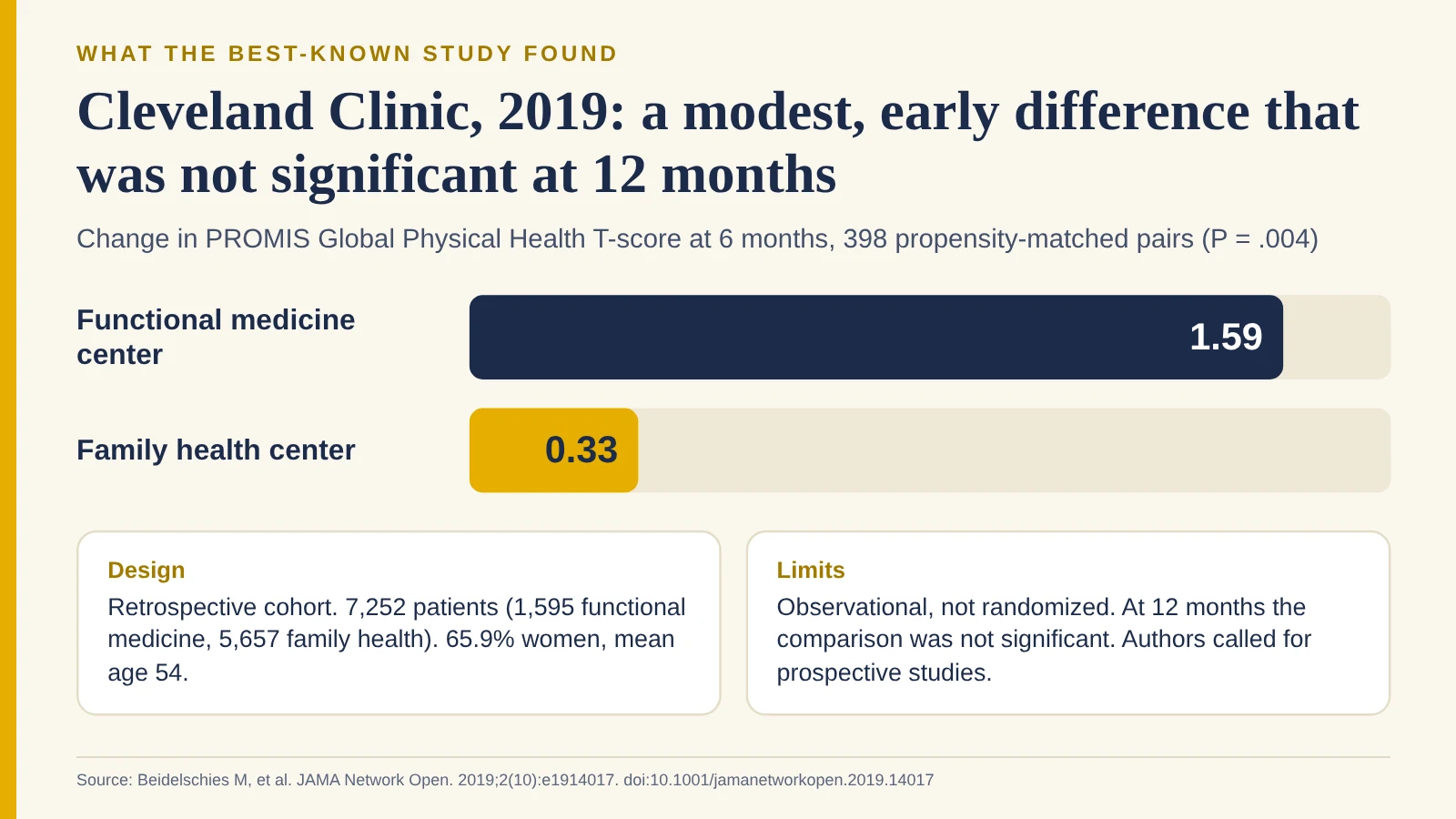
The most cited study is a retrospective cohort published in JAMA Network Open in 2019, by Beidelschies and colleagues at the Cleveland Clinic.[1] The researchers compared patients treated at the Cleveland Clinic Center for Functional Medicine with patients treated at Cleveland Clinic family health centers between April 2015 and March 2017. Across both groups there were 7,252 patients: 1,595 at the functional medicine center and 5,657 at family health centers. About two-thirds, 65.9 percent, were women, and the average age was 54.
The main outcome was the change in a patient-reported measure called PROMIS Global Physical Health, scored as a T-score with a mean of 50, at six months. Among 398 pairs of patients matched on a statistical score, the functional medicine group improved by an average of 1.59 points and the family health group by 0.33 points, a difference that was statistically significant (P = .004).[1] At twelve months, the functional medicine patients showed improvement similar to that seen at six months, but the comparison with the family health group was not significant. In a subgroup with data at both six and twelve months, the difference favored functional medicine again, 2.61 versus 0.25 points, in just 91 matched pairs.[1]
How to read those numbers
Three things matter when you interpret this study, and the authors themselves acknowledge the central one, writing that prospective studies are warranted to confirm the findings.[1]
The size of the difference is small. T-scores are standardized so that ten points represent one standard deviation, which means a difference of about 1.3 points is a fraction of a standard deviation. It is statistically detectable in a large sample, and it may be real, but it is not a dramatic transformation.
The durable comparison was not significant. The twelve-month comparison, which asks whether the benefit lasted, did not reach significance. The subgroup analysis that did reach significance was restricted to patients who happened to have data at both time points, which is a selected group.
The design cannot separate the model from the patient. This was not a randomized trial. Patients who seek out a specialty center differ from patients who walk into a family health center, in motivation, in what they believe, in the nature of their problems, and in ways no statistical match fully captures. A retrospective cohort can show an association. It cannot prove that the care caused the change.
None of this makes the study worthless. It makes it a reasonable early signal that deserves follow-up, and it is a good example of why "a study showed" is the beginning of a question rather than the end of one.
The first randomized pilot, 2026
The follow-up evidence from the same program is a randomized trial, and it is sobering. In a 24-month, open-label randomized pilot published in 2026, adults with type 2 diabetes were assigned either to a functional medicine approach, which combined intensive lifestyle modification and tailored dietary supplements with usual care, or to conventional endocrinology management alone.[2] Of 107 people screened, 34 were randomized to functional medicine and 37 to usual care, and only 47 completed the study. The primary endpoint, a combination of insulin discontinuation without a rise in hemoglobin A1c, or an A1c below 7 percent at twelve months, was reached by 15.8 percent of the functional medicine group and 11.1 percent of the usual care group, a difference that was not statistically significant (P = 0.68). The secondary measures, including A1c change, insulin dose, hypoglycemia, weight, and quality of life, also did not differ significantly between arms. The authors concluded that adding the functional medicine approach did not significantly improve glycemic, metabolic, or quality-of-life outcomes compared with usual care in people with type 2 diabetes.[2]
A caution is essential here, and I want to apply it to both sides. This was a small pilot, with a high dropout rate, in an older population with established diabetes, a very different group from the midlife women this guide addresses. A null result in a small pilot does not prove the approach fails. But it also means that the one randomized test of the model against usual care in a chronic disease did not find an advantage, and an honest summary has to include that.
A randomized coaching trial, 2024
A third study tested a narrower question. In a 10-week randomized trial, 125 healthcare professionals followed an elimination diet either with five sessions of functional medicine health coaching or on their own.[3] Both groups improved on patient-reported health measures, and in the primary analysis there was no difference between groups. The authors found that among participants who began with more symptoms, the coaching group showed larger improvements in mental health and symptom scores. That subgroup finding is interesting, but a subgroup finding in a trial whose main comparison was null is a hypothesis for the next study, not a conclusion. What the trial does show is how much people improved on a self-guided elimination diet alone, which is a useful reminder that the active ingredient may be the behavior, not the supervision.
Cost and claims studies
A few observational studies have examined health plan costs among people receiving functional medicine care, such as a 2024 analysis of pharmacy claims among school district employees with musculoskeletal disorders.[42] Observational cost comparisons are vulnerable to the same selection problems as the Cleveland cohort and are better treated as hypothesis-generating than as proof of savings.
| Study | Design | Who was studied | What it found | Main limit |
|---|---|---|---|---|
| Beidelschies, 2019 | Retrospective cohort, propensity matched | 7,252 adults, 65.9% women, mean age 54 | Six-month physical health score improved 1.59 vs 0.33 points (P = .004) | Not randomized; 12-month comparison not significant |
| Eldib, 2026 | Randomized, open-label pilot, 24 months | 71 randomized adults with type 2 diabetes; 47 completed | No significant difference in glycemic, metabolic, or quality-of-life outcomes | Small, high dropout, older population |
| D'Adamo, 2024 | Randomized coaching trial, 10 weeks | 125 healthcare professionals | No between-group difference in the primary analysis; both arms improved | Short; relatively healthy sample |
| Cutshall, 2016 | 28-week pilot | Middle-aged women with stress, fatigue, digestive complaints | Improvements in many stress, fatigue, and quality-of-life measures | Pilot, no randomized comparison group described |
The honest summary
Putting the studies together, the evidence so far shows: a modest, early association with better patient-reported physical health in one large observational study, a null result in one small randomized pilot, a null primary result in one short randomized coaching trial, and encouraging but uncontrolled results in a small pilot in women. The studies I reviewed measure patient-reported quality of life, glycemic control, and symptom scores. I am not aware of a trial in this literature that measures hard outcomes such as heart attacks, fractures, or mortality, and if one exists I would welcome it. That is not the profile of a proven model. It is also not the profile of a debunked one. It is the profile of a field that has produced hypotheses and has not yet produced the large, well-designed, adequately powered trials that would settle them.
In the 2026 commentary, the authors argue that new clinical frameworks should meet the same standards of evidence and clinical validity expected throughout medicine.[5] I agree with them, and I think most thoughtful functional medicine clinicians do too. A field that believes in its approach should want it tested.
Is It the Medicine or the Time?

If many women feel better under functional medicine care, why? That question is more interesting than it sounds, and the honest answer is that we usually cannot tell which element is responsible. A woman who starts a practice like mine gets, all at once, a long conversation, a new set of food and sleep habits, a few supplements, some lab results that explain things, a sense of being taken seriously, and a plan. Any one of those could be doing the work.
What a placebo experiment teaches
One of the clearest experiments on this topic was not about functional medicine at all. In a 2008 randomized trial published in the BMJ, researchers studied 262 adults, 76 percent of them women, who had irritable bowel syndrome.[6] For three weeks, patients were assigned to a waiting list, to sham acupuncture delivered in a minimal way, or to the same sham acupuncture delivered by a practitioner who deliberately offered warmth, attention, and confidence. The proportion of patients reporting adequate relief of symptoms rose in a stepwise pattern: 28 percent on the waiting list, 44 percent in the limited sham group, and 62 percent in the group whose practitioner relationship was augmented. The authors concluded that nonspecific effects can produce statistically and clinically significant outcomes, and that the patient-practitioner relationship was the most robust component.[6]
Read that carefully, because it cuts in two directions. It means that warmth, attention, and confidence are not trivial. They are powerful, measurable contributors to symptom relief, and a clinician who provides them is delivering something real. It also means that a woman who feels better after an hour and a half with a caring practitioner cannot conclude from that alone that the stool test, the supplement, or the protocol is what helped. The relationship, the validation, and the sense of control may have done a large share of the work.
Why this matters for your decisions
None of this is a criticism of women who feel better. Feeling better is the point, and the therapeutic relationship is a legitimate part of medicine. But it has a practical consequence for how you spend your money. If the time and attention are a main active ingredient, then you should be able to buy them without also buying an expensive set of tests and a large supplement stack whose value you cannot separate from the relationship.
That is one reason I think the entry point of a practice matters. A thirty-minute paid session or a sixty-minute intake buys you time, a thorough history, and a plan for next steps, and it lets you judge the clinician and the approach before committing to a six-month program. We describe each step on our cost page, and you can compare the options without a sales conversation. I raise our own approach here not as an advertisement but because transparency about cost is itself one of the most reliable signals of an honest practice, a point I return to later.
A decision rule for unbundling
Here is a practical rule you can apply to any practice, including mine. After the first two or three months of care, take each component of your plan and ask three questions about it.
- What is this for? Can the clinician name the specific symptom, result, or goal that it targets?
- How will we know if it is working? Is there a measurable change, such as a lab value, a symptom score, a sleep log, or a functional goal, and by when?
- What happens if it is not working? Is the plan to stop it, or to add something else?
Keep the components that have a clear purpose, a way to measure the result, and an exit plan. Question the components that fail those tests. If the answer to "what is this for" is a general phrase like "to support your gut" or "to balance your hormones," that is a prompt to ask for specifics. A good clinician will welcome the questions. The relationship that Kaptchuk and colleagues identified as so powerful is strengthened, not weakened, by a patient who asks them.
A Framework for Grading Every Claim
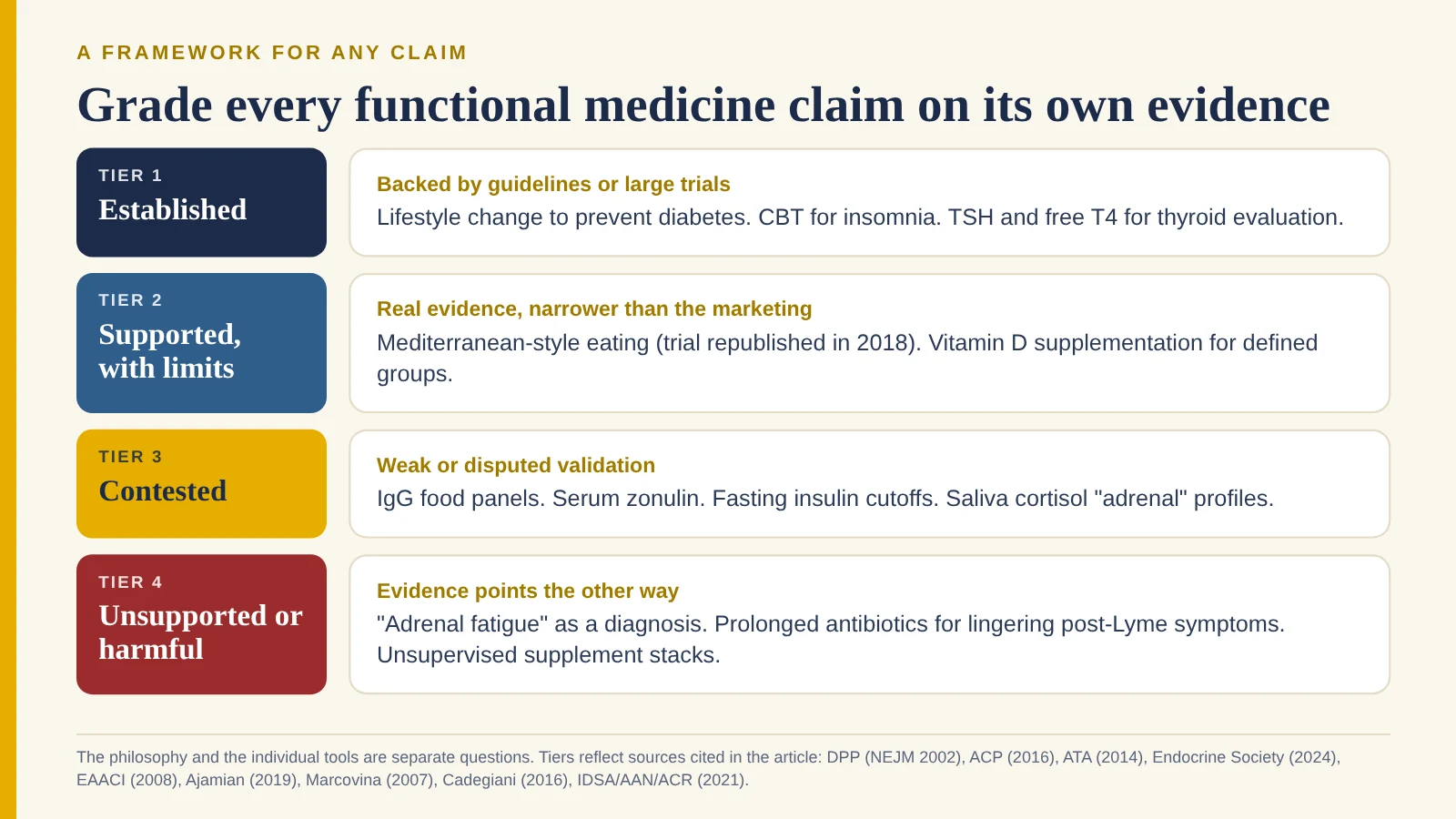
The central mistake in most arguments about functional medicine is treating it as one thing that is either true or false. It is a bundle. Inside the bundle are practices with excellent evidence, practices with partial evidence, practices with weak or disputed evidence, and a few practices the evidence argues against. If you accept or reject the bundle as a whole, you will be wrong about most of its contents. A more useful move is to unbundle it and grade each part on its own merits.
Here is the framework I use, and that I would encourage you to use with any practitioner, including me. It has four tiers.
| Tier | What it means | Examples covered in this guide | How to act |
|---|---|---|---|
| Tier 1: Established | Backed by guidelines from major professional bodies or large, well-designed trials | Structured lifestyle change to prevent type 2 diabetes[8]; CBT-I as first-line treatment for chronic insomnia[10]; TSH-based thyroid evaluation with levothyroxine as standard treatment[16] | Reasonable to expect from any competent clinician. Use them. |
| Tier 2: Supported, with limits | Real evidence, narrower or more qualified than popular claims suggest | Mediterranean-style eating, whose major trial was retracted and republished in 2018[9]; vitamin D supplementation for defined groups rather than everyone[17] | Use with a clear goal and an honest understanding of the limits. |
| Tier 3: Contested | Weak, disputed, or poorly standardized validation | Food-specific IgG panels[11],[12]; serum zonulin assays[13]; fasting insulin interpretation across assays[14],[15]; saliva cortisol patterns offered as proof of "adrenal" problems[19] | Treat results as, at most, one clue. Never as a diagnosis or a reason for an expensive protocol. |
| Tier 4: Unsupported or harmful | The evidence points against it, or the practice carries meaningful risk without benefit | "Adrenal fatigue" as a diagnosis[19],[20]; additional antibiotics for lingering nonspecific symptoms after standard Lyme treatment[22]; unsupervised multi-ingredient supplement stacks[25],[26] | Decline, and look for a different practitioner if this is central to the plan. |
The bracketed numbers in the table point to the references at the end of this guide. If you do nothing else with this section, notice that the tiers do not map onto "conventional" and "functional." Tier 1 contains items that functional medicine clinicians use every day, such as lifestyle treatment and standard thyroid testing, and Tier 3 and Tier 4 contain items that some conventional clinicians also use, such as unnecessary vitamin D screening in healthy adults or antibiotics for vague symptoms.
Five questions to ask about any claim
To place a claim into a tier, you do not need a medical degree. You need five questions, which a good clinician should be glad to answer.
- What exactly is this supposed to do for me? A specific symptom or goal is a good answer. "Support," "balance," and "detox" are not.
- How do we know it works? Is there a randomized trial, a guideline, or at least a plausible mechanism with human data? Or is the support mostly a company's brochure and patient testimonials?
- Was it tested in people like me? A result in elderly men with diabetes does not automatically apply to a forty-eight-year-old woman in perimenopause, and the reverse is also true.
- Who profits if I say yes? This is not an accusation. It is a normal question about incentives that every informed consumer should ask of every seller of anything.
- What does it cost, in dollars and in risk, if it turns out not to work? Cheap, low-risk interventions deserve more benefit of the doubt than expensive or risky ones.
If a practitioner cannot answer these questions in a way that satisfies you, you have learned something important about how that practice thinks, regardless of the tier. The following sections apply the framework to specific areas, starting with what holds up.
What Holds Up: Lifestyle Medicine

If I had to place one bet on which part of functional medicine is most reliably legitimate, it would be lifestyle treatment. The reason is not that functional medicine invented it. It is that lifestyle treatment has the strongest evidence of anything in the toolbox, and a practice that takes the time to deliver it well is delivering something proven.
The landmark evidence: preventing diabetes
The Diabetes Prevention Program, published in 2002 in the New England Journal of Medicine, is the cleanest demonstration that structured lifestyle change can rival or beat a drug. Researchers randomly assigned 3,234 adults with elevated blood sugar to placebo, to metformin, or to a lifestyle program with goals of at least 7 percent weight loss and at least 150 minutes of physical activity per week. The participants had an average age of 51 and an average body mass index of 34, and 68 percent were women. After an average follow-up of 2.8 years, the lifestyle intervention had reduced the incidence of diabetes by 58 percent and metformin by 31 percent, and the lifestyle program was significantly more effective than metformin.[8] To prevent one case of diabetes over three years, about seven people needed to join the lifestyle program, compared with about fourteen who needed to take metformin.[8]
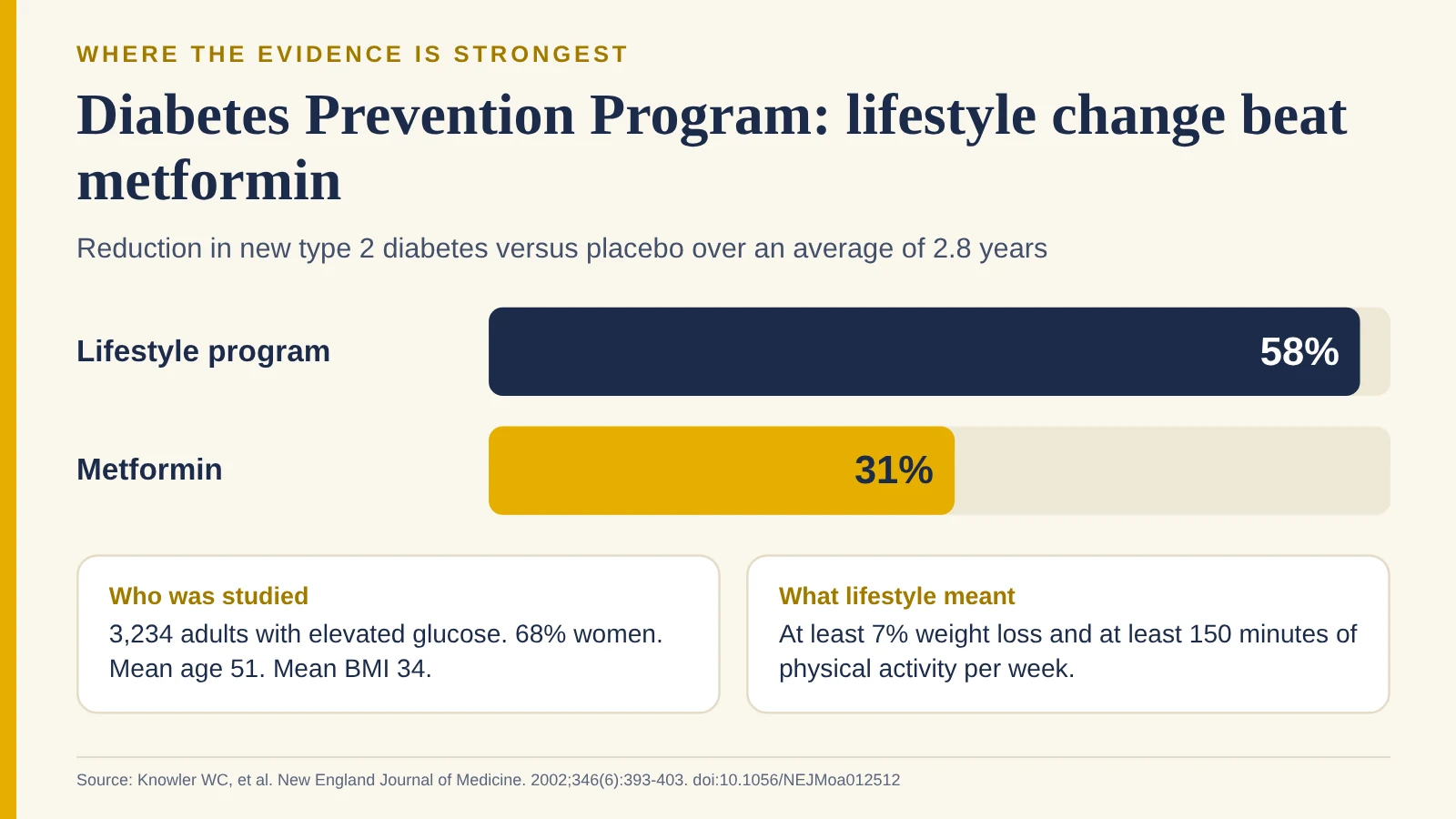
I place this result at the center of the case for the lifestyle-first approach for a simple reason: it is a randomized trial, it is large, the effect is big, and the population included mostly women in midlife. When a practice tells you that food, movement, and weight management are medicine, this is the evidence they should be pointing to. It is also an honest reminder that these programs worked because they were structured, supervised, and sustained, not because someone handed out a pamphlet.
A lesson in humility from the Mediterranean diet
The Mediterranean diet is another cornerstone of lifestyle medicine, and the story of its flagship trial is a useful lesson in how science corrects itself. The PREDIMED trial, published in the New England Journal of Medicine in 2013, reported that a Mediterranean diet supplemented with extra-virgin olive oil or nuts reduced cardiovascular events. In 2018, the journal retracted and republished the paper after investigators found irregularities in how some participants had been randomized, and the republished analysis, which accounted for the problem, was issued along with the retraction notice.[9] I include this not to undermine the diet, which remains well supported by a wide range of other evidence, but to model the right attitude. A good study can have flaws, a flaw can be found and addressed, and the honest response is to say so openly. When a practitioner presents any single trial as final, they are showing you they have not read the history of their own field.
Sleep as a treatable condition
Sleep is the area where lifestyle treatment is most clearly stronger than the prescription pad. The American College of Physicians issued a guideline in 2016 recommending that all adults with chronic insomnia receive cognitive behavioral therapy for insomnia, known as CBT-I, as the initial treatment, a strong recommendation based on moderate-quality evidence.[10] Medications were relegated to a shared decision-making discussion for people in whom CBT-I alone was unsuccessful.[10] That is a mainstream professional society telling every clinician to start with a behavioral therapy before reaching for a sleeping pill, which is exactly what the functional medicine instinct about sleep would predict. A woman in perimenopause who cannot sleep is sometimes offered a sleeping pill first, when the better first step is a structured behavioral program, often combined with evaluation of hormonal and other contributors. We explore the hormonal side in our guide to hormonal sleep and anxiety.

Food, movement, and the Michigan and Wisconsin calendar
Lifestyle advice only works if it fits the life you actually live, and in the Upper Midwest that includes long winters. A walking plan that assumes sunny mornings will fail in January. A produce-heavy plan that ignores what is available between November and April will fail too. The practical version of lifestyle medicine for our region leans on frozen vegetables, winter squash, root vegetables, cold-water fish, canned beans, a strength routine that can be done in a basement or a spare bedroom, and indoor movement that does not depend on weather. Michigan and Wisconsin also offer a lot to work with in the other seasons: farmers markets that stretch from spring to late autumn, community-supported agriculture shares, and trails and shorelines that make daily walking easier to sustain.


For women in the second half of life, strength training deserves special mention because muscle and bone decline accelerate around menopause, and resistance training has good evidence behind it. We cover protein, progressive strength work, and bone loading in detail in our guide to menopause after 50 and in the menopause weight gain guide, including how to move safely through a Michigan or Wisconsin winter.
What lifestyle medicine cannot do
One caution belongs here. Lifestyle treatment is powerful, but it is not a cure for everything, and a practice that implies otherwise is overpromising. Diet and exercise will not reverse a failing thyroid gland, correct a genetic lipid disorder, or replace a medication that a person genuinely needs. The DPP prevented diabetes in many people, but it did not prevent it in all of them. When a clinician tells you that your condition is entirely a matter of willpower and food choices, treat that as a red flag about their judgment, not as encouragement. The best lifestyle-first practices combine behavior change with the full range of conventional tools when the situation calls for them.
What Holds Up: Thoughtful Basic Testing

The second legitimate pillar is the careful use of ordinary laboratory tests. Much of what functional medicine clinicians order is the same blood work any internist would recognize: a thyroid panel, hemoglobin A1c, a lipid panel, iron studies, vitamin levels. The difference is often not the test but the decision to look, the time to interpret, and the willingness to ask what a result means for a particular woman. Even so, each of these tests has its own evidence profile, and a few have subtleties that matter.
Thyroid testing
The central issue in thyroid care is whether a normal TSH rules out a thyroid problem as a cause of symptoms. The honest answer sits between two popular extremes. The American Thyroid Association's 2014 guideline on hypothyroidism treatment is clear that levothyroxine remains the standard of care and that no strong evidence shows combination therapies or desiccated thyroid are superior.[16] At the same time, the same guideline acknowledges that some patients remain unwell on treatment and calls for better biomarkers to supplement the TSH.[16] A reasonable clinician orders a TSH and free T4, and may add thyroid antibodies when the history suggests autoimmune disease, and then interprets the results in light of symptoms, age, medications, and other conditions. Ordering a full panel is defensible. Promising a woman that an out-of-range reverse T3 explains her fatigue and treating it with a prescription or a supplement is considerably harder to defend. Our thyroid guide and our thyroid care page walk through how we approach this, including where the evidence is stronger and weaker.
Blood sugar and fasting insulin
Hemoglobin A1c and fasting glucose are standard tests with established roles. Fasting insulin is more complicated, and it is a good example of a test that is widely used in functional medicine and also deserves a caveat. Insulin measurements are not standardized across laboratories in the way that glucose is. The American Diabetes Association workgroup that compared twelve commercial insulin methods from nine manufacturers found among-assay variation of 12 to 66 percent, with a median of 24 percent, and a common reference material did not fix the disagreement.[14] A follow-up analysis found that for seven of ten methods, the bias compared with a reference method exceeded 15.5 percent in 36 to 100 percent of individual samples.[15] The practical meaning is that an insulin number from one laboratory may not be directly comparable to a cutoff derived from another. A fasting insulin result can still be a useful clue, particularly when it is markedly high and fits the clinical picture, and tracking your own results over time at the same laboratory is more reliable than comparing to a universal cutoff. But anyone who tells you that a single insulin value proves you have a particular metabolic condition is claiming more than the measurement can support.
Vitamin D
Vitamin D is one of the most commonly ordered and most commonly misunderstood tests in functional medicine, and it matters in the Upper Midwest, where winter sunlight is limited. Here is what the mainstream guidance says. The Endocrine Society's 2024 guideline on vitamin D for the prevention of disease suggests empiric vitamin D supplementation for children and adolescents, for adults aged 75 and older, for people who are pregnant, and for people with high-risk prediabetes, and it suggests against empiric supplementation above the current recommended intake in healthy adults younger than 75. It also suggests against routine 25-hydroxyvitamin D testing in the absence of established indications, and it notes that optimal blood levels for specific health benefits still need research.[17] The U.S. Preventive Services Task Force similarly concluded in 2021 that the evidence is insufficient to assess the benefits and harms of screening for vitamin D deficiency in asymptomatic adults.[18]
That does not make vitamin D testing wrong for every woman. The guideline applies to people without established indications, and a woman with risk factors, malabsorption, bone disease, or symptoms may have a legitimate reason for testing and treatment. It does mean that higher target ranges, such as the 50 to 80 ng/mL some functional practices favor, are a matter of clinical judgment rather than guideline consensus, and where other articles on this site cite such ranges, I would ask you to read them in that spirit. I would rather give you the mainstream guidance and let you weigh it than pretend a more aggressive target is settled science.
Iron, B12, and other nutrient markers
Ferritin and B12 are common and useful tests, and there are real situations in which a woman with fatigue, hair shedding, or heavy periods is helped by finding iron deficiency. I have discussed those situations in detail in our guide to hair loss in women 35 to 55, including the frank point that there is no trial-derived ideal ferritin target for hair. The principle for all nutrient testing is the same: test when a symptom, a history, or a risk factor gives you a reason, treat deficiency when you find it, and recheck to confirm it improved. Avoid supplementing blindly based on a general sense that "most women are low."
A caution about biotin and your lab results
One subtle risk of supplements applies directly to testing. High-dose biotin, which is commonly taken for hair, skin, and nails, can interfere with some laboratory assays and produce falsely high or falsely low results. The FDA issued safety communications about this in 2017 and updated its warning in 2019, noting that thyroid tests and cardiac troponin tests can be affected.[28] If you take biotin, tell your clinician and the laboratory, and ask whether you should pause it for several days before a blood draw. This is the kind of detail that separates a careful practice from a careless one.
How to test thoughtfully
If I could change one habit across all of medicine, conventional and functional, it would be to attach a question to every test before it is ordered. A thoughtful testing plan has four features.
- A reason. Each test is tied to a symptom, a history, or a risk factor.
- A decision it can change. The clinician can say what they would do if the result were high, low, or normal.
- A reasonable scope. A focused panel of common, treatable contributors beats a battery of eighty markers with no plan for interpreting them.
- A plan to recheck. Repeat testing happens when it will change management, not on autopilot.
Our own Root Cause Lab Panel, is built around common markers: vitamin D, B12, ferritin, zinc, and red blood cell magnesium; TSH, free T3, free T4, and thyroid peroxidase antibodies; a lipid panel and lipoprotein(a); fasting glucose, hemoglobin A1c, and fasting insulin; liver enzymes; and the inflammation markers hs-CRP and homocysteine. Every one of those is a standard laboratory test, ordered through a commercial laboratory, not an exotic assay. I will be candid, though, that some broad-panel markers, such as homocysteine and hs-CRP, are more useful for context than as direct treatment targets, and that is exactly why I would encourage you to ask what any result would change before you pay for it. Details are on our services page.
What Is Contested: Specialty Testing

Now to the tests that give the field its reputation, for better and worse. I will walk through the main categories in order, and I will be explicit about which ones I use and what weight I put on them. This is where I think honesty from a practitioner matters most, because it is precisely here that a patient cannot judge for herself.
Food-specific IgG panels
The blood test that reports IgG antibodies to dozens or hundreds of foods is among the most heavily marketed tests in this space and among the least supported. The EAACI task force that reviewed it concluded that testing for IgG4 against foods is not recommended as a diagnostic tool, in part because many samples are positive without corresponding clinical symptoms and because IgG4 mainly reflects repeated exposure to food proteins, not a cause of hypersensitivity.[11] The AAAAI recommends against using IgG testing to diagnose food allergies or food intolerances, and it has done so for years as part of its contribution to a national campaign against low-value testing.[12] If a practitioner offers you an IgG panel and tells you the foods you reacted to are the cause of your symptoms, you are being sold a test that the leading allergy and immunology organizations advise against.
The Mediator Release Test, or MRT, which we discuss at length in our guide to MRT food sensitivity testing, is a different technology that measures a different thing, the release of inflammatory mediators from white blood cells exposed to food extracts, rather than antibody levels. Its supporting evidence is more limited than that for conventional allergy testing, which I say plainly in that guide. I treat it as a tool for building a structured elimination diet for women with persistent symptoms, not as a diagnosis, and I would ask you to hold any result from it with the same caution.
Serum zonulin and "leaky gut"
The existence of increased intestinal permeability is not in dispute as a physiological phenomenon, and there is a legitimate research literature on it. The problem is the commercial blood test. In the 2019 study that examined commercial zonulin assays, the researchers used mass spectrometry to identify what the kits actually detected and found it was not zonulin but other proteins, including haptoglobin and complement C3. They concluded that current commercial assays do not detect the actual protein, and advised caution in interpreting the measurement.[13] If a practice orders a serum zonulin level and tells you that an elevated result proves you have leaky gut, you now know why to be skeptical. This is the reason our guide to testing for leaky gut devotes an entire section to why that particular blood test fails, and explains what we use instead and the limits of that approach.
Cortisol, "adrenal" panels, and hormone-metabolite tests
Saliva and urine tests that map cortisol and sex-hormone metabolites across the day are popular in this field. The question is what the results mean for symptoms. In the systematic review that concluded "adrenal fatigue" does not exist, the authors found conflicting results across studies regardless of the quality of the cortisol tests, and noted that the methodology used in many of them was not endorsed by endocrinologists.[19] That does not mean these tests are meaningless in every setting. It means that a pattern on a saliva cortisol curve is not a validated diagnosis for exhaustion, and that a treatment protocol built on that pattern alone rests on weak ground. I explain how I think about cortisol and stress physiology, and where it is on firmer footing, in the cortisol and HPA axis guide.
Our free guide, and our practice, do make use of tests in this category, including urine-based hormone-metabolite panels. I use them selectively, I tell patients exactly how much weight to put on them, and I do not use them to diagnose a condition that mainstream endocrinology does not recognize. If you encounter a practice that does the opposite, that is information about the practice.
Comprehensive stool analyses
Stool-based microbiome and pathogen panels are a legitimate area of active research, and they can occasionally identify something that explains symptoms. They also produce long lists of findings, such as the presence of certain organisms at certain levels, whose clinical significance is uncertain, and the temptation to treat every flagged item with antimicrobials or supplements is a classic path to cost and to unnecessary treatment. I use stool testing as one piece of a larger evaluation, and the gut guide on this site states clearly that conventional gastrointestinal care remains essential for red-flag symptoms such as bleeding, unintentional weight loss, and persistent changes in bowel habits. Read our complete gut health guide for how those boundaries are drawn.
The 2026 commentary's concern, in plain language
The critics who wrote the American Journal of Medicine commentary argue that the diagnostic strategies of functional medicine can lead to low-value testing and care cascades because they rely on specialized diagnostic constructs and nonstandard testing.[5] I think that concern is fair, and I would add a practical corollary: the more unusual the test, the more important it is that the practitioner can explain exactly what the result will and will not change. If the answer is vague, the test is probably serving the business more than the patient.
| Test or claim | What it is promoted for | What the evidence says | How to treat a result |
|---|---|---|---|
| Food-specific IgG panels | Identifying foods that cause symptoms | EAACI advised against IgG4 testing in 2008[11]; AAAAI recommends against it[12] | Do not use as a diagnosis or a basis for restrictive diets |
| Serum zonulin | Diagnosing leaky gut | Commercial assays did not detect actual zonulin in a 2019 study[13] | Disregard as a diagnostic marker |
| Fasting insulin | Detecting early insulin resistance | Assays disagree widely between manufacturers[14],[15]; useful as a clue, not a verdict | Track at one laboratory over time; interpret with the whole picture |
| Saliva cortisol curves | Diagnosing "adrenal" dysfunction | Conflicting results; methods not endorsed by endocrinologists in the reviewed studies[19] | Do not accept "adrenal fatigue" as a diagnosis; see an endocrinologist if adrenal disease is a real question |
| Vitamin D level | Optimizing health | No routine testing in healthy adults per Endocrine Society; USPSTF finds insufficient evidence[17],[18] | Test when there is a reason; avoid chasing high targets without one |
| Standard thyroid panel | Evaluating thyroid symptoms | TSH-based care is standard; better biomarkers still needed[16] | Reasonable; interpret in context rather than by narrow "optimal" ranges alone |
What Is Unsupported or Harmful

The fourth tier deserves its own section, because these are the practices that can cause real harm or can quietly keep you from the diagnosis you need. I will cover three, in increasing order of how directly they affect women in our two states.
"Adrenal fatigue" as a diagnosis
I mentioned this earlier and will keep it brief. The Endocrine Society, the professional body for endocrinologists, states that no scientific proof exists that adrenal fatigue is a true medical condition.[20] A systematic review of 58 studies reached the same conclusion.[19] The harm is not that it is a harmless wellness metaphor. The harm is that a woman told she has "adrenal fatigue" is typically then prescribed adrenal glandulars, high-dose supplements, or a cortisol-targeting protocol, and she stops looking for the real explanation for her exhaustion. That could be anemia, a thyroid problem, sleep apnea, depression, perimenopause, a medication effect, or in rare cases real adrenal disease such as primary adrenal insufficiency, which has a professional guideline for diagnosis and is treatable.[21] Stress physiology and burnout are real, and I take them seriously in the cortisol guide, but they are different from a disease called adrenal fatigue, and the distinction matters.
"Chronic Lyme disease" and prolonged antibiotics
This is the most dangerous controversy in this territory, and it is especially relevant here. Lyme disease is common and growing in the Upper Midwest. The Wisconsin Department of Health Services reports that the state had 8,929 cases of Lyme disease in 2025, the highest on record, and that about 5,300 cases were reported per year on average from 2020 through 2024.[24] If you hike, garden, hunt, or live near wooded or grassy edges in northern Michigan or anywhere in Wisconsin, this is not an abstract concern.
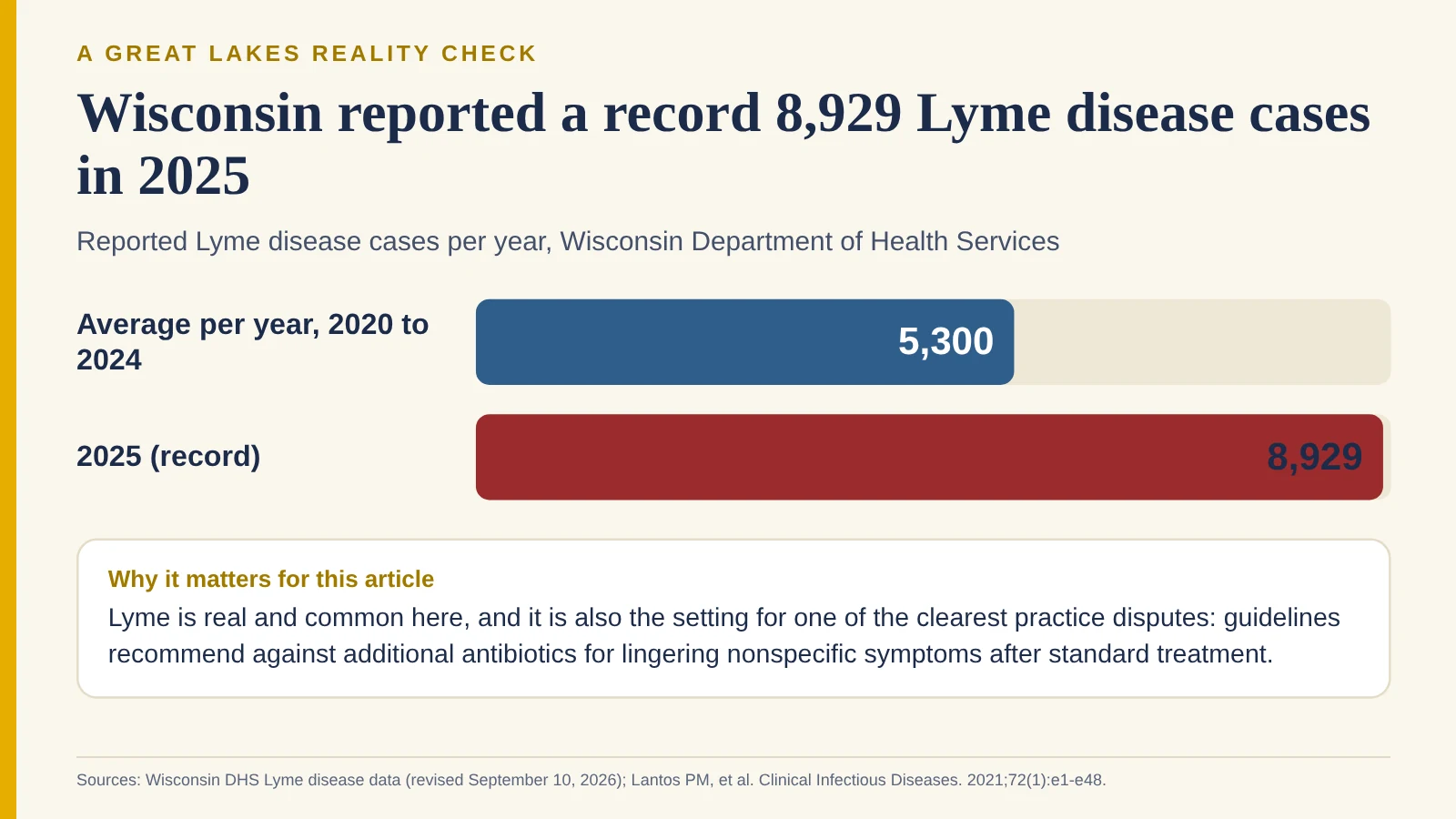
What the evidence says about treatment is clear on the part that matters here. The Centers for Disease Control and Prevention states that most people diagnosed with Lyme disease recover completely when treated with two to four weeks of antibiotics, that some can have prolonged symptoms such as fatigue, body aches, and difficulty thinking, that the cause of those symptoms is currently unknown, and that the science around prolonged symptoms is limited and evolving.[23] The 2020 clinical practice guideline from the Infectious Diseases Society of America, the American Academy of Neurology, and the American College of Rheumatology addresses lingering symptoms directly. For patients who have persistent or recurring nonspecific symptoms such as fatigue, pain, or cognitive impairment following recommended treatment for Lyme disease, but who lack objective evidence of reinfection or treatment failure, the panel recommends against additional antibiotic therapy. It rated that a strong recommendation based on moderate-quality evidence.[22] The guideline also notes that in one systematic study, more than half of patients previously given the diagnosis of chronic Lyme disease actually had other specific disorders, and it observes that prolonged intravenous antibiotic therapy for symptoms after initial treatment has been associated with documented deaths.[22]
I want to be precise about what this means and what it does not. It does not mean your lingering symptoms are not real. They are real, and they deserve a careful workup for other causes, supportive care, and attention to sleep, pain, and function. It does not mean you should avoid prompt treatment for a tick bite or a new rash, which is time-sensitive and effective. It does mean that if a practitioner diagnoses you with "chronic Lyme" on the basis of symptoms and a nonstandard test and recommends months of antibiotics or an elaborate antimicrobial protocol, that plan runs against the strongest guideline in the field, and the harms of prolonged antibiotics are well documented. If you suspect Lyme, see a conventional clinician, ideally one who works with infectious disease, early, and get the standard treatment. If you are told you have an unusual form of it after the standard course, ask for a second opinion from an infectious disease or rheumatology specialist before accepting a long antimicrobial plan.
Supplement stacks without a reason
The third category is the long, undifferentiated supplement list. The risks documented in the emergency department and liver injury literature that I described earlier are real,[25][26] and they are higher when many products are taken together, when the ingredients are not well characterized, and when no one is checking for interactions or kidney and liver function. A practitioner who starts you on twelve products at the first visit, with no stated goal for each, is not practicing evidence-based medicine, regardless of what they call it. The next section gives you a way to handle supplements safely, whether you take them on your own or under guidance.
The common thread
Across all three of these, the thread is the same. Each takes a real symptom, such as exhaustion or lingering pain, and attaches a confident explanation that sits outside mainstream evidence. And each risks delaying the right diagnosis or exposing the patient to harm from the treatment. That is the heart of why this fourth tier exists, and why the best protection is not cynicism toward every alternative idea but a willingness to ask, of any confident explanation, what the evidence is and what else it might be.
Not sure which of your own tests and supplements hold up?
Bring your lab results and your supplement list to a free assessment call. We will help you sort what has real evidence behind it from what does not.
Book Free Assessment CallSupplements: Where Money Is Wasted and Where Risk Hides

Supplements deserve their own section because they are where functional medicine most often touches your wallet and your body at the same time, and because the rules that protect you here are weaker than most women assume. I will start with how the system works, then give you a practical protocol.
How supplements are regulated
The FDA explains that firms producing dietary supplements are responsible for evaluating the safety and labeling of their products before marketing them, and that the FDA has authority to act against an adulterated or misbranded supplement after it reaches the market.[27] That is a post-market system. It is not the pre-market review that applies to prescription drugs, in which a manufacturer must demonstrate safety and effectiveness to the agency before selling a product. A consumer shopping for a supplement is therefore depending on the manufacturer's quality control and on her own judgment to a much greater degree than she would with a prescription.
What the harm data show
It is easy to assume that anything sold in a health food store is gentle. The data say otherwise. In an analysis of national surveillance data covering 2004 through 2013, researchers estimated 23,005 emergency department visits per year in the United States attributable to adverse events related to dietary supplements, resulting in about 2,154 hospitalizations per year.[25] Supplements for weight loss and energy were commonly implicated, and weight-loss or energy products caused nearly 72 percent of the supplement-related events that involved palpitations, chest pain, or a racing heart.[25] Separately, a review published in Hepatology reported that herbal and dietary supplement injury now accounts for about 20 percent of cases of hepatotoxicity in the United States, with the major agents including anabolic steroids marketed as bodybuilding supplements, green tea extract, and multi-ingredient nutritional supplements, and with the majority of cases being due to multi-ingredient products in which the responsible component is usually unknown.[26]
I do not share those numbers to frighten you off supplements. Many are used safely, and some have a clear role. I share them because the safety of any specific product depends on what is in it, at what dose, in combination with what else, and in which person, and because those variables are exactly what a long, unmonitored supplement list tends to ignore.
Where supplements have a clear role
There are situations in which a supplement is well justified. Vitamin D is recommended by the Endocrine Society for defined groups, including children, adults aged 75 and older, pregnant people, and those with high-risk prediabetes.[17] A documented deficiency, such as low ferritin with iron deficiency, low B12, or low vitamin D in a person with a reason to test, is a reasonable target for correction. In each of these, there is a reason, a measurable goal, and a way to confirm the problem is resolved. That is the pattern to look for.
A safer way to use supplements
Whether you take supplements on your own or under a practitioner's guidance, these habits reduce risk and waste.
- Insist on a reason for every product. If a practitioner cannot name the symptom, lab value, or goal it addresses, ask them to explain or to remove it.
- Add one thing at a time. If you start six products on the same day and feel better or worse, you will never know which one was responsible.
- Bring every bottle to your pharmacist. A pharmacist can check for interactions with your prescription medications, which is a service most women never use. Supplements and medications can interact, and this check costs nothing.
- Be especially cautious with weight-loss, energy, and "fat burner" products, which were the leading culprits in the emergency department data.[25]
- Be cautious with concentrated botanical extracts, such as green tea extract, which has been linked to liver injury.[26]
- Tell your clinician and your laboratory about biotin before blood work, because it can distort thyroid and cardiac tests.[28]
- Tell every clinician what you take, including a surgeon or anesthesiologist before any procedure.
- Set a review date. At ninety days, review each supplement against the three questions from earlier: what is it for, how will we know it is working, and what happens if it is not.
- Set a monthly budget and treat it as a ceiling. A plan that cannot be sustained at that level will not be sustained.

A simple rule of thumb
If your supplement list is longer than your ability to explain it to a friend in two sentences each, it is probably too long. A good plan is one you can understand, afford, and defend.
Training, Credentials, and Regulation

Because the phrase "functional medicine" does not tell you who is treating you, the single most useful thing you can do is to find out what the person actually is. This is not about prestige. It is about scope, accountability, and the ability to complain if something goes wrong.
Three different things people confuse
A license, a board certification, and a training certificate are three different things, and a practice's marketing often blurs them.
- A license is a legal permission granted by a state to practice a profession, such as medicine, nursing, or dietetics. It defines what you are allowed to do, includes a disciplinary process, and can be looked up by the public. If someone practices without a license where they should have one, that is illegal.
- A board certification is a credential awarded by a certifying organization after demonstrating knowledge, usually through an examination. Physician specialties are certified by the member boards of the American Board of Medical Specialties, and nurse practitioners are certified in their population focus by national certifying bodies. Functional medicine is not among the ABMS specialties or subspecialties.[30]
- A training certificate is evidence that someone completed an educational program. Many organizations offer functional medicine programs, and they can be valuable education. They are not licenses, and they are not specialty board certifications.
If a practitioner lists a string of letters after their name, ask what each one is, who awards it, and whether it is a license, a board certification, or a certificate of completion. A confident, honest practitioner will answer without defensiveness.
Who can practice, and what they can do
Functional medicine is practiced by a range of license holders: physicians, nurse practitioners, physician assistants, chiropractors, naturopathic doctors where they are licensed, dietitians, and health coaches, among others. What each of them is permitted to do, such as diagnose conditions, prescribe medication, or order laboratory tests, is determined by state law and varies from state to state. That is why it is important to know the license behind the label and to check the rules of your own state rather than assuming that one state's scope of practice applies in another.
I am a nurse practitioner. My national certification is NP-C, I have more than twenty years in clinical healthcare, and I am certified in medical weight management. I mention these not to impress you but because they are the sort of facts you should ask any clinician to state, and then verify. Our about page gives my background.
Telehealth and state lines
Many women in Michigan and Wisconsin see functional medicine clinicians by telehealth. As a general rule, a clinician must hold a license in the state where the patient is located at the time of the visit, so a practitioner licensed only in another state is not permitted to treat you while you are at home in Michigan or Wisconsin. Confirm this directly with the state licensing board rather than relying on a website's assurance. Novaleo is licensed to provide telehealth in both states, and we describe how that works on our Michigan telehealth and Wisconsin telehealth pages, but the point stands for any practice you consider: verify it.
How to verify, in about ten minutes
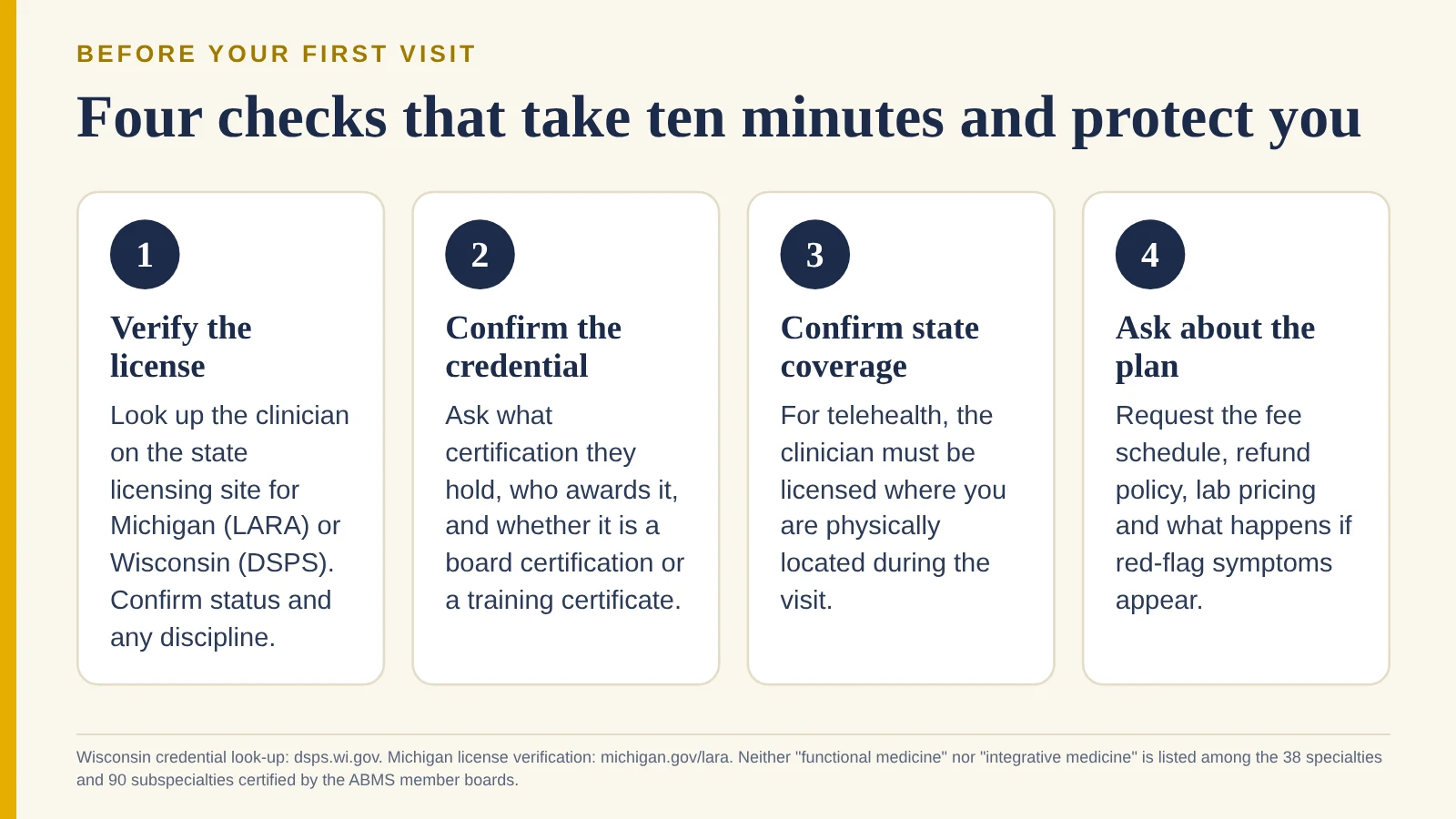
- Look up the license. In Wisconsin, the Department of Safety and Professional Services offers a public credential look-up.[37] In Michigan, the Department of Licensing and Regulatory Affairs provides license verification and information on filing complaints.[38] Check that the license is active, in the right profession, and free of discipline.
- Ask about each credential. Request the full name of the certifying body and whether it is a license, a board certification, or a certificate of training.
- Confirm the clinician is licensed where you will be during the visit. This matters most for telehealth.
- Ask about the plan in writing. Request the fee schedule, what is and is not included in any package, the cost of any laboratory testing, and the refund policy before you pay.
Wisconsin's Department of Safety and Professional Services also describes how to file a complaint against a licensed professional, and Michigan's licensing department has a parallel process.[37][38] Knowing that these channels exist is part of what makes licensed care different from an unregulated service. If a practice offers advice that they claim is protected from any oversight, that is a reason to walk away.
Cost, Insurance, and the Cash-Pay Reality

Money is the part of this decision that women most often feel awkward discussing, and it is also the part most likely to determine whether a good experience turns into a regret. I will be direct.
Why most functional medicine is outside insurance
Most functional medicine practices operate on a cash-pay basis, which means insurance does not pay for the visits, and the patient is the payer. A cash-pay model allows long appointments and flexibility, which many patients value. It also moves the full financial burden onto you and removes the check that an insurer provides on what is billed. The 2026 commentary specifically flags substantial out-of-pocket costs as a source of inequity associated with this model.[5] I think that is a fair concern, and it is one reason I take transparency about price so seriously.
What transparent pricing looks like
Cost should be explained before you commit. A free assessment call lets you ask questions without paying. A 30-minute Clarity Session and a 60-minute Root Cause Intake are separate paid sessions. The Root Cause Lab Panel includes written insights on your results, and it is credited toward the program if you enroll within 30 days. The Root Cause Restoration Program runs six months and is limited to four clients at a time. We do not take insurance, and we accept FSA and HSA cards, as well as credit and debit cards. You can see what each step includes on our cost page.
I also want to be honest about our refund policy, because it is the kind of detail that surprises people after the fact. Our published terms state that all sales are final and no refunds are issued. You should know that before you book, and you should ask every practice you consider for its refund policy in writing. A practice that is vague about refunds is making a decision you should factor into your own.
FSA and HSA accounts
Many women assume that because they have a health savings account or flexible spending account, everything a clinician recommends is eligible. The rules are more specific. The Internal Revenue Service, in its guide to medical and dental expenses, states that you cannot include the cost of nutritional supplements, vitamins, or herbal supplements unless they are recommended by a medical practitioner as treatment for a specific medical condition diagnosed by a physician, because these items are generally taken to maintain ordinary good health and are not for medical care.[29] The publication also says expenses that are merely beneficial to general health do not qualify.[29] That means that a supplement taken for "general wellness" is generally not an eligible expense, while a supplement for a documented deficiency, with documentation from a clinician, may be. Eligibility is ultimately determined by your plan administrator, so ask them before you assume.
A six-month cost worksheet
The most reliable protection against financial regret is to total the real cost before committing. For any practice, write down the following and add it up.
- The cost of the first visit and each follow-up visit, and how many follow-ups are expected in six months.
- The cost of laboratory testing, including repeat testing, and whether the lab fees are included or billed separately.
- The expected monthly cost of supplements and whether you are required to buy them from the practice.
- Any membership, program, or package fee, and what it includes.
- The refund and cancellation terms.
Compare the total with what you could get elsewhere. A visit with your primary care clinician, a referral to an endocrinologist or gynecologist, and laboratory tests ordered through your insurance may cover part of what you need for far less money. In many cases the most sensible approach combines the two: use your insurance for what it covers, and pay out of pocket only for the time and the additional work you value. If you have recent results from your primary care provider, bring them, so that you do not pay to repeat tests that were done last month.
Finally, treat cost as a clinical variable. A plan that you cannot afford to complete is a plan that will fail, and a good clinician will help you design a version of the plan that fits your budget. If a practitioner cannot or will not adjust the plan to your means, they are selling a product, not providing care.
Business Models and Conflicts of Interest

Every healthcare business has incentives, and conventional medicine has plenty of its own, from fee-for-service billing that rewards volume to pharmaceutical relationships that shape prescribing. Pretending that functional medicine is uniquely conflicted would be unfair. But it is worth understanding the specific incentive structures you are likely to encounter, because they affect what you are offered.
The models you will see
| Business model | What is good about it | What to watch for |
|---|---|---|
| Fee-for-service visits | You pay for time and expertise; the incentive is aligned with conversation, not product | Visit fees can add up; ask how many follow-ups to expect |
| Membership or program packages | Predictable cost; often includes messaging and follow-up | Prepaying large amounts; unclear refund terms; paying for services you do not use |
| Selling supplements through the practice | Convenience; the practice can control quality | A financial incentive to recommend products; pressure to buy only from the practice; mark-ups |
| Laboratory packages | Bundled pricing for panels; fewer separate bills | Large batteries of tests with no plan for interpretation; paying for tests you did not need |
| Affiliate or commission arrangements | Sometimes disclosed transparently | Recommendations that are really advertisements; undisclosed relationships with companies |
| Coaching and add-on programs | Behavior change support has evidence behind it | Overlap with what the clinician should already be providing; cost |
None of these models is automatically unethical. Many careful practices use some of them. The difference between an honest practice and a predatory one is whether the incentives are disclosed, whether the recommendations would be the same if no one profited from them, and whether the patient can decline a product without penalty.
Questions that surface conflicts
You do not need to be accusatory. You can ask these questions in a friendly, curious tone, and the way a practice answers will tell you a great deal.
- Do you sell any of the supplements you recommend, and do I have to buy them from you?
- Do you receive any payment, discount, or commission from the laboratories or companies whose products you recommend?
- Which of the tests you are proposing are standard tests, and which are specialty tests that would not be recommended in a typical primary care visit?
- If I said no to the supplements and only changed my food, sleep, and movement, would you still work with me?
- What would you recommend if the test results came back completely normal?
I will answer each of these for you on a first call, and I would think less of you if you did not ask. The last question is especially revealing. A practice that has a plan for a normal result, such as continuing with lifestyle changes, rechecking in a few months, or referring for another evaluation, is oriented toward your wellbeing. A practice for which a normal result is a problem is oriented toward selling the next product.
For further guidance on evaluating any practice, including how cost and testing fit together, see the provider-evaluation section of our city-by-city guide to medical weight loss and hormone therapy in Michigan and Wisconsin, which describes what a trustworthy root-cause provider looks like regardless of where you live.
The Michigan and Wisconsin Landscape

The question of whether functional medicine is legitimate is partly a national question and partly a local one. For women in our two states, the local part matters more than most national articles acknowledge.
Why so many women look beyond a conventional visit
Access is a real driver. The Health Resources and Services Administration designates areas with too few primary care clinicians, and the Kaiser Family Foundation reports the data by state. As of December 31, 2025, Michigan had 280 primary care shortage-area designations covering about 2.63 million people, with 47.5 percent of the primary care need in those areas met, and it would need about 464 more practitioners to remove the designations. Wisconsin had 175 designations covering about 2.01 million people, with 66 percent of the need met, and it would need about 223 more practitioners.[32]
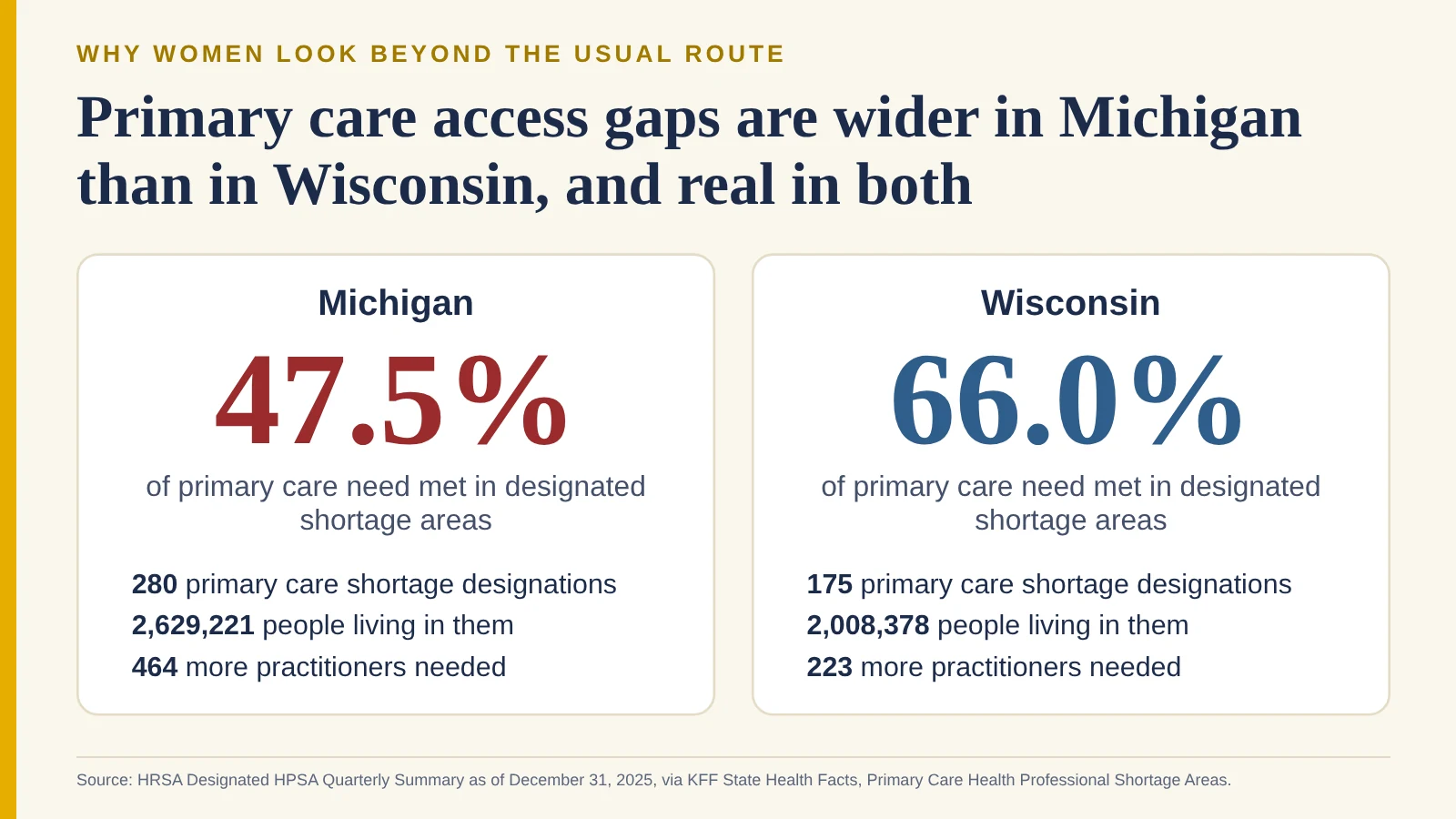
Those numbers help explain why many Michigan and Wisconsin women, particularly in rural counties, the Upper Peninsula, and the Driftless region of southwest Wisconsin, turn to telehealth for care that they cannot easily find nearby. They also explain why it matters so much that the telehealth practice be a good one. When a clinic is your main access point for specialized thinking, the cost of a mistake rises, because there may be no second opinion within a reasonable drive.
What you can find from universities and health systems
Both states' flagship health systems offer academic integrative programs, which are a different kind of option from a cash-pay functional medicine practice. UW Health in Madison operates integrative health and wellness clinics, and notes that primary care services are not provided there.[39] Michigan Medicine in Ann Arbor offers an Integrative Family Medicine program in the Department of Family Medicine.[40] If an academic referral is feasible for you, it can be a useful second opinion. If it is not, because of distance, waiting lists, or what the program does and does not offer, a well-run independent telehealth practice can fill part of the gap.
The Lyme and tick landscape, again
Wisconsin's record Lyme year, with 8,929 cases reported in 2025,[24] is a reminder that the Upper Midwest has its own distinctive infectious disease landscape, and it is one reason that a practitioner in our region should be familiar with the standard guidelines on tick-borne illness. If a practice that serves our region cannot describe the standard approach to Lyme and the reasons for avoiding prolonged antibiotics after standard treatment, that tells you something.[22]
Licensing and telehealth across two states
A clinician serving both states must hold licensure in each, and the licensing boards differ. You can verify a Michigan clinician through the state's licensing department[38] and a Wisconsin clinician through the Department of Safety and Professional Services.[37] If you live in one state and spend part of the year in the other, which many families do, ask how the practice handles care when you are physically located across the border, because the clinician generally must be licensed where you are during the visit.
Where our own pages can help
If you are weighing a telehealth practice in our region, our location pages explain how care works for Michigan, Wisconsin, and Grand Rapids, and our city-by-city guide covers Grand Rapids, Metro Detroit, Ann Arbor, Lansing, Kalamazoo, Milwaukee, Madison, Green Bay, and the smaller communities in between. We wrote those guides so that you can see for yourself how the practicalities of lab draws, licensing, and follow-up work in your corner of the Great Lakes.
Want to see how this approach holds up on your own questions?
Our free assessment call is a no-pressure conversation. Bring your questions about evidence, cost, and credentials, and we will answer them directly before you decide anything.
Book Free Assessment CallWhen Conventional Care Fails Women

I have spent this guide being hard on functional medicine, because that is what the question demands. Fairness requires that I be equally honest about the other side, because the reason functional medicine exists as a market is that conventional care has, for many women, genuinely fallen short. If you are drawn to alternatives, it is not because you were gullible. It is often because you were not listened to.
The structure of the problem
Part of it is time. When the average primary care exam lasts 18 minutes, and a substantial share of visits run over their scheduled slot, a clinician faces an impossible task with a patient who has several overlapping complaints.[7] Part of it is how the system is built, with specialists focused on single organs and few people paid to integrate across them. And part of it, uncomfortably, may be about how medicine has historically listened to women.
What the research on sex differences shows
The research on sex differences in diagnosis and treatment is more developed than many people realize, and I want to describe it carefully rather than overstate it. A 2019 study in Nature Communications analyzed hospital data for the entire Danish population and found that, for the majority of diagnoses, incidence differed between men and women, and that the age at first diagnosis was typically lower for men than for women.[33] The authors argued that the findings point to the need for greater attention to sex-stratified medicine. That study does not prove that women are diagnosed later because of bias. Biology, health-seeking behavior, and many other factors could contribute. It does show that sex differences in the diagnostic journey are measurable and widespread.
A 2001 paper in the Journal of Law, Medicine and Ethics, titled "The girl who cried pain: a bias against women in the treatment of pain," examined sex differences in how pain is treated, and a 2022 paper in the same journal asked whether sex-based disparities in the experience and treatment of pain still exist.[34][41] I cite these not to claim that every clinician dismisses women, which would be false and unfair to the many excellent ones. I cite them because sex differences in the diagnostic journey and in pain care are a recognized subject of research, not just anecdote, and because they help explain why so many women arrive at my practice already convinced that they will not be believed.
The midlife gap
For women in their late thirties through their fifties, the problem has a specific shape. Perimenopause, the years of hormonal transition before the final menstrual period, produces sleep disruption, mood changes, brain fog, irregular cycles, and changes in body composition, and it is a phase that many women report being told is stress, depression, or normal aging. This is one of the reasons we have written so many guides on the topic, including the one on perimenopause starting in your thirties, in which we explain why symptoms appearing earlier than expected are often missed.
The balance to keep
Having said all that, I want to protect you from a conclusion that feels natural but is wrong. Being dismissed by one clinician does not mean the answer was wrong. Sometimes a "normal" result is both accurate and good news, and some symptoms, including some real and distressing ones, do not have a laboratory signature. A functional practice that treats every normal result as evidence of a hidden problem is making the opposite error from the clinician who dismisses everything. The goal is not a clinician who always finds something. It is a clinician who takes your symptoms seriously and tells you the truth about what the evidence supports.
How to get more from a conventional visit
If you want to improve your odds with a conventional clinician, a few habits help, and they are worth using whether or not you ever see a functional medicine practitioner.
- Lead with the one or two issues that matter most rather than a long list, and ask for a follow-up visit for the rest.
- Bring a one-page timeline of when symptoms began, how they have changed, and what else was happening in your life.
- Say what you are afraid of. "I am worried this is something serious" gives the clinician information that changes how they respond.
- Ask what would change the plan. "What would you do if this were your mother?" is a useful question.
- Ask for the plan in writing, including what to do if symptoms do not improve and when to return.
- Ask for a referral when your concern is outside the clinician's scope, and ask what the wait time is.
These steps do not fix a structural problem, but they shift the odds. They also make you a better partner for any practitioner you work with later.
When to Start With Conventional Care

I told you at the start that I would say when not to come to a practice like mine, and this is that section. The principle is simple: a wellness practice, whatever it is called, is not the right place to begin for a symptom that could signal an urgent or dangerous condition, and it is not a substitute for routine screening.
Symptoms that need prompt conventional evaluation
The following should lead you to an urgent care clinic, an emergency department, or your primary care clinician right away, not to a functional medicine intake.
- Chest pain or pressure, shortness of breath, or a rapid or irregular heartbeat that is new or severe.
- Sudden weakness, numbness, facial drooping, trouble speaking, or vision loss, which can signal a stroke.
- A sudden, severe headache unlike any you have had before.
- Unexplained weight loss, drenching night sweats with fever, or persistent fevers.
- Any vaginal bleeding after menopause, which always warrants prompt evaluation.
- A new breast lump, nipple discharge, or skin change.
- Blood in the stool, black stools, or persistent changes in bowel habits.
- A rash that looks like an expanding red patch after a tick bite, or a fever and flu-like illness after outdoor exposure in tick season.
- Thoughts of harming yourself. In the United States, you can call or text 988, the Suicide and Crisis Lifeline, at any hour.
A good functional medicine practice will tell you this on the first call. If a practice instead tells you that these symptoms can be sorted out with a supplement plan, leave.
Screening is not the same as testing
One of the most common ways a wellness practice can do harm, without anyone intending it, is by creating the impression that an extensive set of blood tests replaces standard cancer screening. It does not. Blood panels do not detect breast, colon, or cervical cancer.
For colorectal cancer, the U.S. Preventive Services Task Force recommends screening for average-risk adults aged 45 to 49 (a B recommendation) and for adults aged 50 to 75 (an A recommendation).[35] For breast cancer, the Task Force's 2024 recommendation is biennial screening mammography for women aged 40 to 74.[36] If you are in these age groups and you are not up to date, please talk with your primary care clinician about scheduling, whichever other care you pursue. A practice that discourages screening, or that suggests an alternative that it claims is equivalent, is making a serious mistake.
| Situation | Where to start | Why |
|---|---|---|
| Chest pain, stroke symptoms, severe headache, suicidal thoughts | Emergency care or 988 | Time-sensitive and potentially life-threatening |
| New breast lump, bleeding after menopause, blood in the stool, unexplained weight loss | Primary care or the relevant specialist, promptly | Could signal cancer or another serious condition that needs standard evaluation |
| Due for mammogram or colorectal screening | Primary care or the screening service | Screening has strong evidence; blood panels do not replace it |
| Suspected tick-borne illness | Primary care or urgent care, early | Prompt standard treatment is effective and guidelines are clear |
| Fatigue, brain fog, weight change, sleep disruption, and irregular cycles with unremarkable first tests | Either a conventional or a functional practice, ideally both | Multifactorial symptoms may benefit from time and a broader look |
| Perimenopause or menopause symptoms | A clinician with menopause expertise, conventional or functional | Hormone therapy and symptom management are well-studied topics |
When a functional practice can be a good first or second stop
It would be a mistake to take this section as a case against functional care. There is a broad middle where a thoughtful functional practice is a reasonable choice: persistent fatigue, sleep disruption, weight change, brain fog, digestive symptoms, and the cluster of changes that arrive with perimenopause, particularly after an initial conventional workup has not explained them. The best arrangement for many women is both. Keep your primary care clinician informed, keep up with screening, bring your functional results to your conventional clinicians, and let each side check the other.
Our conditions page lists what we work on, and our approach page describes how we coordinate. In every case, we encourage patients to keep their conventional care in place.
A Condition-by-Condition Reality Check

General principles are useful, but most women reading this are thinking about a specific problem. So here is a condition-by-condition reality check for the concerns I hear about most often. For each, I describe a sensible place to start, where a thoughtful functional approach can add something, and where to be careful. These are not diagnoses or treatment plans, and they are written within the limits of the evidence summarized above.
Persistent fatigue
Start here: a conventional evaluation that reviews your medications, sleep, mood, and basic laboratory tests, with attention to anemia, thyroid function, and blood sugar. Fatigue has a long list of treatable causes, and some deserve prompt attention, such as sleep apnea, depression, and anemia.
Where a functional approach can add: time to untangle overlapping contributors, and a plan that treats sleep, nutrition, movement, and stress as medicine. If insomnia is part of the picture, CBT-I is the first-line treatment recommended by the American College of Physicians.[10]
Be careful about: a diagnosis of "adrenal fatigue," which is not recognized and can distract from the real cause,[19],[20] and any protocol that treats exhaustion as a supplement problem. Our cortisol and burnout guide goes deeper on what is and is not supported.
Brain fog and memory changes
Start here: your primary care clinician, especially if the changes are progressive, severe, or interfering with safety at work or at home. Medication effects, sleep problems, mood disorders, thyroid disease, and other conditions can all affect thinking.
Where a functional approach can add: attention to sleep, hormonal timing in perimenopause, nutrition, and stress, and the time to track patterns. Our guide to perimenopausal brain fog describes how to distinguish common hormonal fog from changes that call for a different kind of evaluation.
Be careful about: expensive supplement protocols that promise to restore memory, and about any practitioner who dismisses progressive symptoms as "just hormones."
Weight resistance and midlife weight gain
Start here: a conversation with a clinician who will look at the full picture, including sleep, medications, thyroid function, and blood sugar, and who can discuss both lifestyle and medical options.
Where a functional approach can add: structured lifestyle treatment, which has the strongest evidence in the field. In the Diabetes Prevention Program, a program aiming for at least 7 percent weight loss and 150 minutes of activity per week reduced new diabetes by 58 percent.[8] Strength training, protein, and sleep deserve attention in midlife, as our guides to menopause weight gain and GLP-1 plateaus explain.
Be careful about: single-number explanations. A fasting insulin value from one laboratory is not a precise measure that can be compared against a universal cutoff,[14] and no test result should be used to promise that weight will come off.
Thyroid symptoms
Start here: a TSH and free T4, with thyroid antibodies if the history suggests autoimmune thyroid disease. The American Thyroid Association guideline treats levothyroxine as the standard of care for hypothyroidism.[16]
Where a functional approach can add: a closer look at symptoms, medications, nutrients, and other contributors when results sit in a gray zone, and a willingness to take persistent symptoms seriously. The same guideline acknowledges that some patients remain unwell on levothyroxine and that better biomarkers are needed.[16] See our thyroid care page.
Be careful about: claims that combination therapy or desiccated thyroid is clearly superior, since the guideline found no consistently strong evidence that it is,[16] and about treating reverse T3 or other secondary markers in isolation.
Perimenopause and menopause symptoms
Start here: a clinician who is comfortable discussing the menopause transition, whether conventional or functional. Heavy or unusual bleeding needs evaluation, and any bleeding after menopause needs prompt attention.
Where a functional approach can add: time to connect sleep, mood, cycle changes, and body composition, and to discuss options with candor. Our guides to perimenopause in your thirties, hot flashes and night sweats, bioidentical hormone therapy, and menopause after 50 cover the evidence in detail, and our perimenopause and menopause care page explains how we approach it.
Be careful about: hormone testing that claims to identify exactly when you will reach menopause, and any plan that dismisses standard evidence on the benefits and risks of hormone therapy in either direction.
Digestive symptoms
Start here: a conventional evaluation first if you have red-flag features such as bleeding, black stools, unintentional weight loss, persistent vomiting, or a significant change in bowel habits. Colorectal cancer screening is recommended starting at 45 for average-risk adults.[35]
Where a functional approach can add: dietary pattern work, attention to stress and sleep, and selective testing once serious causes are addressed. Our gut health guide draws these boundaries.
Be careful about: food IgG panels, which allergy and immunology organizations advise against,[11],[12] and serum zonulin tests, which did not detect actual zonulin in a 2019 study.[13]
Sleep and anxiety
Start here: a mental health professional or primary care clinician, particularly if anxiety or low mood is significant. If you are in crisis or thinking about harming yourself, call or text 988.
Where a functional approach can add: evaluation of hormonal and other contributors to sleep disruption, alongside therapy. CBT-I is first-line for chronic insomnia.[10] See our guide to hormonal sleep and anxiety.
Be careful about: any plan that positions hormones or supplements as a replacement for mental health care.
Hair shedding and thinning
Start here: a clinician who will examine your scalp and check common contributors such as thyroid function and iron stores, and a dermatologist if there are signs of scarring or patchy loss.
Where a functional approach can add: a broader look at nutrition, stress, medications, and hormonal changes. Our hair loss guide covers this, including the frank point that there is no trial-derived ideal ferritin level for hair.
Be careful about: high-dose biotin, which can interfere with some laboratory tests.[28]
Possible tick-borne illness
Start here: a conventional clinician, early. Prompt treatment is effective, and most people treated with two to four weeks of antibiotics recover completely.[23]
Where a functional approach can add: supportive care for lingering symptoms, including sleep, pain, and function, after other causes have been evaluated.
Be careful about: a "chronic Lyme" diagnosis and prolonged antibiotics, which the 2020 guideline recommends against for persistent nonspecific symptoms without objective evidence of ongoing infection.[22]
The pattern across all of these
In every case, the safest route is the same: rule out the serious and the treatable first, use lifestyle treatment generously, and use specialty testing and supplements sparingly and with a clear purpose. That sequence works whether you see a conventional clinician, a functional medicine clinician, or both.
Seven Questions to Ask Any Practice

Here is the practical core of this guide: seven questions you can ask any functional medicine practice, before you pay, with a description of what a good answer sounds like and what should worry you. You can ask them on a free call, by email, or at the start of a first visit. Print this section if it helps.
1. What are your license and certifications, and how can I verify them?
A good answer gives you the name of the license, the state, and the certifying bodies for each credential, and invites you to look them up. A worrying answer is a list of acronyms without explanation, evasion about the underlying license, or irritation at being asked. The verification steps are in the credentials section.
2. What will you do if my tests come back normal?
A good answer describes a plan: continue the lifestyle changes, recheck at a defined time, consider other explanations, or refer for another evaluation. A worrying answer suggests that a normal result means more testing, a different kind of test, or that your "functional" results will find a problem where conventional tests did not.
3. Which of the tests you recommend are standard, and which are specialty tests, and what is the evidence for the specialty ones?
A good answer separates the two categories, can describe what each specialty test can and cannot tell you, and acknowledges where evidence is limited. A worrying answer is a confident claim that every test is essential, or testimonials in place of evidence. If the practice proposes food IgG panels, serum zonulin, or "adrenal" saliva curves as diagnostic, you now know what the evidence says about them.[11],[12],[13],[19]
4. How will we decide whether this is working, and when will we stop something that is not?
A good answer names measurable markers, such as symptom scores, sleep logs, lab values, or a functional goal, and a time frame for review. A worrying answer is open-ended, with no point at which anything would be judged a failure.
5. Do you sell what you recommend, and do I have to buy it from you?
A good answer is direct and transparent, discloses any financial relationship, and makes clear that you can source recommendations elsewhere. A worrying answer is vagueness, defensiveness, or pressure to buy only through the practice.
6. When will you refer me to a conventional clinician, and will you coordinate with my primary care provider?
A good answer names the situations that trigger a referral, such as red-flag symptoms or findings outside the practice's scope, and welcomes communication with your other clinicians. A worrying answer casts conventional medicine as the enemy or discourages you from seeing your doctor or keeping up with screening.
7. What will the whole thing cost, in writing, including the refund policy?
A good answer is a clear, itemized fee schedule, an honest estimate of follow-ups and laboratory costs, and a refund policy stated up front. A worrying answer is a high-pressure sale, a large prepayment with unclear terms, or an inability to estimate costs.
Why these seven work
Each question tests a different part of an honest practice: credentials, humility about evidence, honest use of tests, accountability, conflicts of interest, willingness to refer, and financial transparency. A practice that answers all seven well is likely to be trustworthy regardless of what it calls itself. A practice that stumbles on several is telling you who it is.
Green Flags and Red Flags
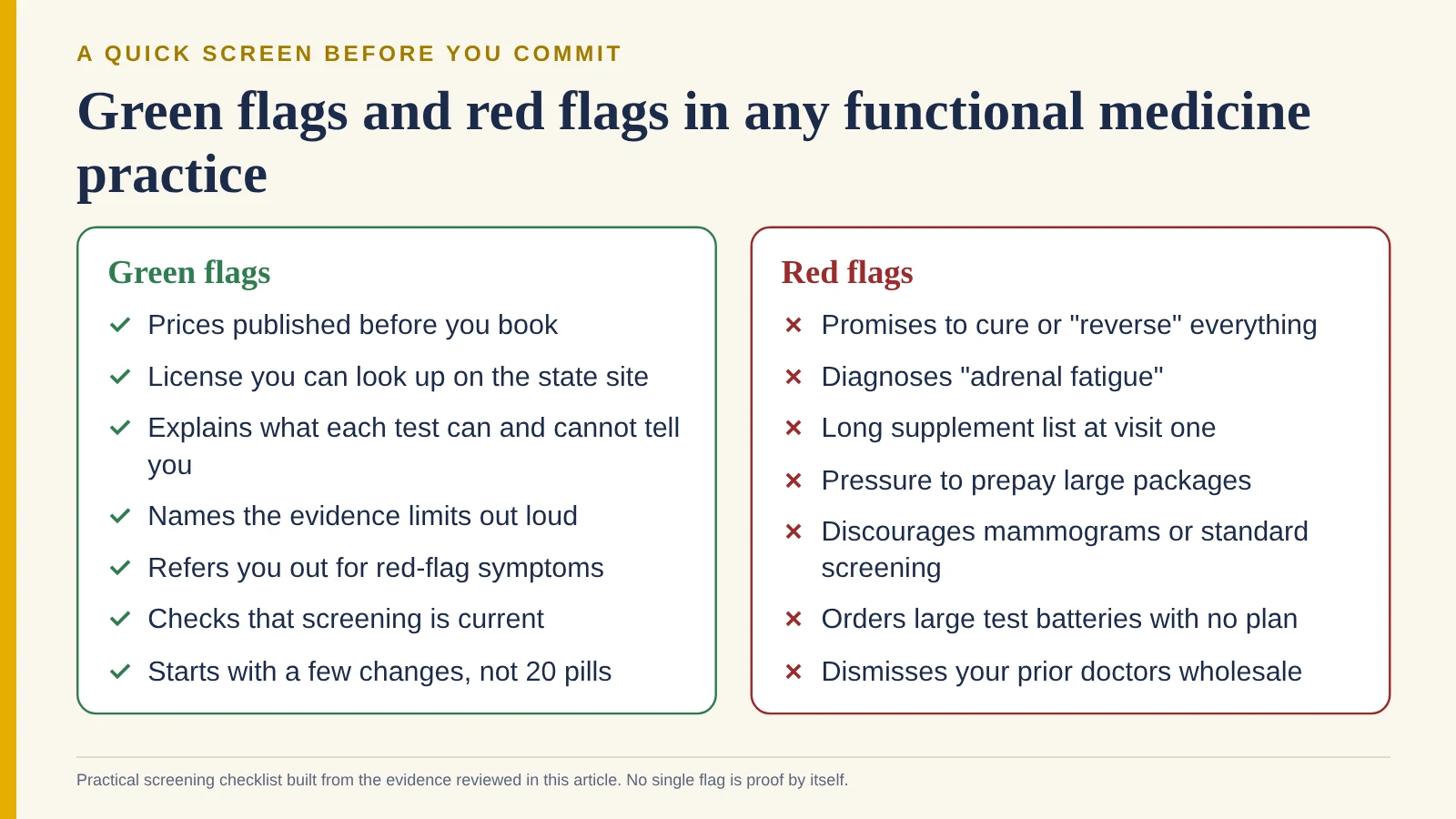
The seven questions give you answers. This section gives you a faster screen, for when you are reading a website or watching a first call and want to know what to notice. Remember that no single flag settles anything. Look for patterns.
Green flags
- Published prices. A practice that tells you what it costs before you book is showing respect for your decision.
- A license you can look up. The practitioner readily gives you the license and credential information.
- Candor about evidence. They tell you what is well established, what is uncertain, and what is mostly hope.
- Acknowledging the limits of testing. They explain that a test result is a piece of information, not a verdict.
- Referral for red flags. They tell you when to see a conventional clinician and whether they coordinate.
- Current screening. They ask about mammograms, colon screening, and other routine care.
- A short list to start. They begin with a few changes, not twenty.
- Room for "no." You can decline a test or a product without penalty.
Red flags
- Promises to cure or "reverse" everything. Real medicine uses probabilities and honest limits.
- Diagnosing "adrenal fatigue." This signals that the practice relies on a diagnosis that endocrinology does not recognize.[19],[20]
- A long supplement list at the first visit. Especially if each product is not tied to a goal.
- Pressure to prepay large packages or a countdown timer on a "special offer."
- Discouraging screening or standard care, including mammograms, or characterizing your doctors as the enemy.
- Large test batteries with no plan, or tests whose results cannot change what happens next.
- Treating a normal test as a failure of the test. Not every symptom has a laboratory signature.
- Dismissing all of your previous clinicians wholesale, which is a way of creating dependency.
- Fear-based marketing. "Everyone has this and does not know it" is a sales line, not an observation.
- Treating prolonged antibiotics for lingering symptoms as routine. Guidelines recommend against it.[22]
Use these as a conversation starter, not a verdict. If you see several red flags and few green ones, trust that. If you see mostly green flags and one or two yellow ones, ask about them directly. You are entitled to a practice that makes you feel safe asking.
How We Answer These Questions

It would be unfair to give you seven questions and then decline to answer them myself. Here is how Novaleo Weight and Wellness answers each, based on our published information, with the caveat that the best test of any claim is to ask us directly on a call and to check what we tell you.
License and certifications
I am a board-certified nurse practitioner with the NP-C credential, I have more than twenty years of experience in clinical healthcare, and I am certified in medical weight management. Novaleo provides telehealth care to women in Michigan and Wisconsin, and you can verify licensure through each state's licensing authority using the steps above. Our about page has the details.
If your tests are normal
A normal result does not end the conversation, and it also does not mean we keep searching until something looks abnormal. It means we look at the rest of the picture: sleep, food, movement, stress, hormonal timing, medications, and other explanations, and we agree on what to change, how long to wait, and when to recheck. If the picture points to something that belongs with another clinician, we refer you to one.
Standard tests and specialty tests
Our Root Cause Lab Panel consists of standard laboratory tests, as listed in the testing section. We also use some specialty tests selectively, and our free guide names two, the DUTCH hormone-metabolite test and the GI-MAP stool test. Our guides to MRT testing, leaky gut testing, and gut health explain the limits of the evidence for those tests, and I would ask you to read them as seriously as the parts that make the case for them. I do not use food IgG panels or serum zonulin as diagnostic tests, and I do not diagnose "adrenal fatigue."
How we decide whether something is working
We set goals at the start, which might include sleep, energy, weight, cycle changes, digestive symptoms, or specific lab values, and we review them at follow-up visits. The Root Cause Restoration Program is structured around four areas: nutrition and blood sugar stability, sleep and circadian rhythm, stress and nervous system regulation, and movement and metabolic strength. Each of those areas has evidence behind it, as the lifestyle section above explains, and each can be tracked.
What we sell
The program lists supplement recommendations and nutrition guidance among its components. Ask us, before you pay, whether you must purchase anything through us and whether anyone receives any compensation for a recommendation. I will answer directly, and you should walk away from any practice, including ours, that will not.
When we refer you out
Red-flag symptoms, overdue screening, and findings that need a specialist go to conventional care, and we encourage every patient to keep their primary care relationship in place. The guides on this site list the red flags that call for conventional evaluation in each area, and this article's earlier section lists them for the whole body.
Cost and refunds
What each step includes is described on our cost page: a free assessment call, a Clarity Session, a Root Cause Intake, a Root Cause Lab Panel, and a six-month program limited to four clients at a time. We do not accept insurance, and we accept FSA and HSA cards as well as credit and debit cards. Our terms state that all sales are final and that no refunds are issued, so please read them before booking and ask any question that is not clear.
What we are not
We are not a replacement for your primary care clinician, we are not an emergency service, we are not an insurance-covered practice, and we do not claim that functional medicine has been proven as a complete model of care. We offer time, thorough evaluation, evidence-based lifestyle treatment, and thoughtful use of testing, and we try to be honest about everything beyond that. If that is what you are looking for, you can start with a free assessment call, or with a Clarity Session if you prefer a longer first conversation.
Hold us to the seven questions
Book a free assessment call and ask us every question in this guide. If our answers do not satisfy you, you will have lost nothing and learned a lot.
Book Free Assessment CallFour Women, Four Outcomes

The principles in this guide can feel abstract, so here are four composite stories, each assembled from patterns I have seen and none describing a real individual. The names, towns, and details are invented. They are intentionally different in how they turned out, because the honest answer to "is functional medicine legit?" is that the outcome depends on the practice, the patient, and the problem.
Marlene, 51, Grand Rapids: the long supplement list
Marlene is the woman from the beginning of this guide. After fourteen months, she is taking eleven supplements, has spent close to $2,400, and cannot say which of them is doing anything. Her sleep has improved, her weight has not moved, and her gastroenterologist was unmoved by her stool report.
When she brought everything, bottles, results, and receipts, to a new clinician, the clinician did something simple. They went through the list one product at a time and asked the three questions: what is it for, how will we know if it is working, and what happens if it is not. For seven of the eleven, no one could give a clear answer. Those were paused, one or two at a time, over several weeks. The two with a documented rationale, vitamin D in a woman who had a measured deficiency and iron for a low ferritin, were kept. The clinician also noticed that her sleep had improved around the same time she had stopped drinking coffee after noon and begun a consistent bedtime, which had been part of the first plan. The supplements were not the likeliest explanation.
Marlene did not conclude that the first practice was a scam. She concluded that the first practice had given her time and attention she valued, and had also sold her more than she needed. Her monthly cost fell by more than half. Her next step was a conversation, which she had avoided for two years, about whether her irregular cycles and sleep changes were perimenopause. What she learned from the experience was to ask what each thing was for before she paid for it.
Teresa, 44, Madison: the heavy periods
Teresa went to a functional medicine practice for fatigue, brain fog, and hair shedding. She was thoughtful about her choices and had done her reading. The practitioner took a detailed history, ordered a broad but standard panel, and found a very low ferritin and mildly low hemoglobin. In the history, Teresa had mentioned that her periods had become very heavy over the past year, with clots, and that she had been soaking through protection every couple of hours.
The practitioner did what a good one does. They told her that heavy bleeding with iron deficiency needed a gynecologic evaluation, not a supplement plan. They wrote a letter to her primary care provider, helped her get an appointment, and asked for the results. The workup found a structural cause that was treated conventionally. Her ferritin was repleted under the guidance of her gynecologist, and her fatigue and hair shedding improved over several months.

This is the best-case version of the model: a long history revealed what a short visit might have missed, and the practitioner had the integrity to refer instead of treating. The long conversation was the valuable part, and the right referral was the thing that fixed the problem. Notice that the improvement did not come from a specialty test or a proprietary protocol.
Joan, 56, Marquette: the Lyme diagnosis
Joan lives in the Upper Peninsula, loves to be outdoors, and had a tick bite some years earlier that she remembers vaguely. She has been tired for a long time, with aching joints, poor sleep, and low mood. A practitioner she found online told her, after a nonstandard test, that she had chronic Lyme disease, and put her on a prolonged course of antibiotics along with a series of supplements. Three months in, she felt worse: persistent diarrhea, more fatigue, and new anxiety about whether she would ever recover.
A friend who is a nurse urged her to get a second opinion at an academic medical center. The infectious disease clinician reviewed her records and explained that the standard guidance recommends against additional antibiotic therapy for persistent nonspecific symptoms in the absence of objective evidence of ongoing infection, and that in one systematic study more than half of the people given a chronic Lyme diagnosis turned out to have other specific disorders.[22] A sleep study found significant sleep apnea. Her mood symptoms, which had been dismissed as part of "the infection," were evaluated and treated. Her joint pain was assessed and found to be consistent with osteoarthritis and menopause-related changes rather than infection.
Joan's symptoms were real the whole time. What changed was that they were finally pursued with standard tools. She also learned that a long drive to an academic center was worth it for a second opinion, and that telehealth follow-up with a clinician who coordinated with that center made ongoing care manageable from home.
Priya, 41, Milwaukee: when it works
Priya came to a functional practice with fatigue, trouble sleeping, shorter cycles, mood changes, and a family history of thyroid disease. The first visit lasted ninety minutes. The clinician reviewed her history, ordered standard thyroid tests including antibodies, ferritin, a metabolic panel, and a lipid panel, and asked about her mammogram and routine screening, which she was due for. She was offered a short list: a sleep routine drawn from CBT-I principles, a strength routine she could do at home, dietary changes, vitamin D based on a measured low value, and a plan to recheck in twelve weeks. She was told which tests the practice would not order and why, and given the full cost of the plan in writing.
At twelve weeks, her sleep had improved, her energy was better, her cycle pattern was clearer, and her thyroid antibody result was being followed by her primary care clinician as well. She had her mammogram. She had a clear sense of what she would do if things changed.
I include Priya not as a promise that this will happen to you, but as a picture of what a well-run version looks like: standard tests, a short list, a measurable plan, an honest price, current screening, and coordination with her other clinician. And even in her case, I would be cautious about crediting any single part of the plan. The time, the structure, and the sense of being taken seriously all contributed, as the Kaptchuk trial would predict.[6]
What the four stories teach
- The label does not predict the experience. Marlene and Priya both saw "functional medicine" practices, and the quality of their care differed.
- The best moments are often not exotic. Teresa's turning point was a good history and an appropriate referral. Priya's was a short, measurable plan.
- The worst moments involve overconfidence. Joan's harm came from an unvalidated diagnosis and a treatment that guidelines advise against.[22]
- Second opinions are a feature. In all four stories, a conventional clinician helped, and in two of them a second opinion changed the plan.
- You can recover from a wrong turn. Marlene and Joan both made costly detours and both ended up better because they were willing to ask hard questions.
Preparing for a First Visit With Any Practice

You will get more from any first visit, with any clinician, if you walk in prepared. The preparation also protects you, because it gives you the information to judge what you are being told. Here is the checklist I give women who book with us, which works equally well anywhere.
Gather
- A one-page timeline. When did each symptom begin? What changed around then, such as a move, a loss, a pregnancy, an illness, a medication, or a life stress? What have you already tried?
- Every medication and supplement you take, with doses. Bring the bottles, or take clear photos of the labels.
- Recent lab results from the past two or three years, especially thyroid tests, blood counts, iron studies, and lipid and glucose results, so you do not pay to repeat them.
- Family history of thyroid disease, autoimmune disease, early menopause, heart disease, osteoporosis, and cancers.
- Your screening dates: the most recent mammogram, colorectal screening, cervical screening, and bone density test if you have had one.
- Your cycle history, if you are still menstruating, including changes in length, heaviness, and regularity.
Decide
- Your top two goals. What would "better" look like in practical terms? Sleeping through the night? Getting through a workday without a crash? Fewer hot flashes?
- Your budget ceiling, including a number for supplements and a number for testing, and a point at which you will pause and reassess.
- Your non-negotiables. Perhaps you do not want to start a medication, or you want to keep your primary care provider involved.
Ask
Bring the seven questions from earlier. Add any specific questions about your situation, and write the answers down. If the clinician is using a term you do not know, ask them to explain it. Good clinicians welcome this.
After the visit
- Ask for the plan in writing, including each recommendation and its purpose.
- Ask for copies of all test results and the reasoning behind any specialty tests.
- Share the plan with your primary care clinician, especially if it includes a prescription.
- Start with one or two changes, not everything at once.
- Schedule the review in your calendar, with the three questions ready.
Talking With Your Primary Care Clinician About Your Plan

Many women feel awkward telling their regular doctor that they are also working with a functional medicine practice. They worry about being judged, or about the conversation becoming a debate. That reluctance is understandable, and it is also costly, because the best protection you have against an unnecessary test, a risky supplement interaction, or a missed diagnosis is two clinicians who know what the other is doing. Here is how to make the conversation easier.
Why it matters
Your primary care clinician is the one who knows your long-term history, manages your prescriptions, orders your screening, and will see you in an emergency. A functional medicine clinician may know you in more detail on a given day but, in many practices, sees you less often and may not have your full records. When they do not communicate, you become the messenger, and important details can fall through the gaps: a new supplement that interacts with a medication, a lab value that deserved a follow-up, or a screening that has not been done.
What to bring and what to say
The simplest tool is a one-page summary. It should fit on a single sheet and include the following.
- Why you sought additional care, in one or two sentences, for example "I wanted more time to look at my fatigue, sleep, and cycle changes."
- What was tested and the results, including any specialty tests, with copies of the reports attached.
- Every medication and supplement you now take, with doses and start dates.
- What the plan is, in simple bullets, with the purpose and the review date of each component.
- The questions you would like your primary care clinician's input on.
Then say something like this: "I am working with another practice on some of these symptoms. I want to keep you informed and I value your opinion. Could you look at this plan and tell me if anything concerns you, and let me know if there are tests you would want that I have not had?" That language invites collaboration instead of a verdict, and it gives your clinician an easy way to say yes.
If your clinician has concerns
Listen. A primary care clinician who is skeptical of a specific test or supplement may be right, and some of their concerns, such as those about IgG food panels or serum zonulin, are supported by professional societies and published studies.[11],[12],[13] Ask what specifically concerns them, what evidence they would point to, and what they would suggest instead. If their objection is to the whole field, rather than to a specific item, you can ask them to focus on the parts of the plan that raise safety questions, since those are the ones that matter most.
You can also take their concerns back to the other practice and ask for a response. A good functional medicine clinician will engage with a thoughtful objection, and if they will not, you have learned something.
If your clinician is dismissive
The reverse can happen too. A primary care clinician may wave away your concerns, refuse to look at your results, or discourage you from pursuing anything outside the conventional path. That response is not helpful, and it is one of the reasons many women look elsewhere. You are allowed to calmly ask them to review the plan for safety, to ask for the standard tests they would recommend, and to request a referral if your problem is outside their scope. If you do not feel heard, you can seek another primary care clinician. The goal is a partnership in which both sides take your symptoms seriously and are honest about what they do not know.
Keep screening and prescriptions in one place
As a rule, keep screening mammograms, colorectal screening, cervical screening, and bone density tests coordinated through your primary care clinician or the relevant specialist, because they are the ones who will follow up on abnormal results.[35],[36] Keep prescription management clear as well. If more than one clinician prescribes for you, make sure each knows the others' prescriptions, and make sure your pharmacist has the complete list. At Novaleo, we encourage every patient to bring recent results from their primary care clinician and to share our plans with them, and our approach page describes how care is coordinated.
A 30-Day Plan to Evaluate a Practice

A first month is long enough to tell a great deal about a practice, and short enough that you have not committed much. Here is a simple plan that you can use with any practice, including ours, to decide whether to continue.
Week 1: Check before you pay
- Verify the clinician's license through the Michigan or Wisconsin licensing authority.[37],[38]
- Read the price list, the refund policy, and any terms you are asked to sign.
- Ask the seven questions, ideally in writing.
- Decide your budget ceiling and write it down.
Week 2: The first visit
- Bring your folder and your questions.
- Notice how you are treated: Are you given time? Are you interrupted? Do you feel judged?
- Notice what you are offered: a short list or a long one? Standard tests or exotic ones?
- Leave with a written plan and a cost estimate.
Week 3: Try it, one change at a time
- Start the first one or two changes. Keep a simple log of symptoms, sleep, and energy.
- Hold off on additional products until you can tell what the first changes did.
- Share the plan with your primary care clinician.
Week 4: Review and decide
- Score the practice using the scorecard below.
- Decide whether to continue as planned, modify the plan, or stop.
- If you continue, set a 90-day review with measurable goals.
The scorecard
| Criterion | Question to ask yourself | Score 1 to 5 |
|---|---|---|
| Honesty | Did the practitioner tell me what is uncertain, including about their own tests? | |
| Clarity | Can I explain what each part of my plan is for, and how we will know it is working? | |
| Safety | Did they ask about red flags, screening, and my other clinicians? | |
| Value | Does the cost match what I received, and was it what I was told? | |
| Respect | Did I feel heard, and could I say no without pressure? |
If the total is high, you have probably found a good practice, and you can continue with a clear plan and a budget. If the total is low, or if any single answer is a firm "no" on safety or honesty, trust that and move on. You have spent a month and a modest amount of money, and you have learned what you need. That is a good trade.
Myths on Both Sides

Debates about functional medicine generate myths in both directions. Here are twelve, with the corrections.
Myth 1: "Functional medicine is all pseudoscience."
It is not. Much of what it does, from nutrition and exercise to sleep and stress management, is evidence-based, as even its critics acknowledge.[5] The legitimate criticism is aimed at specific tests, diagnoses, and the lack of validation for the model as a whole, not at lifestyle treatment itself.
Myth 2: "Cleveland Clinic studies prove it works."
They do not. The cohort study found a modest early benefit that was not significant at twelve months in a nonrandomized design,[1] and the randomized pilot found no significant difference from usual care in type 2 diabetes.[2] The studies are encouraging as a start, and they are not proof.
Myth 3: "Conventional doctors do not care about root causes."
Most do. They are working inside a system that gives them 18 minutes per visit.[7] The failure is usually structural, not moral, and many conventional clinicians practice thoughtful, whole-person medicine.
Myth 4: "If my labs are normal, nothing is wrong."
Normal results are valuable and often reassuring, but many real symptoms, including some caused by hormonal transitions, sleep disorders, and depression, do not have a laboratory signature. Being told your labs are normal does not mean your symptoms are imaginary.
Myth 5: "More tests mean better care."
The reverse can be true. Low-value testing and care cascades are recognized problems, and a test is only useful if its result can change what happens next.[5]
Myth 6: "Natural supplements are safe."
Natural does not mean safe. Dietary supplements are associated with an estimated 23,000 emergency department visits a year in the United States,[25] and supplement-related liver injury accounts for about 20 percent of drug-induced liver injury cases.[26] They are regulated after reaching the market, not before.[27]
Myth 7: "A practitioner with more letters after their name is better."
Letters are not quality. Some credentials are board certifications, some are licenses, and some are training certificates. Ask what each one means, and focus on the license and the conduct.
Myth 8: "If insurance does not cover it, it must be a scam."
Insurance coverage is determined by payment systems, not only by evidence. Many valuable services are not covered. That said, the absence of insurance review means you need to scrutinize cost and value more carefully yourself.
Myth 9: "Leaky gut is made up."
Intestinal permeability is a real physiological concept with a real research literature. What is shaky is the commercial blood test marketed to diagnose it, which a 2019 study found was not detecting actual zonulin.[13] The concept and the test are different questions.
Myth 10: "Adrenal fatigue is real because I feel exhausted."
Your exhaustion is real. The diagnosis of "adrenal fatigue" is not recognized, and a systematic review concluded there is no substantiation for it.[19][20] Exhaustion deserves a proper workup for the many treatable conditions that can cause it.
Myth 11: "I should avoid conventional medicine entirely."
Please do not. Screening, emergency care, infectious disease management, and surgical and specialist care are areas where conventional medicine is strongest. The best outcomes usually come from using both sides well.
Myth 12: "I feel better, so the protocol worked."
Feeling better is the goal, but it does not prove which part of the plan helped. Warmth, attention, and a trusting relationship are powerful in their own right,[6] and the improvement may also reflect time and natural fluctuation. This is why unbundling a plan is worthwhile.

What the Research Cannot Tell Us

A guide that claims certainty about a field this young would be dishonest, so let me end the substantive part of this article by naming what we do not know.
We do not know whether the model as a whole improves hard outcomes
The studies I reviewed measure patient-reported quality of life, glycemic markers, and symptoms. We do not have trials showing that a functional medicine model reduces heart attacks, fractures, hospitalizations, or mortality compared with usual care. Such trials would be large, long, and expensive, and they have not been done in this field as far as I am aware.
We do not know which components matter
When a woman improves, which part helped? The long conversation, the lifestyle plan, the supplements, the tests, the sense of control, or simple passage of time? A well-designed trial would dismantle the model into its components and test them. The coaching trial is a small step in that direction.[3] It found that both groups improved on an elimination diet, which suggests that the behavior itself may carry much of the benefit.
We do not know how much practices vary
Because the term is unprotected, the quality of functional medicine practices varies enormously. A study of a single academic center's program tells us little about a strip-mall clinic selling a proprietary supplement line, and vice versa. Averages hide a lot.
We do not know how well the findings apply to midlife women in particular
The best-known cohort included many women and was older on average, with a mean age of 54,[1] and the randomized pilot was in older adults with diabetes.[2] There is a pilot in middle-aged women,[4] but we lack a randomized trial of a functional medicine approach for the symptoms most of my patients bring, such as perimenopausal sleep disruption, fatigue, and weight change. That is a research gap, and I would be glad to see it filled.
What better research would look like
- Randomized, pragmatic trials comparing functional medicine care with usual care in midlife women, with pre-registered outcomes.
- Component studies that separate the effects of time and relationship, lifestyle coaching, standard testing, specialty testing, and supplements.
- Longer follow-up, at least twelve to twenty-four months, with attention to cost and to harms.
- Independent replication outside the programs that developed the model.
- Transparent reporting of null results as well as positive ones.
The honest bottom line
As of November 2026, the best reading of the evidence is that functional medicine is an unproven model whose strongest components are shared with mainstream medicine and whose most distinctive components, its specialty tests and diagnostic constructs, are the least well supported. It deserves to be tested, not dismissed or celebrated. In the meantime, the most reliable way to protect yourself is to evaluate the specific practice, the specific claim, and the specific cost, using the tools in this guide. Recommendations and regulations change, so confirm current details with your clinician and with the official sources listed in the references.
Comprehensive FAQ: Your Questions Answered

Is functional medicine legit?
It depends on what you mean by the question. Functional medicine is not a licensed profession or a recognized medical specialty, and the evidence for it as a complete model of care is early and mixed. But many of its core practices, including long appointments, careful histories, and lifestyle treatment, are evidence based, and a well-run practice can deliver real value. The most useful question is not whether the label is legitimate but whether a specific practice is licensed, honest about evidence, transparent about cost, and willing to refer you to conventional care when needed. A 2026 commentary by critics of the model still acknowledges that nutrition, exercise, sleep, and stress management are evidence based [5]. The same commentary says evidence validating functional medicine as a distinct diagnostic and therapeutic model remains limited [5].
Is functional medicine a real medical specialty?
No. The American Board of Medical Specialties, whose 24 member boards certify physician specialists, lists 38 specialties and 90 subspecialties, and neither functional medicine nor integrative medicine appears among them [30]. There is no functional medicine license either. The people who practice it hold ordinary licenses, such as physician, nurse practitioner, physician assistant, dietitian, or others, and what they are allowed to do depends on that license and on state law. Training programs in functional medicine exist and can be valuable, but a training certificate is not a state license and not a specialty board certification.
Is functional medicine evidence based?
Parts of it are and parts are not. Lifestyle treatment has strong evidence, such as the Diabetes Prevention Program, in which a structured lifestyle program reduced new type 2 diabetes by 58 percent compared with 31 percent for metformin [8]. Some of its tests and diagnoses have weak or negative evidence, including food IgG panels [11, 12], commercial serum zonulin assays [13], and the diagnosis of adrenal fatigue [19, 20]. Studies of the model as a whole are few and early: a retrospective cohort with a modest early benefit [1], a small randomized pilot with no significant difference [2], and a coaching trial with no difference in its primary analysis [3].
What did the Cleveland Clinic study actually find?
The 2019 study in JAMA Network Open compared 1,595 patients at the Cleveland Clinic Center for Functional Medicine with 5,657 patients at family health centers. At six months, among 398 matched pairs, patient-reported physical health improved by 1.59 points in the functional medicine group versus 0.33 points in the family health group, a statistically significant difference [1]. At twelve months, the comparison was not significant [1]. It was a retrospective, nonrandomized study, so it cannot prove that the care caused the difference, and the authors called for prospective studies to confirm the findings [1].
Is functional medicine the same as integrative medicine?
They are often confused but are not the same. A 2026 commentary in The American Journal of Medicine describes integrative medicine as an academic discipline that incorporates evidence-informed complementary practices within conventional standards of diagnosis and management, and functional medicine as a distinct clinical model built around root-cause assessment, specialized diagnostic constructs, and nonstandard laboratory testing [5]. In Michigan and Wisconsin, the flagship university health systems run academic integrative programs, such as UW Health's integrative health clinics in Madison [39] and Michigan Medicine's Integrative Family Medicine program in Ann Arbor [40]. Those are a different arrangement from an independent cash-pay functional medicine practice.
Who can practice functional medicine, and how do I verify a license?
Anyone with a health license, and some without, can use the phrase, because it is not protected. That is why you should verify the underlying license. In Wisconsin, the Department of Safety and Professional Services offers a public credential look-up and a process for filing complaints [37]. In Michigan, the Department of Licensing and Regulatory Affairs handles license verification and complaints [38]. Check that the license is active, matches the profession claimed, and has no discipline. Then ask what each additional credential means, who awards it, and whether it is a license, a board certification, or a certificate of training. For telehealth, confirm that the clinician is licensed in the state where you are located during the visit.
Is functional medicine covered by insurance?
Usually not. Most functional medicine practices, including ours, operate outside insurance on a cash-pay basis, which allows longer visits but places the full cost on the patient. The 2026 commentary flags substantial out-of-pocket costs as a source of inequity [5]. If cost is a concern, you can use your insurance for what it covers, such as primary care visits, screening, and standard laboratory tests ordered by your insurance-participating clinicians, and pay out of pocket only for the additional time and services you value. Ask any practice for an itemized estimate before you commit.
Can I use my HSA or FSA for functional medicine?
Possibly for visits and laboratory testing, depending on your plan, but supplements are more restricted. The IRS states that you cannot include the cost of nutritional supplements, vitamins, or herbal supplements as medical expenses unless they are recommended by a medical practitioner as treatment for a specific medical condition diagnosed by a physician, because they are generally taken to maintain ordinary good health [29]. Expenses that are merely beneficial to general health do not qualify [29]. Your plan administrator makes the final determination, so check with them first. We accept FSA and HSA cards for our services.
How much does functional medicine cost?
It varies widely, which is why you should get an itemized estimate before you commit. Costs usually include visits, laboratory testing, supplements, and sometimes a program fee. At Novaleo, the steps are laid out up front: a free assessment call, a Clarity Session, a Root Cause Intake, a Root Cause Lab Panel, and a six-month program limited to four clients. We do not accept insurance, and our terms state that all sales are final. A useful exercise for any practice is to total the expected cost over six months, including follow-ups, repeat testing, and supplements, and to compare it with your budget.
Are the tests used in functional medicine reliable?
It depends on the test. Standard tests, such as a thyroid panel, hemoglobin A1c, ferritin, and lipid panel, are widely used and well understood. Some specialty tests have significant limitations. Food-specific IgG testing is advised against by allergy and immunology organizations [11, 12]. Commercial serum zonulin assays were found not to detect actual zonulin [13]. Fasting insulin assays from different manufacturers disagree substantially, with among-assay variation of 12 to 66 percent in one comparison [14]. A good practice will tell you which of its tests are standard, which are specialty, and what a result can and cannot tell you.
Is adrenal fatigue real?
Adrenal fatigue as a medical diagnosis is not recognized. A 2016 systematic review of 58 eligible studies concluded that there is no substantiation that it is an actual medical condition [19], and the Endocrine Society states that no scientific proof exists to support it [20]. Your exhaustion can be absolutely real, and real adrenal diseases such as primary adrenal insufficiency exist and are treatable [21]. The concern is that a made-up diagnosis can keep you from finding the real cause, which may be iron deficiency, thyroid disease, sleep apnea, depression, perimenopause, or something else.
Is leaky gut real?
Increased intestinal permeability is a real physiological concept with an active research literature. The problem is the claim that a particular commercial blood test can diagnose it. A 2019 study found that commercial serum zonulin assays were not detecting actual zonulin but other proteins, and the authors advised caution in interpreting the measurement [13]. Symptoms that people attribute to leaky gut, such as bloating, fatigue, and food reactions, are real and deserve evaluation, but they have many possible causes. Our guide to testing for leaky gut explains the controversy in detail and the limits of what we can test.
Are IgG food sensitivity tests accurate?
The leading allergy and immunology organizations advise against them. A European task force concluded in 2008 that testing for food-specific IgG4 is not recommended as a diagnostic tool, because the antibodies reflect exposure rather than causing reactions [11]. The American Academy of Allergy, Asthma and Immunology describes IgG food panels as a myth and recommends against using them to diagnose food allergies or intolerances [12]. If you suspect a food is causing symptoms, a structured elimination diet with careful reintroduction, ideally guided by a clinician or dietitian, is a commonly recommended alternative, and it is worth discussing with your own clinician.
Is chronic Lyme disease real?
Lyme disease is real and common in Wisconsin, which reported a record 8,929 cases in 2025 [24]. Most people treated promptly with two to four weeks of antibiotics recover completely, though some have prolonged symptoms whose cause is unknown [23]. The 2020 guideline from the Infectious Diseases Society of America, the American Academy of Neurology, and the American College of Rheumatology recommends against additional antibiotic therapy for persistent nonspecific symptoms such as fatigue, pain, or cognitive impairment after treatment, in the absence of objective evidence of reinfection or treatment failure [22]. If you have lingering symptoms, they deserve a workup for other causes and supportive care. Be cautious about any plan that involves months of antibiotics.
Are supplements safe?
Many are used safely, but they are not risk free and they are regulated differently from drugs. The FDA notes that firms are responsible for evaluating safety and labeling before marketing, and that the agency acts against adulterated or misbranded products after they reach the market [27]. A national analysis estimated about 23,000 emergency department visits a year related to supplement adverse events, with weight-loss and energy products especially implicated [25], and supplements account for about 20 percent of drug-induced liver injury cases in the United States [26]. Tell every clinician what you take, ask your pharmacist about interactions, and make sure each product has a clear purpose.
Should I stop seeing my regular doctor if I start functional medicine?
No. Keep your primary care clinician, share your plan and results with them, and stay current with screening. The U.S. Preventive Services Task Force recommends colorectal cancer screening for average-risk adults from age 45 [35] and biennial mammography for women aged 40 to 74 [36], and blood panels do not replace either. The best results for many women come from combining both approaches, with each side checking the other. A practice that discourages you from seeing your doctor or from getting standard screening is a practice to leave.
When should I skip functional medicine and go to conventional care?
For symptoms that could signal something urgent or serious: chest pain or pressure, shortness of breath, sudden weakness or trouble speaking, a sudden severe headache, unexplained weight loss, any bleeding after menopause, a new breast lump, blood in the stool, or thoughts of harming yourself. In the United States, you can call or text 988 at any time. A rash after a tick bite or a flu-like illness in tick season also deserves prompt conventional care. A good functional medicine practice will tell you the same on your first call.
How do I know if a functional medicine practice is trustworthy?
Look at behavior, not the label. Green flags include published prices, a license you can look up, honesty about the limits of evidence, referral for red-flag symptoms, attention to current screening, a short list to start, and room to say no. Red flags include promises to cure everything, diagnosing adrenal fatigue, a long supplement list at the first visit, pressure to prepay large packages, discouraging standard care, large test batteries with no plan, and fear-based marketing. This article gives you seven questions to ask any practice and a thirty-day plan for evaluating one.
Can functional medicine help with perimenopause and menopause symptoms?
A thoughtful clinician can help, because many women in these years are under-served in short conventional visits. Good care includes a careful history, appropriate testing, lifestyle treatment, and a candid discussion of options, including hormone therapy where appropriate, with attention to evidence and individual risk. The evidence for the functional medicine model specifically in perimenopause is limited, though a small pilot in middle-aged women reported improvements in stress, fatigue, and quality-of-life measures [4]. Our guides to perimenopause in your thirties, brain fog, hot flashes, and menopause after 50 go through the evidence in depth.
Is telehealth functional medicine as good as an in-person visit?
For many parts of care, such as taking a history, reviewing results, building a lifestyle plan, and follow-up, telehealth works well and removes the barrier of distance. It cannot replace a physical examination, an imaging study, or emergency care, and a practice should be clear about what it will refer to in-person clinicians. Telehealth also matters in our region, where many women live far from specialists: as of December 2025, Michigan had 280 primary care shortage-area designations and Wisconsin 175 [32]. Confirm that the clinician is licensed in the state where you are located during the visit.
What happens at a first visit with Novaleo?
You can start with a free assessment call to ask questions, a 30-minute Clarity Session, or a 60-minute Root Cause Intake. The intake covers your health history, current symptoms, lifestyle, nutrition, stress, sleep, and prior labs, and ends with a personalized starting plan. If testing is appropriate, the Root Cause Lab Panel includes written insights on your results. We encourage you to bring your recent labs, your medication and supplement list, and your questions, and to keep your primary care clinician informed.
What if I try it and it does not work?
Then you should be able to say so and change course, and a good practice will help you do it. Before you start, agree on what success looks like and when you will review it, such as at thirty and ninety days. If the plan is not working, the options are to modify it, to stop components that lack a clear purpose, to seek a second opinion, or to end the relationship. Remember that our terms state that all sales are final, so check the refund policy of any practice in advance. Knowing the exit terms before you begin is part of choosing well.
How long should I give a plan before deciding?
Long enough to judge, short enough to limit cost. For lifestyle changes such as sleep routines and strength training, many people need several weeks to notice changes. For laboratory markers, a recheck at about twelve weeks is common. A reasonable approach is a thirty-day check on how the practice treats you and a ninety-day check on whether the plan is moving your goals. If you see no measurable change at ninety days and no clear explanation for why, it is reasonable to revise the plan, get a second opinion, or stop.
Did you write this article to sell your services?
I am a nurse practitioner who practices functional medicine, so I have an obvious conflict of interest, and I said so at the beginning of the article. That is why every factual claim is tied to a source listed in the references, why I included evidence that is unfavorable to the model, and why I described when not to use a practice like ours. You do not have to take my word for any of it. Read the sources, check the license of any clinician you consider, and ask the seven questions of everyone, including me.
Glossary
Plain-language definitions for the terms used in this guide.
- Functional medicine
- A clinical approach that emphasizes identifying and addressing underlying drivers of chronic symptoms through a long history, systems-based assessment, lifestyle treatment, and often specialty testing and supplements. It is not a licensed profession or a recognized medical specialty.
- Integrative medicine
- An academic discipline that combines conventional medicine with evidence-informed complementary approaches within standards of diagnosis and management. It is distinct from functional medicine in how its proponents and critics describe the two.
- Root cause
- The underlying driver of a symptom or condition. The term is useful for describing a search for treatable contributors but can overpromise when a condition has many causes.
- License
- A legal permission granted by a state to practice a profession. It defines what a clinician may do and can be looked up through the state licensing authority.
- Board certification
- A credential awarded by a certifying organization after an examination or equivalent demonstration of knowledge. It is different from both a license and a training certificate.
- ABMS
- The American Board of Medical Specialties, the organization whose 24 member boards certify physician specialists in the United States.
- NP-C
- A credential held by some board-certified nurse practitioners, awarded through national certification.
- Retrospective cohort study
- A study that looks back at existing records of groups of patients and compares outcomes. It can show associations but cannot prove that a treatment caused the difference.
- Propensity score matching
- A statistical method that pairs patients who are similar on measured characteristics so that groups can be compared more fairly in a nonrandomized study. It cannot account for characteristics that were not measured.
- Randomized controlled trial
- A study in which participants are randomly assigned to different treatments, which reduces the chance that differences between groups explain the results.
- Pilot study
- A small preliminary study designed to test feasibility and generate hypotheses. Its results are suggestive rather than conclusive.
- PROMIS
- The Patient-Reported Outcomes Measurement Information System, a set of standardized questionnaires used to measure aspects of health such as physical and mental function.
- T-score (PROMIS)
- A standardized score with an average of 50 in which 10 points represent one standard deviation, used to express patient-reported measures on a common scale.
- Nonspecific effects
- Improvements that come from the context of care, such as attention, warmth, expectation, and the clinician relationship, rather than from the specific treatment.
- Care cascade
- A chain of tests and treatments set off by an initial, often unnecessary or ambiguous, finding. Each step may seem reasonable, but the sequence can be costly and sometimes harmful.
- Low-value care
- Tests or treatments that are unlikely to benefit the patient given the evidence, or whose potential harms or costs outweigh their benefits.
- IgG food panel
- A blood test that measures immunoglobulin G antibodies to many foods. Allergy and immunology organizations advise against using it to diagnose food allergy or intolerance.
- MRT (Mediator Release Test)
- A blood test that measures the release of inflammatory mediators from white blood cells exposed to food extracts. It is a different technology from IgG testing, and its evidence base is more limited than conventional allergy testing.
- Zonulin
- A protein discussed in research on intestinal permeability. Commercial blood assays marketed to measure it were found in one study not to detect the actual protein.
- Fasting insulin
- The level of insulin in the blood after an overnight fast. It can be a useful clue but is measured differently by different laboratory methods, which limits universal cutoffs.
- Hemoglobin A1c
- A blood test reflecting average blood sugar over the previous two to three months, used to screen for and monitor diabetes.
- TSH
- Thyroid-stimulating hormone, made by the pituitary gland. It is the standard first test for evaluating thyroid function.
- Ferritin
- A blood protein that reflects the body's iron stores. Low ferritin can indicate iron deficiency.
- CBT-I
- Cognitive behavioral therapy for insomnia, a structured behavioral treatment recommended as the first-line treatment for chronic insomnia in adults.
- Empiric supplementation
- Taking a supplement without first testing for a deficiency, as defined in the Endocrine Society's vitamin D guideline as intake above the recommended dietary intake without testing.
- Health professional shortage area
- A federal designation for a geographic area, population group, or facility with too few health professionals relative to need. Percent of need met describes how much of the needed workforce is present.
- Telehealth licensure
- The requirement that a clinician be licensed in the state where the patient is located at the time of a virtual visit.
A Personal Note from Katie

If you have read all the way to here, you have read more about functional medicine than most people who practice it. I did not write it this way to defend my profession, and I did not write it to attack it. I wrote it because of the woman at the kitchen table at 10:40 on a Tuesday night, typing a question into a search bar that she was afraid to say out loud.
I have been that woman. I know what it is like to be tired in a way that sleep does not touch, to be told everything looks normal, and to wonder whether the problem is you. That experience is a large part of why I do this work, and it is also why I think I owe you the most uncomfortable version of the truth. The truth is that a field built to listen to women who were not being heard has also, at times, taken advantage of the very fact that they were desperate to be heard. Both things are real. A good practice holds both in mind.
I want you to leave this guide with three things. The first is a way of thinking: unbundle the label, grade each claim, and ask what it is for, how you will know, and what happens if it does not work. The second is a set of tools: the seven questions, the green and red flags, the verification steps, the cost worksheet, and the thirty-day plan. The third is permission. You have permission to ask a practitioner anything. You have permission to say no to a test or a product. You have permission to get a second opinion, to keep your regular doctor, and to leave a practice that makes you feel uneasy.
I also want you to know what this guide cannot do. It cannot examine you. It cannot tell you whether the symptoms you are living with are perimenopause, a thyroid problem, sleep apnea, iron deficiency, or something else entirely. It cannot replace a clinician who knows your history, and it cannot guarantee that any practice, including mine, will be right for you. What it can do is help you walk into any consultation, with any clinician, as an informed and confident participant instead of a hopeful bystander.
If you would like to ask me these questions yourself, I would be glad to hear them. You can book a free assessment call, learn how we work on our approach page, or read more about the conditions we help with on our conditions page. If we are not the right fit, I will tell you, and I will try to point you toward something that is. And if you want something to read next, our free guide explains why so many women are told their labs are normal while still feeling unwell.
With respect and warmth,
Katie
Ready to Ask the Hard Questions?
You have done the reading. Now bring your questions about evidence, credentials, and cost to a free assessment call. It is a low-pressure next step, not a commitment.
Book Free Assessment CallReferences
- [1] Beidelschies M, Alejandro-Rodriguez M, Ji X, Lapin B, Hanaway P, Rothberg MB. "Association of the functional medicine model of care with patient-reported health-related quality-of-life outcomes." JAMA Network Open. 2019;2(10):e1914017. View source
- [2] Eldib M, Hatipoglu B, Beidelschies M, Alejandro-Rodriguez M, Xiao H, Rothberg M, et al. "A functional medicine approach to diabetes control and quality of life: an open-label randomized pilot study." Journal of Clinical and Translational Endocrinology. 2026;44:100437. View source
- [3] D'Adamo CR, Kaplan MB, Campbell PS, et al. "Functional medicine health coaching improved elimination diet compliance and patient-reported health outcomes: results from a randomized controlled trial." Medicine (Baltimore). 2024;103(8):e37148. View source
- [4] Cutshall SM, Bergstrom LR, Kalish DJ. "Evaluation of a functional medicine approach to treating fatigue, stress, and digestive issues in women." Complementary Therapies in Clinical Practice. 2016;23:75-81. View source
- [5] Soffer GK, Loy M, Bierman S, Weil A. "Drawing a line between integrative and functional medicine." The American Journal of Medicine. 2026. View source
- [6] Kaptchuk TJ, Kelley JM, Conboy LA, et al. "Components of placebo effect: randomised controlled trial in patients with irritable bowel syndrome." BMJ. 2008;336(7651):999-1003. View source
- [7] Neprash HT, Everhart A, McAlpine D, Smith LB, Sheridan B, Cross DA. "Measuring primary care exam length using electronic health record data." Medical Care. 2021;59(1):62-66. View source
- [8] Knowler WC, Barrett-Connor E, Fowler SE, et al; Diabetes Prevention Program Research Group. "Reduction in the incidence of type 2 diabetes with lifestyle intervention or metformin." New England Journal of Medicine. 2002;346(6):393-403. View source
- [9] Estruch R, Ros E, Salas-Salvado J, et al. "Primary prevention of cardiovascular disease with a Mediterranean diet supplemented with extra-virgin olive oil or nuts" (republication after retraction of the 2013 article). New England Journal of Medicine. 2018;378(25):e34. Republished article | Retraction and republication notice
- [10] Qaseem A, Kansagara D, Forciea MA, Cooke M, Denberg TD; Clinical Guidelines Committee of the American College of Physicians. "Management of chronic insomnia disorder in adults: a clinical practice guideline from the American College of Physicians." Annals of Internal Medicine. 2016;165(2):125-133. View source
- [11] Stapel SO, Asero R, Ballmer-Weber BK, et al. "Testing for IgG4 against foods is not recommended as a diagnostic tool: EAACI Task Force Report." Allergy. 2008;63(7):793-796. View source
- [12] American Academy of Allergy, Asthma and Immunology. The myth of IgG food panel testing. Patient resource page. View source
- [13] Ajamian M, Steer D, Rosella G, Gibson PR. "Serum zonulin as a marker of intestinal mucosal barrier function: may not be what it seems." PLoS One. 2019;14(1):e0210728. View source
- [14] Marcovina S, Bowsher RR, Miller WG, et al. "Standardization of insulin immunoassays: report of the American Diabetes Association Workgroup." Clinical Chemistry. 2007;53(4):711-716. View source
- [15] Miller WG, Thienpont LM, Van Uytfanghe K, et al. "Toward standardization of insulin immunoassays." Clinical Chemistry. 2009;55(5):1011-1018. View source
- [16] Jonklaas J, Bianco AC, Bauer AJ, et al. "Guidelines for the treatment of hypothyroidism: prepared by the American Thyroid Association Task Force on Thyroid Hormone Replacement." Thyroid. 2014;24(12):1670-1751. View source
- [17] Demay MB, Pittas AG, Bikle DD, et al. "Vitamin D for the prevention of disease: an Endocrine Society clinical practice guideline." Journal of Clinical Endocrinology & Metabolism. 2024;109(8):1907-1947. View source
- [18] US Preventive Services Task Force; Krist AH, Davidson KW, Mangione CM, et al. "Screening for vitamin D deficiency in adults: US Preventive Services Task Force recommendation statement." JAMA. 2021;325(14):1436-1442. View source
- [19] Cadegiani FA, Kater CE. "Adrenal fatigue does not exist: a systematic review." BMC Endocrine Disorders. 2016;16(1):48. View source
- [20] Endocrine Society. Adrenal fatigue. Endocrine Library patient resource, January 25, 2022. View source
- [21] Bornstein SR, Allolio B, Arlt W, et al. "Diagnosis and treatment of primary adrenal insufficiency: an Endocrine Society clinical practice guideline." Journal of Clinical Endocrinology & Metabolism. 2016;101(2):364-389. View source
- [22] Lantos PM, Rumbaugh J, Bockenstedt LK, et al. "Clinical practice guidelines by the Infectious Diseases Society of America (IDSA), American Academy of Neurology (AAN), and American College of Rheumatology (ACR): 2020 guidelines for the prevention, diagnosis, and treatment of Lyme disease." Clinical Infectious Diseases. 2021;72(1):e1-e48. Journal article | Full guideline text (IDSA)
- [23] Centers for Disease Control and Prevention. Lyme disease: clinical care for health care providers (prolonged symptoms). Page updated August 17, 2026. View source
- [24] Wisconsin Department of Health Services. Lyme disease: Wisconsin data. Page revised September 10, 2026. View source
- [25] Geller AI, Shehab N, Weidle NJ, et al. "Emergency department visits for adverse events related to dietary supplements." New England Journal of Medicine. 2015;373(16):1531-1540. View source
- [26] Navarro VJ, Khan I, Bjornsson E, Seeff LB, Serrano J, Hoofnagle JH. "Liver injury from herbal and dietary supplements." Hepatology. 2017;65(1):363-373. View source
- [27] U.S. Food and Drug Administration. Dietary supplements. View source
- [28] Lab Tests Online. FDA warns that biotin may affect some lab test results (summary of the FDA safety communications of 2017, updated 2019). View source
- [29] Internal Revenue Service. Publication 502: Medical and Dental Expenses (nutritional supplements; expenses for general health). View source
- [30] American Board of Medical Specialties. Specialty and subspecialty certificates (38 specialties and 90 subspecialties certified by 24 member boards). View source
- [31] Institute for Functional Medicine. About: founders. View source
- [32] Kaiser Family Foundation. Primary care health professional shortage areas (HPSAs), by state. Data from the Health Resources and Services Administration, as of December 31, 2025. View source
- [33] Westergaard D, Moseley P, Sorup FKH, Baldi P, Brunak S. "Population-wide analysis of differences in disease progression patterns in men and women." Nature Communications. 2019;10(1):666. View source
- [34] Hoffmann DE, Tarzian AJ. "The girl who cried pain: a bias against women in the treatment of pain." Journal of Law, Medicine & Ethics. 2001;29(1):13-27. View source
- [35] US Preventive Services Task Force; Davidson KW, Barry MJ, Mangione CM, et al. "Screening for colorectal cancer: US Preventive Services Task Force recommendation statement." JAMA. 2021;325(19):1965-1977. View source
- [36] US Preventive Services Task Force; Nicholson WK, Silverstein M, Wong JB, et al. "Screening for breast cancer: US Preventive Services Task Force recommendation statement." JAMA. 2024;331(22):1918-1930. View source
- [37] Wisconsin Department of Safety and Professional Services. Look up a credential, and file a complaint. Credential look-up | File a complaint
- [38] Michigan Department of Licensing and Regulatory Affairs (LARA). License verification and complaint information. View source
- [39] UW Health. Integrative health and wellness services, Madison, Wisconsin. View source
- [40] University of Michigan Medical School, Department of Family Medicine. Integrative Family Medicine program. View source
- [41] Hoffmann DE, Fillingim RB, Veasley C. "The woman who cried pain: do sex-based disparities still exist in the experience and treatment of pain?" Journal of Law, Medicine & Ethics. 2022;50(3):519-541. View source
- [42] D'Adamo CR, Grebinsky K, Roedersheimer G, et al. "Functional medicine care was associated with lower pharmacy claims costs among Ashland School District employee health plan participants with musculoskeletal disorders." Alternative Therapies in Health and Medicine. 2024;30(10):34-38. View source
Information reflects the sources cited as of November 2026. Guidelines, regulations, and prices change, so confirm current details with your clinician, with the official state licensing boards, and with the original sources listed above. Some government and professional society websites block automated access; they are linked as published and open normally in a web browser.